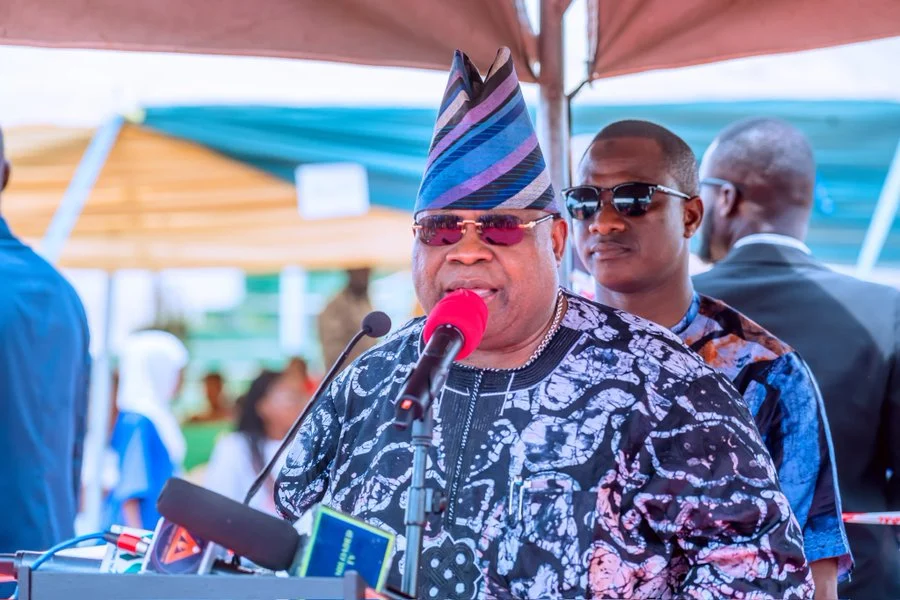

The Accord Party has openly invited Osun State Governor, Ademola Adeleke, to join its ranks as he prepares for his 2026 re-election bid, following his recent resignation from the Peoples Democratic Party (PDP). Governor Adeleke’s decision to leave the PDP was reportedly triggered by a persistent and damaging leadership crisis within the state chapter, forcing him to seek a more reliable political home.
In an interview in Lagos, the state Chairman of Accord, Dele Oladeji, confirmed that the party is ready to receive the governor immediately.
“We are waiting for his declaration. That is what we can say for now. We are waiting for when he will declare for Accord,” Oladeji stated. He described the Accord Party as a significantly more stable platform for any serious contender aiming to secure a second tenure.
Oladeji emphasised the internal harmony within his party, arguing that Accord offers a distinct advantage over the traditional major parties. “Accord is a very stable and sanitised political platform. We have no factions and no godfathers,” he said. “Any candidate who joins us between now and 2027 is sure of a peaceful and dependable structure.” The chairman added that should the Governor decide to join, party members would immediately commit to securing his success at the polls.
However, political analysts warn that continuous party switching and internal wrangling, even when seeking stability, carry a high cost for the state’s socio-economic development. Political stability is considered a critical factor for attracting and retaining investment, especially in a state like Osun, which relies heavily on tourism and local trade.
Experts note that political instability, such as that caused by prolonged party crises and frequent elite maneuvering, often leads to decreased investments and a slowdown in business activity. The focus on political survival and realignment, instead of governance, can weaken local economic sustainability and discourage job creation.
A political economy analyst commented that the perpetual shifting of allegiance is frequently driven by “economic materialism,” where political gladiators seek to position themselves for access to power and contracts, rather than focusing on the welfare of the masses.
“When a governor’s attention is diverted by party survival tactics, it signals a high-risk environment to both local and foreign investors,” the analyst explained. “The perception of political uncertainty slows down long-term projects and capital expenditure, which ultimately impacts job creation for the local populace.”
The move by Governor Adeleke to a more stable platform, if confirmed, is therefore seen as a strategic step for his career, but one that highlights the chronic political volatility that continues to undermine economic progress in the South-West state.