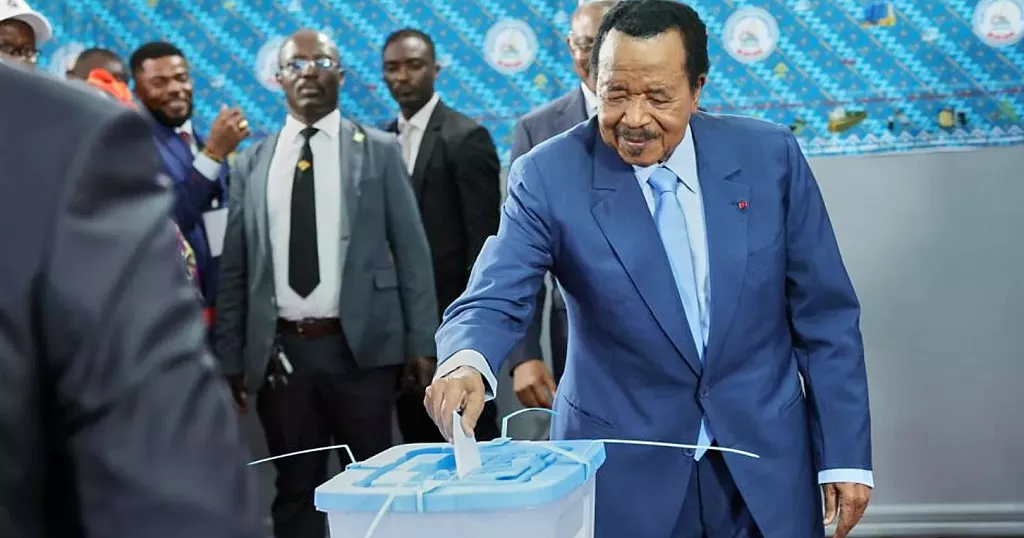

Eight days after Cameroon’s presidential election, the National Vote Counting Commission has released provisional results placing President Paul Biya in the lead with just over 53 percent of the vote. His main challenger, Issa Tchiroma Bakary, secured around 35 percent, according to the commission’s announcement. However, the opposition has rejected the outcome, alleging widespread electoral fraud, irregularities, and a lack of transparency in the vote-counting process.
Tchiroma, a former minister turned opposition candidate, claimed he actually won the election with about 60 percent of the vote and called on electoral authorities to annul the announced results. “The people have made their choice, and that choice must be respected,” he told supporters in Yaoundé. “This election was neither free nor fair. We will not accept a stolen victory.”
The disputed results have triggered a wave of demonstrations across the country, with opposition supporters taking to the streets in several cities, including Douala, Bafoussam, and Garoua. Protesters have accused the electoral commission of colluding with the ruling Cameroon People’s Democratic Movement (CPDM) to manipulate vote tallies in favour of Biya. Security forces have responded with heavy deployments, firing tear gas and using water cannons to disperse crowds in some areas. Reports indicate that clashes between demonstrators and police have resulted in injuries and several arrests.
The National Vote Counting Commission’s announcement comes amid growing scepticism about the credibility of Cameroon’s electoral institutions. Opposition parties and civil society organisations have long criticised the country’s electoral framework as being heavily tilted in favour of the incumbent. They point to Biya’s control over key state institutions, including the Constitutional Council and the national broadcaster, as factors that make genuine competition difficult.
President Biya, who has been in power since 1982, is now 92 years old and already ranks among Africa’s longest-serving leaders. If the provisional results are upheld by the Constitutional Council, the victory would extend his rule beyond four decades, further entrenching his dominance in the country’s political landscape. His supporters have hailed the results as a reflection of popular trust in his leadership, crediting him with maintaining stability in a nation frequently tested by separatist conflict, economic challenges, and regional insecurity.
Government spokespersons have dismissed opposition claims of fraud, describing the election as peaceful and transparent. “The process was conducted in accordance with the law, and international observers confirmed that voting took place in a calm and orderly manner,” said René Emmanuel Sadi, Minister of Communication. “Those who lost must accept the will of the people.”
However, several observer groups have reported logistical shortcomings and alleged instances of ballot stuffing and voter intimidation, particularly in the Anglophone regions of the country. In the northwest and southwest, where separatist insurgencies continue to disrupt civic life, voter turnout was reportedly low amid fears of violence and military presence at polling stations.
The Constitutional Council, Cameroon’s highest electoral authority, is expected to release the final official results by 26 October. The Council has the power to uphold, amend, or annul the provisional figures announced by the Vote Counting Commission. Opposition lawyers have already filed petitions demanding the cancellation of results from multiple districts, citing evidence of “systematic manipulation” and “fabricated tallies.”
The coming days will be crucial for Cameroon’s stability. While Biya’s government maintains a firm grip on state power, frustration among younger voters and opposition activists has been rising, fuelled by economic hardship, corruption, and perceived stagnation under decades of the same leadership. Some fear that if the Constitutional Council confirms Biya’s victory without addressing allegations of fraud, the protests could escalate into broader unrest.
For now, Yaoundé and other major cities remain under tight security, with police and military patrols visible in strategic locations. The government has urged calm and warned against “any attempt to disrupt public order.” Opposition leaders, meanwhile, have called for peaceful demonstrations to “defend the people’s vote.”
As the country awaits the official declaration, Cameroon stands at a crossroads, between continuity under one of Africa’s most enduring rulers or the possibility of renewed political confrontation over an election many believe was decided long before ballots were cast.