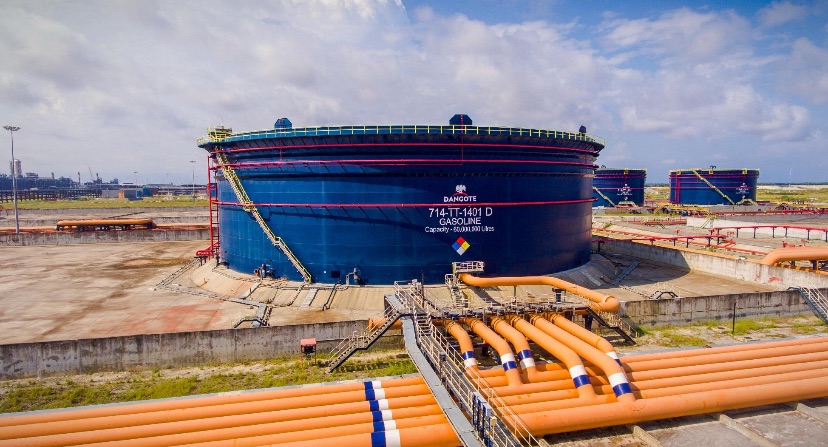

Nigeria’s largest private refinery, Dangote Petroleum Refinery, has returned to selling petrol in naira after a brief period of pricing the product in United States dollars. The company says the decision was made to help prevent fuel shortages and protect Nigerians from another sharp increase in petrol prices.
A senior official of the refinery, who spoke anonymously because he was not authorised to comment publicly, explained that the move was driven by concerns over activities in the downstream petroleum market. According to the official, some fuel importers were reportedly delaying the release of their petrol stocks while expecting prices to rise further.
He said the refinery decided to resume naira transactions in the national interest to discourage market manipulation and ensure a steady supply of petrol across the country.
The official also clarified that the decision was not because the challenge of accessing crude oil had been fully resolved. He noted that discussions between the Dangote Group and the Federal Government on crude supply are still ongoing, expressing hope that both sides would eventually reach an agreement that benefits the country.
Earlier this week, the refinery officially announced the return to naira sales. It fixed its petrol gantry price at N1,215 per litre, while the coastal price was set at N1,602,495 per metric tonne. The announcement immediately attracted attention across Nigeria’s downstream oil sector, as marketers welcomed the easier payment process.
The refinery had previously switched to dollar-denominated sales after explaining that it could no longer obtain enough crude oil through the Federal Government’s naira-for-crude arrangement. As a result, it had to purchase additional crude from the international market, where transactions are conducted in dollars.
That decision created difficulties for many independent petroleum marketers, who complained that obtaining enough foreign exchange to buy fuel became a major challenge. Some marketers even suspended loading petrol from the refinery during the period because they could not meet the dollar payment requirement.
The latest return to naira sales has already started influencing market prices. Following the refinery’s announcement, several fuel depots reduced their prices to remain competitive. Current depot prices are now trading between N1,215 and N1,220 per litre, while petrol is being sold at filling stations for about N1,260 to N1,300 per litre, depending on the location.
Just days earlier, some depot owners had increased their prices to as much as N1,275 per litre after the refinery temporarily suspended loading activities, creating uncertainty in the market.
The refinery official also criticised what he described as a long-standing practice of exporting Nigeria’s crude oil while importing refined petroleum products back into the country. He suggested that strengthening local refining capacity would provide greater energy security and reduce the country’s dependence on imports.
Before the Dangote Refinery began operations in 2024, Nigeria relied heavily on imported petrol because its state-owned refineries in Port Harcourt, Warri and Kaduna were largely inactive. This situation often led to fuel shortages, long queues at filling stations and heavy government spending on fuel subsidies.
Since the refinery commenced production, the domestic fuel market has become more competitive, with increased local supply helping to reduce dependence on imported petrol.
Meanwhile, global oil prices remain under pressure following renewed tensions in the Middle East. Crude oil recently climbed above $100 per barrel before easing to around $96 per barrel. While higher crude prices could improve Nigeria’s oil export earnings and government revenue, they may also increase fuel costs and add to inflation if international prices remain elevated.