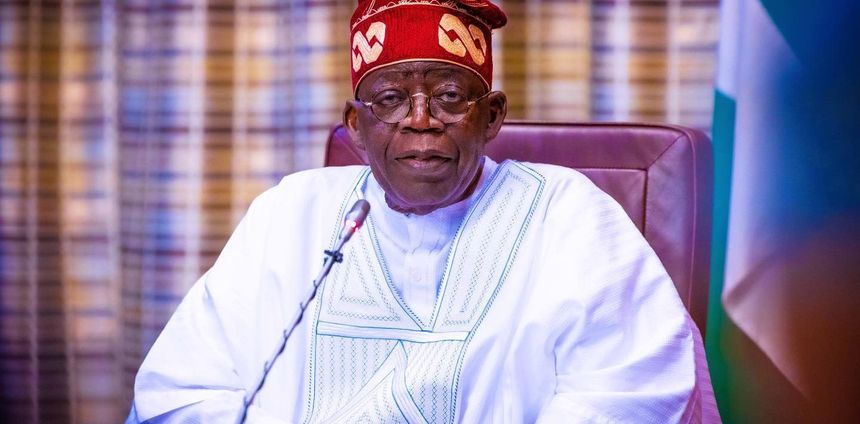

President Bola Tinubu has called on BRICS countries to deepen their economic and technological cooperation with Nigeria as the Federal Government seeks more investment in artificial intelligence, digital infrastructure, telecommunications, critical minerals and advanced manufacturing.
Tinubu made the call during the 18th BRICS Summit in New Delhi, India, where Vice President Kashim Shettima represented him. The President said Nigeria sees its partnership with BRICS as an opportunity to attract foreign investment, transfer technology and develop the skills needed to support long term economic growth. He said Nigeria was seeking partnerships in several areas, including infrastructure, energy, agriculture, healthcare, education, industrialisation and digital development. According to him, development finance would also be important in supporting these sectors.
The President said Nigeria wanted its relationship with BRICS to move beyond traditional trade and investment into areas that could strengthen the country’s productive capacity and technological development.
“As Project BRIDGE expands broadband, fibre and digital public services, we seek an open, secure and inclusive digital ecosystem, advancing innovation, digital trade, responsible artificial intelligence and cyber security,” Shettima said.
He also called for stronger cooperation in artificial intelligence, digital public infrastructure, fintech, telecommunications, cybersecurity, biotechnology and advanced manufacturing. Shettima stressed the need for developing countries to build their own technological capabilities instead of depending mainly on foreign technology. He said countries should focus on creating knowledge, developing local expertise and owning intellectual property.
“A nation that owns no technology risks renting its future,” he said.
Nigeria also used the summit to present itself as an attractive destination for investors seeking access to Africa’s growing consumer market. Tinubu said Nigeria’s position within the African Continental Free Trade Area gives it an important advantage, particularly as the country works to promote digital trade across the continent. He also pointed to Nigeria’s large and youthful population as a major strength for technology, innovation and entrepreneurship.
“With a population of 250 million people and an average age of 16.9, Nigeria’s greatest asset is its young and dynamic population, whose imagination drives our innovation agenda,” he said.
The Federal Government, he added, is investing in digital skills, entrepreneurship, research, artificial intelligence and technology enabled businesses through programmes such as the 3MTT initiative, Project BRIDGE and national artificial intelligence programmes. Nigeria became a BRICS partner country in January 2025, making it the ninth country to join the partner country category. Other partner countries include Belarus, Bolivia, Cuba, Kazakhstan, Malaysia, Thailand, Uganda and Uzbekistan.
The partner status gives Nigeria access to selected BRICS activities and creates opportunities for greater cooperation in trade, investment and financial matters. BRICS currently consists of Brazil, China, Egypt, Ethiopia, India, Indonesia, Iran, Russia, Saudi Arabia, South Africa and the United Arab Emirates. Nigeria has also backed efforts by BRICS to promote reforms in the global financial system and strengthen cooperation among developing countries.
The government is now seeking to use the partnership to attract investment, expand technology capacity and position Nigeria as a stronger participant in the emerging global digital economy.