

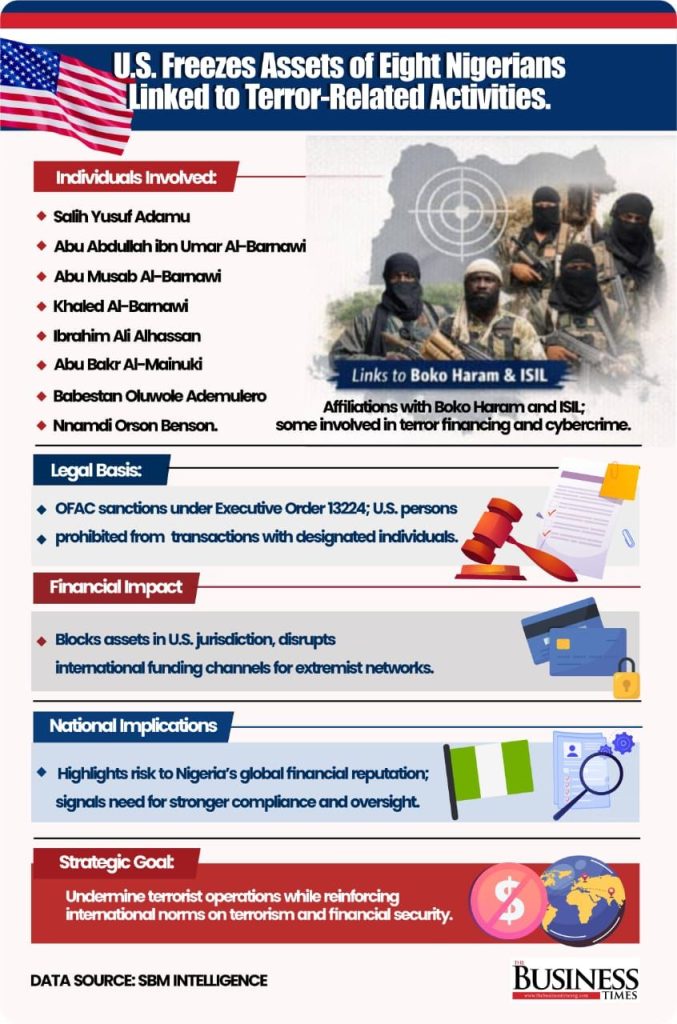
The decision by the United States government to freeze the assets of eight Nigerians linked to terrorist financing has intensified international scrutiny of Nigeria’s security response, financial oversight systems, and global reputation. The sanctions, issued through the U.S. Department of the Treasury’s Office of Foreign Assets Control (OFAC), target individuals accused of supporting extremist organisations, including Boko Haram and the Islamic State of Iraq and the Levant (ISIL).
The affected individuals were added to the Specially Designated Nationals and Blocked Persons List (SDN List), a sanctions register that effectively excludes designated persons from the U.S. financial system. Once listed, all assets under U.S. jurisdiction are frozen, and American citizens and institutions are prohibited from conducting transactions with them. In practice, the implications extend beyond the United States, as international banks and financial institutions typically comply with OFAC directives to avoid regulatory penalties.
The sanctions were imposed under Executive Order 13224, a counter-terrorism framework designed to disrupt financial networks that sustain extremist activities. Rather than focusing solely on armed combatants, the strategy targets financiers, facilitators, and logistical enablers whose resources allow insurgent groups to operate. By restricting access to global banking channels and cross-border transactions, the United States aims to weaken terrorist organisations at their financial roots.
Security analyst Dr. Ikenna Okonkwo believes the action exposes deeper institutional weaknesses within Nigeria’s domestic counter-terrorism framework. According to him, “This action by the United States highlights the fact that because Nigeria has been very inefficient and strangely reluctant to tackle terrorist funding and identify the financiers another country has taken matters in their own hands, at the cost of national embarrassment.”
The eight Nigerians named in the sanctions include individuals allegedly linked to Boko Haram financing structures and cyber-enabled criminal operations. Among them is Salih Yusuf Adamu, previously convicted in the United Arab Emirates for organising a funding network that attempted to transfer approximately $782,000 to insurgents in Nigeria. Others identified include Abu Abdullah ibn Umar Al-Barnawi, Abu Musab Al-Barnawi, Khaled Al-Barnawi, Ibrahim Ali Alhassan, Abu Bakr ibn Muhammad ibn Ali Al-Mainuki, Babestan Oluwole Ademulero, and Nnamdi Orson Benson.
The inclusion of cybercrime-related sanctions alongside terrorism designations reflects an evolving threat environment where extremist groups increasingly rely on digital channels to raise and move funds. Financial intelligence and transaction monitoring have therefore become central tools in modern counter-terrorism efforts.
Beyond security concerns, analysts warn that the sanctions carry broader economic consequences. Even when targeted at individuals, international sanctions shape perceptions of a country’s governance standards, regulatory strength, and financial transparency. For an economy already grappling with weak revenue generation and rising debt obligations, reputational risks may translate into measurable financial costs.
Dr. Okonkwo argues that Nigeria’s investment climate could suffer as a result. “The actions make the country less attractive for the investment the country really needs,” he said. “Nigeria has a revenue problem and funding government spending is requiring more and more loans. With the bad reputation, these loans will be gotten at a premium now.”
Nigeria has increasingly relied on borrowing to finance budget deficits amid constrained revenue performance. Higher perceived risk could lead lenders and investors to demand stronger guarantees, higher interest rates, and stricter compliance checks. Financial institutions abroad may also increase scrutiny of Nigerian transactions, potentially slowing cross-border payments and raising operational costs for businesses.
The sanctions also renew debate about enforcement gaps within Nigeria’s financial monitoring systems. Counter-terrorism experts consistently emphasise that cutting funding sources remains one of the most effective ways to weaken insurgent organisations. Military operations alone often fail to achieve lasting stability without parallel financial disruption.
“A key prong in the fight against terrorism is cutting the sources of funding for weapons,” Okonkwo explained. He noted that technological advances have significantly improved governments’ ability to track financial activity. “With advances in identity management and financial tracking there is less and less reason why it is so easy for terrorists to move funds within the country.”
Nigeria already maintains regulatory cooperation between banks, intelligence agencies, and financial authorities to monitor suspicious transactions. Fraud investigations have shown that authorities can successfully trace illicit funds when enforcement mechanisms are applied consistently. This raises questions about why insurgent financiers continue to operate within existing financial systems.
“There already is oversight of the intelligence and security agencies of banks and financial institutions regarding the flow of money,” Okonkwo said. “There have been cases of tracking fraud where these things have been put to effect. There is no reason why insurgents and bandits are able to access and move money within our borders.”
For Okonkwo, the issue is less about capacity and more about political will and enforcement consistency. When domestic action appears insufficient, international actors may increasingly rely on sanctions and financial restrictions to compel compliance.
“Before diplomacy, the government has to get serious,” he stated. “It is clear that there is intelligence regarding who is funding and aiding the financing of terrorism in the country. The government has to be willing to do what is needed, if not it will be imposed on us by the international community.”
The U.S. decision therefore represents more than a security intervention. It signals growing global expectations that countries must actively police illicit financial flows within their borders. As financial systems become more interconnected and transparent, failure to address terrorism financing risks triggering external enforcement measures with diplomatic and economic consequences.
For Nigeria, the sanctions underscore the close relationship between national security, economic credibility, and international confidence. Addressing terrorism financing is no longer solely a security objective; it is increasingly tied to investor trust, borrowing costs, and the country’s standing in the global financial system.
Ultimately, the episode highlights a broader reality of modern governance: in an era of financial surveillance and global compliance standards, national reputation is shaped not only by policy declarations but by demonstrable enforcement. Strengthening oversight, improving institutional coordination, and decisively confronting illicit financing networks may therefore determine whether Nigeria restores confidence or faces continued external intervention.