
Federal and state governments have committed record naira sums to roads, rail, ports and broadband this year, even as economists warn that execution — not just allocation — will determine whether the spending closes Nigeria’s infrastructure deficit.
Nigeria’s 2026 fiscal year has brought one of the country’s most infrastructure-heavy budgets in recent memory, with the National Assembly approving a revised ₦68.32 trillion Appropriation Bill — up from President Bola Tinubu’s original ₦58.18 trillion proposal — of which ₦32.28 trillion is earmarked for capital projects and legacy infrastructure.
Roads and power dominate the spending plan. According to figures compiled by BudgIT Nigeria, the budget sets aside a cumulative ₦4.23 trillion for roughly 50 major capital projects spread across eight federal ministries, with works and power jointly absorbing ₦3.4 trillion for road construction, electricity transmission and energy access.
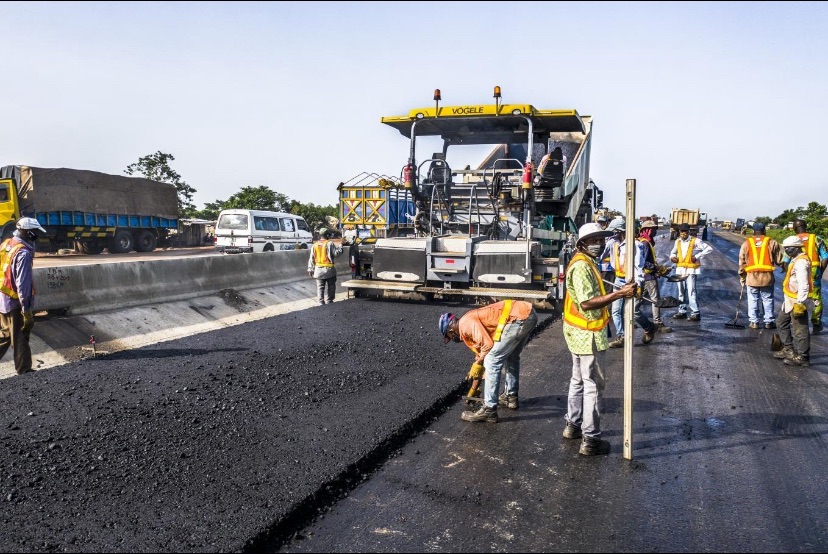
Federal roads alone received a proposed ₦3.23 trillion, a 489% jump from 2024 allocations, according to a Q1 2026 infrastructure sector report. Separately, the government earmarked ₦2.47 trillion for the rehabilitation and reconstruction of 124 roads spanning all six geopolitical zones — including ₦23.6 billion for the Kano–Katsina dualisation project, ₦19.6 billion for Sections III and IV of the Enugu–Port Harcourt Road, and ₦12.6 billion for the Abuja–Lokoja Road, one of the country’s busiest highways.
Rail and maritime projects also feature prominently. The budget allocates ₦102.3 billion in counterpart funding for Phase One of the Lagos Green Line rail project, while the Federal Government continues to move forward on regional initiatives including the $15.6 billion Lagos–Abidjan Highway and a £746 million UK-backed financing deal to redevelop the Lagos ports at Apapa and Tin Can Island. Nigeria’s flagship broadband expansion effort, Project BRIDGE, is backed by more than $600 million in secured World Bank, EBRD and EU funding.
The infrastructure push comes against an improving macroeconomic backdrop. The government projects 4.68% GDP growth for 2026, ahead of both the Central Bank of Nigeria’s 4.49% forecast and the World Bank’s 4.4% estimate. Inflation, which peaked above 33% in 2024, had fallen to 15.15% by December 2025, while the naira has stabilised below ₦1,400 to the dollar and gross external reserves reached $49 billion as of March 2026. To fund the expanded budget, lawmakers are counting on higher oil prices, telecom revenue and external borrowing, with $7.7 billion in unexecuted 2025 projects rolled over into the current fiscal year.
The infrastructure drive is not limited to the federal level. Nigerian states have collectively boosted their 2026 budgets to roughly ₦40 trillion, allocating ₦25.83 trillion to capital projects — though the capital share of total state spending slipped from 73.24% to 64.34% as recurrent costs rose. Rivers State alone proposed a ₦1.85 trillion budget with a strong emphasis on capital expenditure, a 24.49% increase over its adjusted 2025 budget, to be financed through internally generated revenue, federal allocations and capital receipts.
Despite the scale of the commitments, experts caution that allocation is not the same as delivery. Nigeria’s infrastructure stock is currently estimated at just 30–35% of GDP, well below the World Bank’s recommended benchmark of 70% for developing economies. Analysts warn that delays in past budget releases could again slow implementation, and one economist noted the paradox of states trimming capital-spending shares even as population growth increases pressure on existing infrastructure. To address unfinished work, the National Assembly extended the deadline for completing 2025 capital projects from March 31 to June 30, 2026, giving ministries and agencies more room to finish ongoing builds without losing funding.
President Tinubu has framed the spending as central to his administration’s “Renewed Hope Agenda,” arguing that new infrastructure will lower the cost of doing business, expand market access and improve living standards — but whether 2026 marks a turning point or another year of underdelivery will depend on how much of the ₦32.28 trillion capital budget actually reaches the ground.