
In a landmark decision with far-reaching implications for Nigeria’s federal structure, the Supreme Court has upheld the constitutional authority of the President to declare a state of emergency (SoE) in any part of the country and temporarily suspend elected state officials. The ruling dismissed a challenge brought by Adamawa State and ten other Peoples Democratic Party (PDP) governors, who had contested the legality of President Bola Tinubu’s intervention in Rivers State earlier this year.
The controversy centered on the six-month state of emergency declared in Rivers State in March, which saw Governor Siminalayi Fubara, his deputy, and members of the State House of Assembly suspended, and a sole administrator appointed. The PDP plaintiffs argued that the President’s action violated various provisions of the 1999 Constitution, particularly those concerning the inviolability of elected state offices and the separation of powers.
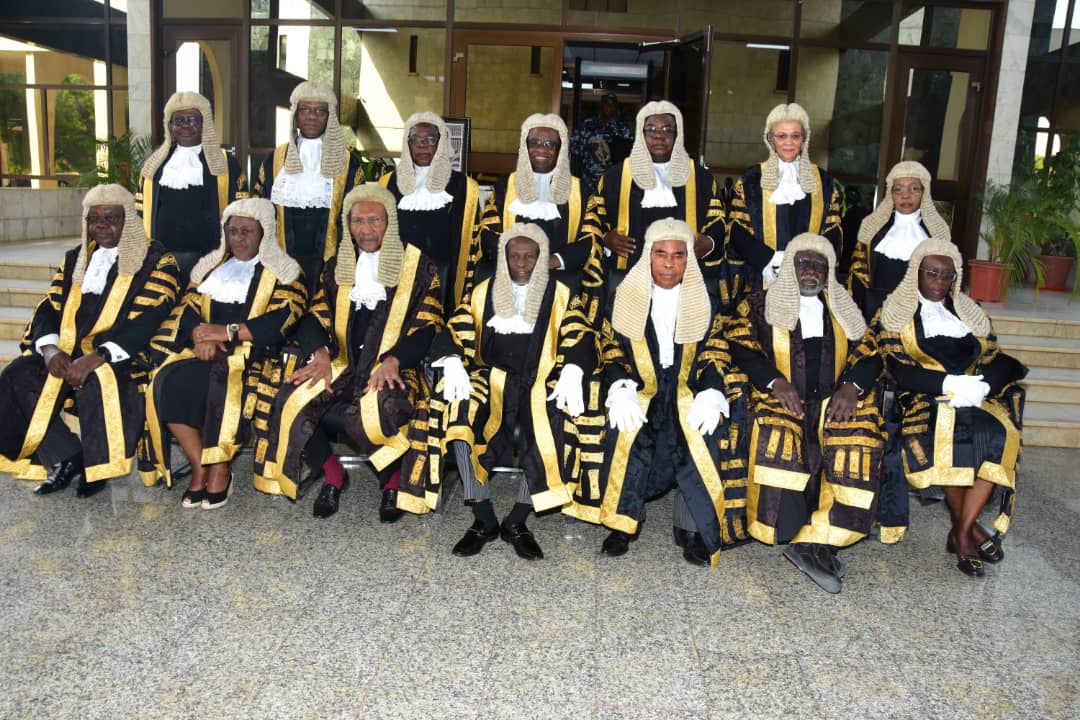
Reading the majority judgment, Justice Mohammed Idris confirmed that Section 305 of the Constitution grants the President wide discretion to determine the measures necessary during an SoE to forestall a breakdown of law and order. The apex court held, in a split decision of six-to-one, that the executive power to declare a state of emergency necessarily includes the power to suspend elected representatives for a limited period, provided the action is aimed at stabilizing the state and protecting national assets.
While the court ultimately struck out the governors’ suit for want of jurisdiction, it proceeded to consider the merits of the case, delivering a powerful affirmation of the Federal Government’s prerogative in times of severe political or security crisis. The lone dissenting voice, Justice Obande Ogbuinya, concurred that the President could declare an emergency but vehemently disagreed on the power to suspend elected officials, arguing such an action subverts the core tenets of democracy and federalism. Legal experts suggest the judgment sets a major precedent, effectively legitimizing the use of federal fiat to restore order in sub-national entities when political conflict threatens governance and national security interests, especially those related to critical economic infrastructure.
The prolonged political turbulence preceding and during the Rivers State of Emergency imposed significant economic hardship on the region, which is Nigeria’s second-largest economy and the nerve centre of its oil and gas sector. The core issue was the paralysis of governance: the state legislature was factionalized, leading to an institutional stand-off that prevented Governor Fubara from presenting the 2025 Appropriation Bill. This budgetary freeze meant the state government could not legally access or deploy funds for crucial operational and developmental projects, creating regulatory uncertainty that immediately deterred both foreign and domestic investment. Multinational corporations, already cautious about the volatile environment, postponed or entirely abandoned planned expansions, damaging the long-term growth prospects of an industrial hub that also houses the critical Onne Port.
Beyond macro-economic consequences, the political crisis rippled down to the local populace and the business ecosystem. Small and medium-sized enterprises (SMEs) faced a sharp decline in sales and revenue due to logistic hurdles created by political protests, roadblocks, and heightened insecurity. Furthermore, the confusion over budgetary control led to significant administrative delays, including the temporary withholding of salaries for local government workers, exacerbating poverty and social unrest during a period of national inflation. The instability directly translated into job losses, with some labour groups estimating as many as 10,000 workers displaced across various sectors during the six-month SoE, underscoring how political infighting directly compromises socioeconomic stability.
Though the emergency rule was eventually lifted in September, restoring formal democratic institutions, the Supreme Court’s definitive ruling solidifies the presidency’s ability to exert direct and temporary control over state political apparatuses under specific conditions of crisis, redefining the boundaries of power in Nigeria’s constitutional democracy.