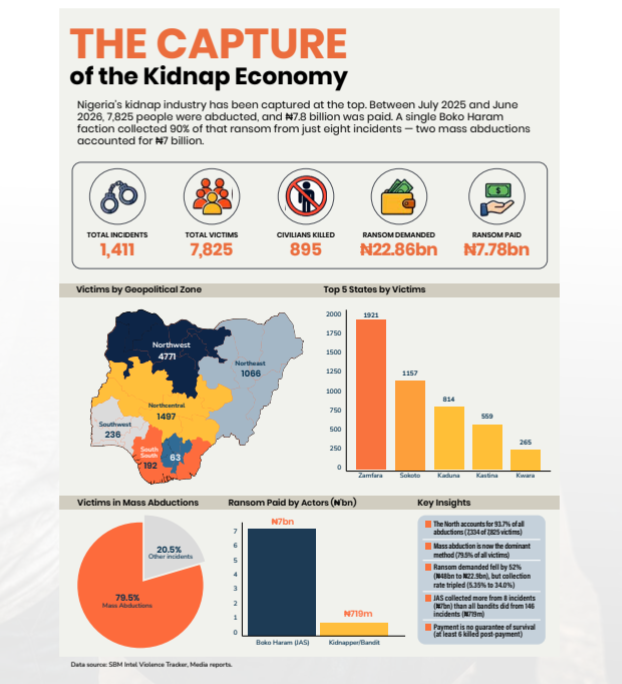

SBM Intelligence, in its August 2026 report titled The Capture of Nigeria’s Kidnap Economy, says a faction of Boko Haram collected 90% of the N7.78 billion paid as ransom in Nigeria between July 2025 and June 2026.
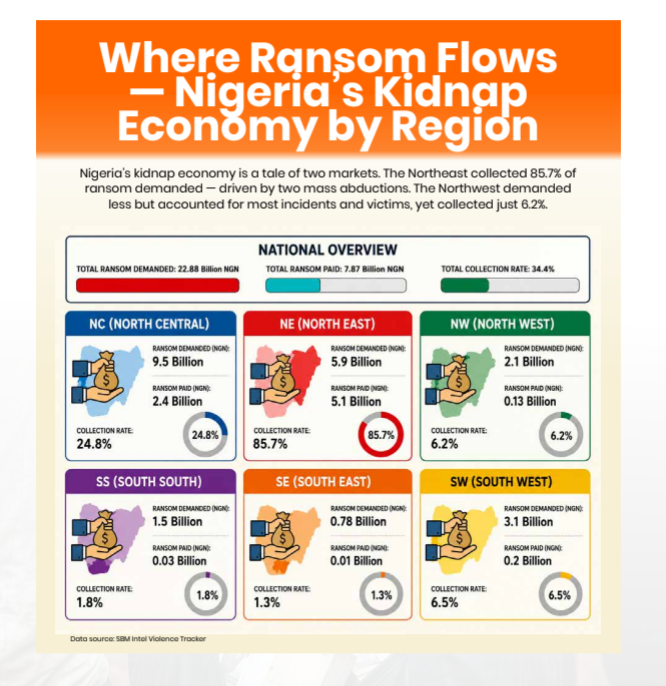
The report said 7,825 people were abducted during the period, showing how mass kidnapping has become an increasingly profitable source of funding for armed groups.The report said kidnappers demanded N22.86 billion during the period but received N7.78 billion. This means that about 34% of the total ransom demanded was paid, compared with just 5.35% in the previous year. The change is significant because the amount demanded actually fell from N48 billion in the previous cycle, while the amount paid more than tripled from N2.56 billion to N7.78 billion. SBM Intelligence said the increase was driven mainly by a few large mass abductions rather than a general rise in ransom payments across all kidnapping cases.Two major incidents accounted for most of the money.
In April 2026, 416 people were abducted from Ngoshe in Gwoza, Borno State. The kidnappers demanded N5 billion and reportedly received the full amount. Earlier, 315 pupils and staff of St Mary’s School in Papiri, Niger State, were abducted. About N2 billion was reportedly paid for their release.Together, the two incidents generated N7 billion, almost the entire amount of ransom paid across the country during the period. The figures show a major difference between the way ordinary kidnappers and terrorist groups make money from abductions. Unidentified kidnappers, including bandits and criminal gangs, accounted for 146 recorded cases. They demanded N13.49 billion, which represented 59% of all ransom demands. However, they collected only N719.4 million, or 9.2% of the total ransom paid.
The Boko Haram JAS faction, on the other hand, was linked to only eight cases. It demanded N9.2 billion and collected N7 billion, giving it a collection rate of 76.1%. In simple terms, ordinary kidnappers made more demands across many more incidents but received relatively little money. Boko Haram made fewer demands but was able to collect much larger sums. This difference is largely connected to the rise in mass abductions.
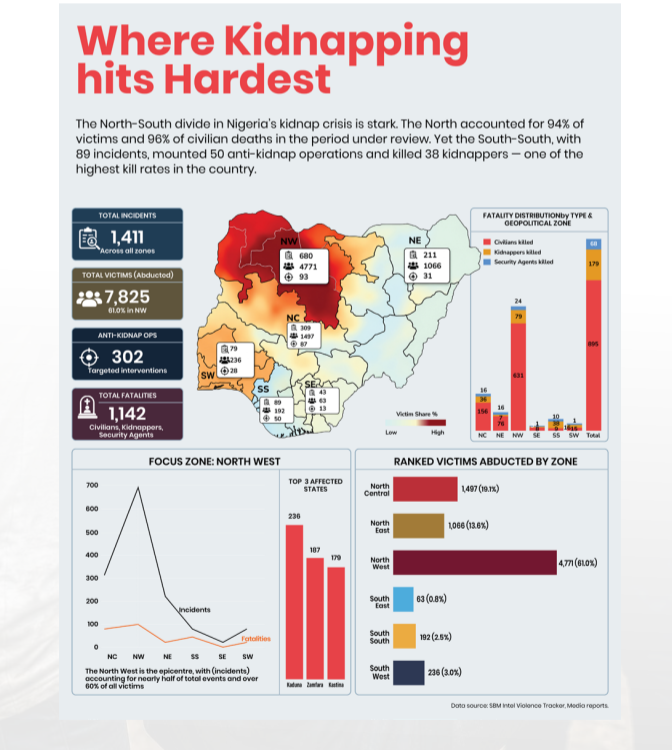
SBM Intelligence recorded 396 mass abductions during the period. Although these represented only 28.1% of all kidnapping incidents, they accounted for 6,222 victims, or 79.5% of all people abducted. This means that about four out of every five people kidnapped in Nigeria during the period were taken in large group abductions.The Northwest was at the centre of this trend, accounting for 267 of the 396 mass abductions. Zamfara recorded the highest number, with 92 mass abductions involving 1,722 victims, followed by Sokoto with 76 incidents and 974 victims. The wider kidnapping crisis also remains heavily concentrated in northern Nigeria. The North accounted for 7,334 of the 7,825 people abducted during the period, representing 93.7% of the national total. The Northwest recorded 680 kidnapping incidents, while the Northcentral and Northeast recorded 309 and 211 respectively.
Zamfara had the highest number of kidnapping incidents and victims, with 236 incidents involving 1,921 people. Sokoto followed with 179 incidents and 1,157 victims, while Kaduna recorded 134 incidents involving 814 victims. The report linked the high number of abductions in the North partly to the size and nature of the region. Large rural areas provide armed groups with places to operate and hold victims. Some victims are also forced to work on farms and in mining activities controlled by the groups. The security response remains uneven.
Nigeria recorded 302 anti kidnapping operations during the period. Benue recorded the highest number with 26, followed by Katsina and Edo with 25 each, Kaduna with 24, and Delta and Plateau with 23 each. Zamfara, however, recorded only four anti kidnapping operations despite having the highest number of incidents, victims and civilian deaths.
SBM Intelligence said the gap points to a security response that has been overwhelmed in some of the worst affected areas.The consequences go beyond the ransom money itself. The return of large school abductions has disrupted education and affected local economies. When insecurity forces schools to close, children lose learning time while businesses around affected communities suffer. Farmers may also abandon their farms because of the risk of abduction, reducing food production and threatening rural incomes. The report noted that insecurity also increases the cost of doing business because households and companies spend more on security and ransom payments. Money that could have gone into consumption, investment or business expansion is instead diverted towards protecting people and securing their release. More worrying is that ransom payment does not always guarantee survival.
SBM Intelligence recorded at least six cases in which victims were killed after ransom was paid. In one case in Kwara State, five of eight worshippers abducted from an ECWA church were killed despite a reported N20 million payment. Other victims in Kwara, Anambra and Zamfara were also killed after their families reportedly paid ransom.The actual value of Nigeria’s ransom economy may also be higher than N7.78 billion. The report confirmed ransom payments in at least 86 incidents, but the exact amount was available for only 70 cases. In 16 other cases, researchers confirmed that ransom had been paid but could not establish how much. This means the N7.78 billion figure is a conservative estimate of the money that changed hands.
For Nigeria, the concern is no longer simply that kidnapping is widespread. The bigger problem is that large ransom payments are increasingly reaching organised terrorist groups.The report said the N7 billion collected by the Boko Haram faction could help finance fighters and operations, creating a cycle in which successful kidnappings provide money for further attacks and abductions.
SBM Intelligence therefore argued that tackling the problem requires more than rescuing victims and arresting kidnappers. Security agencies must also work to stop ransom money from reaching terrorist groups, while addressing the economic conditions that help armed groups recruit and operate.Without such measures, kidnapping risks becoming more than a criminal business. It could remain a reliable source of funding for groups whose activities continue to threaten Nigeria’s security, food production, investment and wider economic stability.