For decades, Nigeria’s economic narrative has been inextricably linked to the fortunes of crude oil. As the nation’s primary source of foreign exchange and government revenue, the hydrocarbon sector is more than an industry; it is the lifeblood of the national budget. Yet, a detailed analysis of data from 2019 through 2024 reveals a persistent and troubling story: the oil sector has consistently failed to meet its targets, creating a chronic cycle of revenue shortfalls that destabilize the entire economy. This underperformance, punctuated by a dramatic crisis in 2022 and a subsequent, ambitious target reset, highlights the profound vulnerability of an economy tethered to a volatile and underperforming resource.
A Pattern of Persistent Underperformance
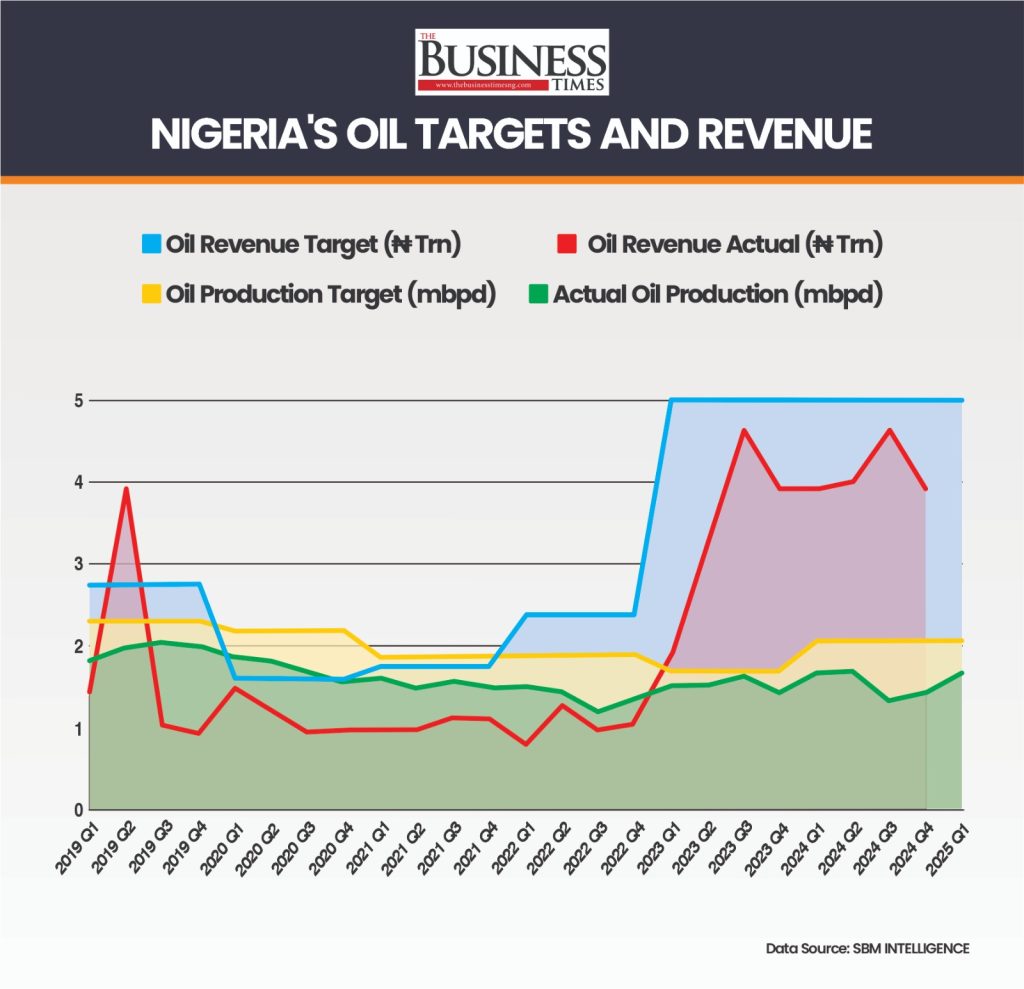
The overarching trend from the six-year period is one of significant gaps between ambition and reality. When the total oil revenue targets are stacked against the actual receipts from 2019 to 2024, Nigeria managed to achieve only 63.65% of its projected oil income. This is not a single-year anomaly but a chronic condition. Similarly, the nation’s oil production, the physical engine of this revenue, averaged just 80.76% of its targeted output. This dual failure in both volume and value has created a permanent fiscal overhang, where government budgets are built on a foundation that is almost guaranteed to erode.
Commenting on the predictability of these shortfalls, Engr. Joe Nwakwue, Partner at Zera Advisory, observed that government revenue projections often overestimate potential output. He stated that it is “most unlikely for the government to achieve the projections on price and production volumes,” resulting in the normalized need to “borrow money to finance the budget.”
The annual oil revenue data (in ₦ Trillions) tells a story of decline, crisis, and a bold, some might say desperate, recalibration. The years 2019 to 2022 saw targets gradually decrease from ₦10.96 trillion to ₦9.52 trillion, acknowledging some of the sector’s challenges. However, actual revenues fell even more sharply. The nadir was 2022, a year that stands out for its catastrophic performance. With actual revenue of just ₦4.10 trillion, the government achieved a meager 43.06% of its target. This was the year the nation felt the full brunt of its oil sector’s fragility, with the first quarter of 2022 delivering a paltry ₦0.80 trillion, the lowest quarterly revenue in the entire dataset.
This crisis precipitated a dramatic policy shift. In 2023, the federal government more than doubled the oil revenue target to an unprecedented ₦20.00 trillion, a level maintained in 2024. This was a clear signal that the state could no longer afford to lowball its expectations, even if meeting them seemed a Herculean task. Interestingly, this move coincided with a remarkable recovery in actual revenue. In 2023, Nigeria recorded its highest annual oil revenue ever: ₦13.56 trillion. This figure, bolstered by a record-breaking third quarter of ₦4.62 trillion, represented a staggering 230% increase over the previous year’s collapse. While this was still only 67.80% of the colossal new target, it demonstrated a significant rebound in nominal terms. The positive trend continued into 2024, where available data shows performance improving to 82.20% of the target, the best rate in the period under review.
The Production Conundrum: Why the Money Dries Up
The revenue story cannot be understood in isolation from the physical production of oil. The data on oil production targets and actual output (in millions of barrels per day, mbpd) reveals a sector grappling with deep-seated operational and security issues. From 2019 to 2022, both targets and actual production trended downwards. The year 2022 was, again, the worst performer, with actual production plummeting to 1.36 mbpd, a clear contributor to that year’s revenue disaster. This decline has been attributed to a perfect storm of massive crude oil theft, technical disruptions at aging infrastructure, and persistent pipeline vandalism.
The response in 2023 was telling. The government set its lowest-ever production target of 1.69 mbpd, a pragmatic admission of the sector’s diminished capacity. This realism paid off in performance metrics, as actual production of 1.52 mbpd resulted in a 90.09% achievement rate, the best in the period. However, this “success” was achieved by significantly lowering the bar. The optimism returned in 2024, with the target raised to 2.06 mbpd, but actual production fell back to 1.53 mbpd, causing the performance rate to drop to 74.15%. This seesawing between unrealistic ambition and managed decline illustrates a fundamental inability to address the root causes of production shortfalls. The government’s drive to attract investment and reform the sector is challenged by policy uncertainty. Ayodele Oni, an energy lawyer and Partner at Bloomfield Law Practice, cautioned that investors typically value legal clarity and predictability, noting, “Investors will pause, delay, or cancel projects if they sense that Nigeria’s petroleum framework is unstable.”
The Economic Domino Effect
The consistent failure to meet oil revenue targets has a direct and cascading effect on the Nigerian economy. The national budget, which funds everything from infrastructure and education to healthcare and national security, is heavily reliant on petronaira. When the expected revenue fails to materialize, the result is a massive fiscal deficit.
This forces the government to borrow extensively, both domestically and internationally, driving up the national debt and diverting an ever-increasing portion of the budget away from capital expenditure and towards debt servicing. This pattern of fiscal pressure highlights a foundational problem. Muda Yusuf, Founder and CEO of the Centre for the Promotion of Private Enterprise, warned of a “fiscal sustainability” issue, stressing that the continual revenue shortfall forces the government to “borrow more.”
This borrowing has escalated significantly. For instance, in 2025, the Nigerian parliament approved a substantial external borrowing plan for the 2025-2026 fiscal cycle, requesting over $21 billion to fund key infrastructure projects like the Eastern Rail Corridor, as well as refinancing maturing debt obligations. Furthermore, the total external funding sought, including loans and instruments like a planned debut sovereign global Sukuk, has been reported in the range of $24 billion to $28.5 billion for medium-term financing, demonstrating the acute need for capital injection due to underperforming oil receipts.
This fiscal pressure is a key driver of inflation. To bridge funding gaps, the government often resorts to ways and means financing from the Central Bank of Nigeria, effectively printing new money. This influx of naira without a corresponding increase in goods and services devalues the currency and fuels inflation, eroding the purchasing power of ordinary Nigerians.
Furthermore, the shortfall in dollar earnings from oil exports creates a scarcity of foreign exchange. This weakens the naira, as seen in the dramatic devaluations in the official and parallel markets. A weaker currency makes imports more expensive, further fueling inflation and making it costlier for Nigerian businesses that rely on imported raw materials and machinery. It also deters foreign investment, as investors fear currency losses. Even when global oil prices offer a temporary revenue boost, the consequences for the domestic economy remain challenging. Energy economist Ademola Adigun observed that since the nation relies heavily on fuel imports, despite high global oil prices being a “positive for government revenue,” Nigerian consumers “will likely have to pay more for petrol and other goods.” The quarterly data underscores this volatility; the nation lurches from the boom of a ₦4.62 trillion quarter to the bust of a ₦0.80 trillion one, making coherent long-term economic planning nearly impossible.
Beyond the Cycle of Crisis
The data from 2019 to 2024 paints a stark picture of an economy held hostage by the underperformance of its most vital sector. The government’s response, slashing production targets to appear successful or dramatically raising revenue targets to reflect fiscal desperation, does little to solve the underlying problems. Nigeria’s economy remains on a rollercoaster, its trajectory determined by the fluctuating output of its oil fields and the volatile price of crude on the global market.
Breaking this cycle requires a two-pronged approach. First, there must be a concerted, strategic effort to fix the oil sector itself. This includes deploying advanced surveillance to combat oil theft, fully implementing the Petroleum Industry Act (PIA) to attract investment, and refurbishing crumbling infrastructure to boost production efficiency. Second, and more critically, Nigeria must accelerate its economic diversification. An Associate Professor of Economics at the University of Port Harcourt, Peter Medee, argued that while diversification is important, the nation “cannot thrive on revenue from non-oil sectors alone. Oil is the nerve centre of [Nigeria’s] economy.”
Therefore, comprehensive reform of the oil sector must go hand in hand with diversification efforts. According to Mazi Colman Obasi, National President of the Oil and Gas Services Providers Association of Nigeria (OGSPAN), achieving stability requires “more investment to unlock crude oil, condensate and natural gas for domestic use and export.” Investing in agriculture, manufacturing, and solid minerals, and creating an enabling environment for the private sector, is no longer a matter of choice but an urgent necessity for national economic survival. Until then, the story of Nigeria’s economy will continue to be written by the troubling gap between oil revenue targets and the reality in its coffers.