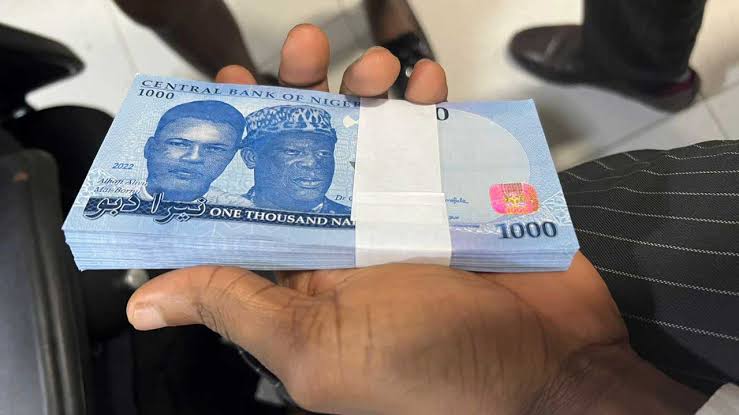

The latest data show a country moving towards electronic payments without abandoning physical money. Cash outside the banking system fell to ₦4.92 trillion in June 2026, down ₦485.8 billion from December 2025, according to the Central Bank of Nigeria’s money and credit statistics. The decline suggests more funds are being held within the banking system, but it does not mean cash has disappeared from daily transactions.
Digital payments, meanwhile, continue to expand. The CBN’s 2025 data show that mobile-money transaction value rose 81.26% to ₦372.14 trillion, from ₦205.31 trillion in 2024. Transaction volume also increased from about 17.3 billion to 28.7 billion.
Yet for many Nigerians, digital payments remain conditional on reliability.
“I prefer cash because I don’t want to need money and network is not good and I’m stranded,” Abu said.
Donatus has a different concern.
“One major reason I prefer cash is I see it with my eyes. Some boys do fake transfer, but with cash it can’t happen,” he said.
Their experiences highlight a weakness in Nigeria’s digital-payment ecosystem: a transfer is only useful when the network and payment infrastructure work.
The CBN moved to address persistent PoS failures in December 2025, directing acquirers, processors and payment-terminal service providers to establish dual connectivity with the Nigeria Inter-Bank Settlement System (NIBSS) and Unified Payment Services Limited (UPSL). The regulator said the measure was intended to reduce disruptions caused by reliance on a single transaction channel.
Cash also remains important to Nigeria’s vast informal economy. Moniepoint’s 2025 Informal Economy Report found that only one in four informal businesses reported receiving at least 10% of their revenue through digital payments, according to TechCabal’s report on the study.
For Mrs Adebayo, a fishmonger who also operates a PoS business, cash is part of keeping her operation running.
“Because of my POS business, I need cash almost every time. I can’t rush to the bank because of my business, so I prefer cash, though I accept transfers,” she said.
Her experience captures Nigeria’s payment paradox. Consumers and businesses are not necessarily choosing cash instead of digital payments; they often use whichever option is dependable at the point of transaction.
For banks, fintechs and regulators, the challenge is therefore bigger than simply reducing cash usage. Digital payment systems must become reliable enough for Nigerians to trust them when money is at stake.
Nigeria’s payment future is unlikely to be defined by the disappearance of cash. Instead, the country is developing a hybrid economy, where digital payments continue to expand while physical money remains a trusted fallback.
Nigeria is becoming more digital, but it is not cashless yet.