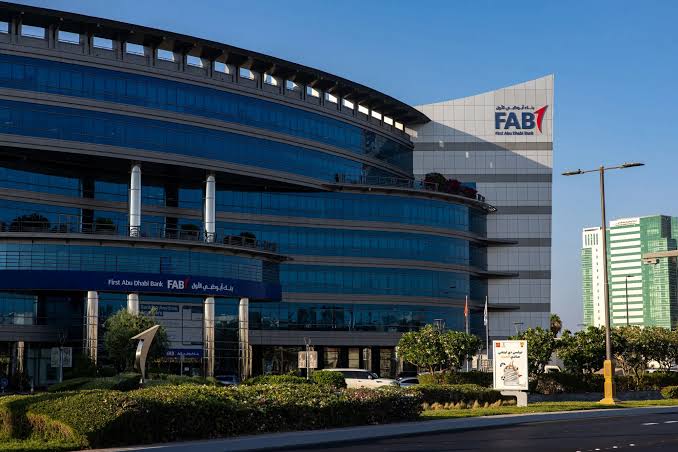

First Abu Dhabi Bank (FAB) is considering sharing part of its exposure to Nigeria’s $5 billion total-return swap with other lenders, putting fresh attention on the government securities being used as collateral for the dollar financing.
Bloomberg reported yesterday, October 1, 2026, that FAB was exploring whether other banks would take portions of its position through a syndication arrangement. People familiar with the discussions said the UAE lender remains committed to the transaction.
Under the proposed arrangement, FAB would remain Nigeria’s counterparty while transferring part of the economic exposure to other lenders. BusinessDay reported yesterday that the move could allow FAB to reduce its concentration in the transaction while potentially earning fees for arranging the syndication.
The financing is not a conventional loan or Eurobond. It is structured as a total-return swap under which Nigeria receives dollars and provides naira-denominated Federal Government securities as collateral.
Nigeria has access to up to $5 billion under the facility and drew $1.5 billion in June, according to BusinessDay. The National Assembly approved the arrangement earlier in 2026, while the government has said the facility will support budget implementation, infrastructure and the refinancing of more expensive obligations.
The collateral requirement is significant. Nigeria is required to pledge Federal Government securities worth about 133.3% of the amount drawn. The structure means that for every dollar of financing drawn, more than a dollar’s worth of naira government securities is placed behind the transaction.
That brings the arrangement into the wider domestic bond market, where pension funds are already heavily invested.
Data from the National Pension Commission, reported by Nairametrics today, show that pension fund assets reached ₦31.8 trillion as of August 31, 2026, with ₦17.80 trillion invested in Federal Government securities. That makes government securities the largest single asset class in Nigeria’s pension portfolios.
The figures do not establish that pension funds’ own securities are being pledged to FAB under the swap. Rather, they show the scale of pension exposure to the same broad class of government securities being used by the Federal Government as collateral.
That distinction matters for millions of contributors whose retirement savings are ultimately invested in government debt.
The terms of the swap also determine how much pressure the collateral could create. The arrangement provides for monthly rather than daily collateral valuation, a minimum margin-call threshold and five business days for Nigeria to meet a collateral shortfall, according to details of the transaction.
The monthly valuation gives Nigeria more breathing room than a daily mark-to-market system, but it does not eliminate the underlying risk. If the value of the pledged securities falls because of movements in bond prices, interest rates or the naira-dollar exchange rate, the government could face a requirement to provide additional collateral.
BusinessDay reported today that the swap’s first tranche carries pricing of SOFR plus 3.95% points, while subsequent tranches are priced at SOFR plus four percentage points. The floating-rate structure means the eventual cost of the financing can change as global interest rates move.
The transaction has already attracted scrutiny over the complexity and transparency of derivative-based sovereign financing. Fitch Ratings warned in June that the structure could make Nigeria’s sovereign debt risks less transparent and potentially complicate a future debt restructuring, while acknowledging that such arrangements can provide financing flexibility and access to foreign currency.
FAB’s possible syndication does not, on its own, indicate that Nigeria is struggling to meet its obligations. Instead, it raises a different question: how widely will the financial risk associated with the swap ultimately be distributed?
For Nigerian workers and pension contributors, the issue is therefore bigger than the headline $5 billion.
The government has gained access to dollar liquidity, while pledging a substantial pool of domestic government securities as protection for the lender.
The key test will be whether the financing remains cheaper and manageable throughout its life without creating additional pressure on the government’s securities, foreign exchange position or broader debt obligations.
For pension savers, that makes transparency over the collateral, margin rules and eventual cost of the facility particularly important, even though there is currently no evidence that their individual pension assets are directly pledged under the swap.