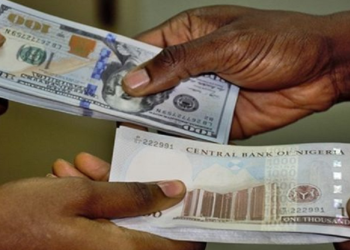
For Nigerian traders who depend on imported goods, the exchange rate has become more than a figure on a financial market screen. It is increasingly part of the daily calculation of what a product should cost, as businesses try to protect their margins against changes in the cost of replacing their stock.
The naira was quoted at about ₦1,331.20 to the dollar in the Nigerian Foreign Exchange Market on Friday, September 18, 2026, the latest confirmed official-market rate available on Monday, September 21. The dollar was quoted at about ₦1,395 in the parallel market on Monday, according to market reports, leaving a gap of about ₦64 between the two rates.
For import-dependent businesses, however, the effect of exchange-rate movements goes beyond the price of goods already sitting on shelves. Traders also have to consider how much it will cost to replace those goods when current stock runs out.
That creates a difficult pricing decision. Holding prices unchanged after the naira weakens can reduce a trader’s margin or make it impossible to restock at the same price. Raising prices too quickly, however, can drive customers away, particularly in highly competitive retail markets.
Recent research suggests that this exchange-rate-to-price relationship is significant in Nigeria. A study by Toni Oki of Harvard University and Olalekan Bello of NYU Stern School of Business, posted on August 27, 2026, found that consumer prices responded strongly to movements in Nigeria’s parallel-market exchange rate using monthly data covering 2014 to 2023.
The researchers estimated that a one-standard-deviation depreciation in the parallel-market rate increased cumulative consumer prices by about 0.5% over the following year, implying a 12-month structural exchange-rate pass-through of 0.29. They attributed the result partly to foreign-exchange rationing, arguing that the parallel rate could become the marginal price of foreign exchange for importers when access to official dollars was restricted.
The finding is consistent with a separate study by Alarudeen Aminu and Joshua Adeyemi Afolabi, published in Economic Annals on December 19, 2024. Using Nigerian data from 2011 to 2021, the researchers found a stronger relationship between domestic prices and the parallel-market exchange rate than the official rate, particularly when the gap between the two markets was large.
Nigeria’s foreign-exchange system has changed significantly since the period covered by much of that research. The International Monetary Fund said in a report published on June 9, 2026, that the Central Bank of Nigeria unified the foreign-exchange market in June 2023 and moved towards a floating exchange-rate regime by 2024. The IMF said the reform sharply reduced the premium between the official and parallel markets, although exchange-rate movements now transmit more directly to domestic prices.
The IMF also noted that, before the 2023 reforms, the parallel-market rate often reflected the marginal cost of foreign exchange for importers because of restrictions and rationing.
For today’s import-dependent traders, the result is a business environment in which currency movements can quickly become pricing decisions.
The pressure is not limited to one market or one type of business. Traders dealing in imported provisions, electronics, spare parts, cosmetics, clothing, household goods and other products exposed to foreign exchange can face higher replacement costs when the naira weakens.
The challenge is that the exchange rate is only one part of the final price. Shipping, duties, transport, storage, financing costs, supplier prices and local competition also determine what consumers eventually pay.
But when the currency moves sharply, traders cannot ignore the cost of obtaining the next shipment.
For many small businesses operating without sophisticated currency-hedging tools, the calculation is straightforward: sell today’s stock at a price that gives them enough room to buy tomorrow’s stock.
That turns the exchange rate from a distant financial-market indicator into a daily business variable, one that can influence what Nigerians pay for imported goods long after the original foreign-exchange transaction has taken place.