
In the sprawling, kinetic city of Lagos, Valentine’s Day has never been a single story. It is a five-course dinner at a five-star hotel, and it is also a N1,000 cash transfer sent via WhatsApp. It is a marriage proposal at a rooftop restaurant in Ikeja, and it is a chastity vow taken by 500 teenagers in Surulere. It is champagne toasts and it is scented candles bought on impulse. But in February 2026, the story of Valentine’s Day in Nigeria’s commercial capital is more sharply divided than ever before.
On one side, luxury hotel chains are rolling out premium packages with price tags that exceed the monthly minimum wage. On the other, a digital payment platform is asking Nigerians to give N1,000 to five strangers. E-commerce giants are discounting electronics for single shoppers, while church leaders warn that the “season of love” has become a season of pressure. To understand the economic impact of Valentine’s Day 2026, one must understand this duality. And to understand how Lagosians are navigating it, one need only listen to them.
Samuel Ogbonna is clear about his strategy. “I prefer online for evaluation of product and services,” he says, adding that he is “prioritising essential gifts over luxury.” His view of the holiday itself is measured: “Good but not so important because love should be celebrated everyday.” For Samuel, Valentine’s Day is not an economic event. It is a Tuesday. But his spending choices, online, practical, budget-conscious, are precisely the kind of consumer behaviour that retailers are scrambling to capture.
Seun Olugbemi takes a similarly pragmatic approach. “Nothing really affects where I shop either physical or online provided it is within my budget,” he explains. “I could do physical, I could do online as long as this is within my budget.” Like Samuel, he is “prioritising essential gifts over luxury.” He describes the holiday as “not necessary,” adding that you can “celebrate your love any day or anytime.” And on its future? “I believe it is staying the same.”
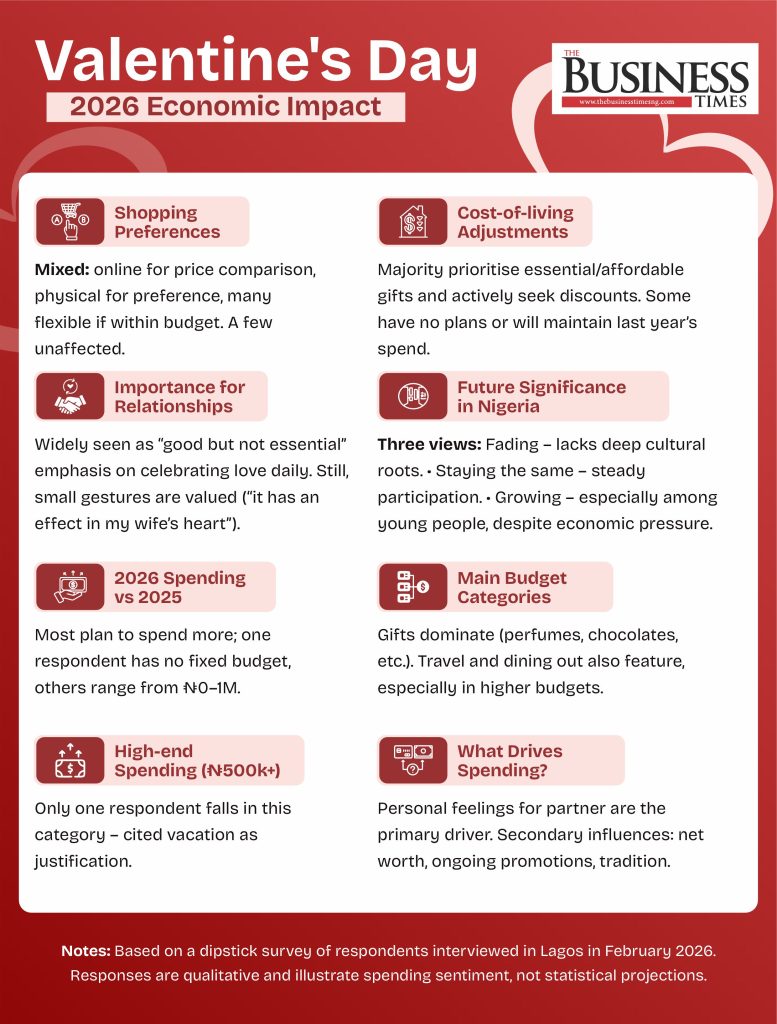
That sentiment, of a holiday that endures without expanding, runs through many of the responses collected from Lagos residents. Opemipo Taiwo believes Valentine’s significance is “staying the same” and applies broadly, “not only to relationship generally.” Joshua, who prefers physical stores, plans to spend similarly to last year. For him, the scale of the gesture matters less than the gesture itself. “It is important because as small as Valentine’s Day is, it still has its effect in my wife’s heart. So doing it small is better than not doing it at all.”
This is the first economy of Valentine’s Day 2026: the economy of maintenance. Of flat budgets and essential gifts. Of shoppers who compare prices across platforms and choose meaningful over lavish. Of the 25.3 percent of Nigerians who, according to recent survey data, plan to keep their Valentine’s spending unchanged from 2025.
But there is a second economy. And it is growing.
Continental Hotels Nigeria has unveiled luxury Valentine’s experiences across its Lagos and Abuja properties, betting that a segment of consumers still has appetite and income for premium romance. At the five-star Lagos Continental Hotel, the “Love Is in the Air” package features a five-course Nigerian gourmet dinner, live music, surprise gifts, and Prosecco toasts at the Ekaabo Restaurant . Couples can book poolside cabanas at the Sugar 52 Pool Bar & Lounge, or arrange a horse-drawn carriage ride around the city. The hotel’s General Manager, Christoph Schleissing, says the goal is “to create magical, memorable moments for every couple, helping them celebrate their connection in the most sophisticated setting in Lagos” .
In Abuja, the Continental Hotel is offering a “Love in Every Touch” spa package for N100,000 per couple, available from February 13 to 15. It includes a Swedish massage, body analysis, pool access, and a healthy smoothie . Aurelio Giraudo, the General Manager, describes Valentine’s Day as “a beautiful opportunity to honour connection and care” .
This is the economy of aspiration. And Oluchi Hilda is its representative voice.
“I plan to spend more,” she says of her 2026 Valentine’s budget. Her range: N400,000 to N1 million. Her categories: travel and dining out. Asked whether she falls into the high-end spending bracket of over N500,000, she answers without hesitation: “Yes, I fall under this category. A vacation justifies the spending.” Her primary driver? “His importance to me is what is influencing my spending.”
Oluchi represents a demographic that, while small, is expanding. Survey data indicates that the share of Nigerians planning to spend over N500,000 on Valentine’s Day rose from 1.59 percent in 2024 to approximately 5 percent in 2025. Businesses are paying attention.
Yet between the essential-gift shoppers and the luxury travellers lies a vast and increasingly contested middle. This is where the real economic story of Valentine’s Day 2026 is being written.
Emmanuel Udora embodies this middle ground. “I compare prices more and shop online often for better deals, though I still use physical stores when necessary,” he says. He is adjusting his plans due to the cost of living: “I focus on affordable, meaningful gifts and look for discounts instead of expensive venues or luxury items.” He believes Valentine’s is “important for appreciation, but love should be shown every day.” And despite the economic headwinds, he is optimistic. “I believe it is growing, especially among young people.”
Konga, Nigeria’s leading e-commerce platform, is betting that Emmanuel is right. On February 1, 2026, the company launched “Black Valentine: Special Love Series,” a 16-day campaign offering discounts of up to 60 percent across categories including Home and Kitchen, Computing, Electronics, Beauty, and Personal Care . The strategic innovation, however, is not the discount depth. It is the target audience.
“The narrative around Valentine’s Day needs expansion,” says Irfan Vayani, Senior Vice President at Konga. “Love is multifaceted, and the most foundational relationship one can nurture is the one with oneself. ‘Black Valentine’ is our way of honouring every individual’s journey, whether you are single, in a relationship, or focused on personal growth” .
This is not merely inclusive marketing. It is a recognition of demographic reality. A substantial portion of Nigeria’s urban, economically active population is single, financially independent, and increasingly focused on wellness, grooming, and personal investment. By reframing Valentine’s Day around self-appreciation, Konga is attempting to unlock spending that traditionally remained dormant in February.
Jonathan Nifemi represents this cohort. He plans to spend more in 2026, though he has no fixed budget. His primary category is gifts. His drivers? “Personal feelings and ongoing promotions or discounts.” He does not fall into the high-end bracket, but his willingness to spend and his responsiveness to discounts make him the exact consumer Konga is pursuing.
Olaitan Fidelis also plans to spend more, with a budget of N0 to N100,000 focused on gifts. His driver is practical: “My net worth, then my personal feelings for my partner.” Chidubem Omeokwe plans to spend between N100,000 and N200,000, also on gifts, driven “mainly to show love” and by “personal feeling for my partner and tradition.”
These are not impulsive spenders. They are calculating, intentional, and value-conscious. They are also, in aggregate, the engine of the Valentine’s economy.
That engine, however, is running in an environment of sustained inflation. The average headline inflation rate for 2024 stood at 33.2 percent, with December 2024 inflation reaching 34.8 percent . Real wages have not kept pace. And yet, 54.8 percent of Nigerians surveyed indicate they plan to spend more on Valentine’s Day 2026 than they did in 2025.
This paradox rising nominal spending amid declining purchasing power is not irrational. It reflects a reallocation of resources rather than an expansion of them. Consumers are not buying more; they are buying differently.
BizWatch Nigeria’s analysis of Valentine’s gifting identifies the sub-N10,000 range as the “sweet spot” for consumer spending . Customised mugs and keyholders, scented candles, miniature fragrance oils, curated chocolate boxes, affordable jewelry, stuffed toys, handwritten notes, and phone accessories dominate this bracket. These items share common characteristics: low production costs, high perceived emotional value, and suitability for impulse purchase. They are not alternatives to luxury. They are alternatives to nothing.
Supacash, a digital payment platform, has taken this logic to its conclusion. Its #100kSmilesChallenge encourages Nigerians to send N1,000 to at least five people via a giveaway feature on its mobile app . Recipients can access the funds without downloading the platform. The campaign, which began on February 3, aims to reach 100,000 Nigerians through small, cascading gifts. Overcomer Idemudia, the company’s CEO, frames the initiative in terms of access rather than abundance. “Small acts of giving can have meaningful effects,” he says.
This is not charity. It is commerce. Supacash is building network effects through generosity. It is also responding to the same consumer insight that Konga has identified: that Valentine’s Day spending is no longer exclusively or even primarily about couples.
The events calendar for Lagos in February 2026 reflects this shift. The Lagos Singles Festival, scheduled for Valentine’s night at Praia on Victoria Island, features blind speed dating, gift sharing, karaoke, and a three-course meal. It is designed explicitly for unmarried attendees. Valentine Revamp at JJt Park in Alausa offers “good conversations, laughter, and reconnecting with what love means.” Movie in the Park provides outdoor cinema for groups of friends. Terra Kulture hosts live music and theatre.
These are not substitutes for the romantic dinner economy. They are expansions of it. And they carry their own economic multiplier effects: venue bookings, catering contracts, security staffing, transportation demand.
Yet for all the innovation in marketing and events, a persistent undercurrent of ambivalence remains. Michael Akinsanya is blunt: “I no get plans for valentine.” He believes the day is important, but assesses its economic impact as negligible. “I think it really has no impact as at now.” His is not a dissenting voice; it is a reminder that non-participation is itself a form of economic data.
So is the chastity parade. On February 10, 2026, more than 500 teenagers from the Assemblies of God Church in Surulere took or renewed a vow to abstain from premarital sex. The event, held ahead of Valentine’s Day under the theme “Chastity, My Life of Freedom,” included palm stamps on a commitment board and addresses from church leaders warning against the pressures of the season. Elder Evangelist Chidi Udo, Pastor of the Teens Church, noted that “many teenagers are pressured into sex under the guise of love”. Pastor Victor Olukoju, founder of the Sexual Chastity Academy, distinguished between genuine love and its distorted commercial representations.
This is not, on its face, an economic story. But it is. Every teenager who opts out of the Valentine’s spending economy represents a unit of demand that will not be realized. Restaurants, gift shops, cinemas, and hotels compete not only with each other, but with abstinence. The church is not merely a moral institution in this context. It is a competitor.
Samuel Ogbonna, who foresees Valentine’s significance “fading in coming years,” offers an explanation that transcends economics. “There are no strong cultural background values,” he says. Without indigenous anchoring, the holiday’s endurance depends entirely on its commercial momentum. And commercial momentum, in an environment of persistent hardship, is difficult to sustain.
Seun believes the significance is “staying the same.” Emmanuel believes it is “growing, especially among young people.” Samuel believes it is fading. All three are describing the same phenomenon from different vantage points: a holiday in transition, its economic footprint expanding in some segments and contracting in others.
What unites them is adaptation. Across every income bracket, every relationship status, every spending plan, Lagosians are making conscious, deliberate choices about how to participate in Valentine’s Day 2026. They are not passive consumers of corporate messaging. They are active managers of constrained resources.
Oluchi Hilda will spend up to N1 million on travel and dining, justifying it through the importance of her partner. Jonathan Nifemi will spend without a fixed budget, guided by promotions and personal feelings. Olaitan Fidelis will stay within N100,000, balancing net worth with sentiment. Chidubem Omeokwe will allocate N100,000 to N200,000 for gifts, driven by tradition and the desire to show love. Joshua will spend similarly to last year, because small gestures matter. Emmanuel will hunt for discounts and prioritize meaningful gifts. Samuel and Seun will focus on essentials and shop within their means. Michael will not participate at all.
These are not contradictions. They are the constituent parts of a single, complex economy. Valentine’s Day 2026 in Lagos will not be defined by any single trend, neither the rise of luxury spending nor the expansion of budget gifting, neither the corporatization of romance nor the resistance to it. It will be defined by the aggregation of millions of individual calculations, each one an answer to the same question: What can I afford to give, and to whom?
The economic impact of Valentine’s Day in Nigeria has never been a simple matter of total spending. It has always been a matter of distribution. Who spends, on what, and why. Which businesses capture which segments. Which values are reinforced and which are resisted.
This year, the data suggests a market more fragmented than ever before, but no less dynamic. Nigerians are not abandoning Valentine’s Day. They are renegotiating its terms. And in that renegotiation, they are revealing something essential about the character of the country’s consumer economy: its resilience, its creativity, and its stubborn insistence on finding meaning within constraint.
Love, in Lagos, has always found a way. This Valentine’s Day, it will find a budget, too.