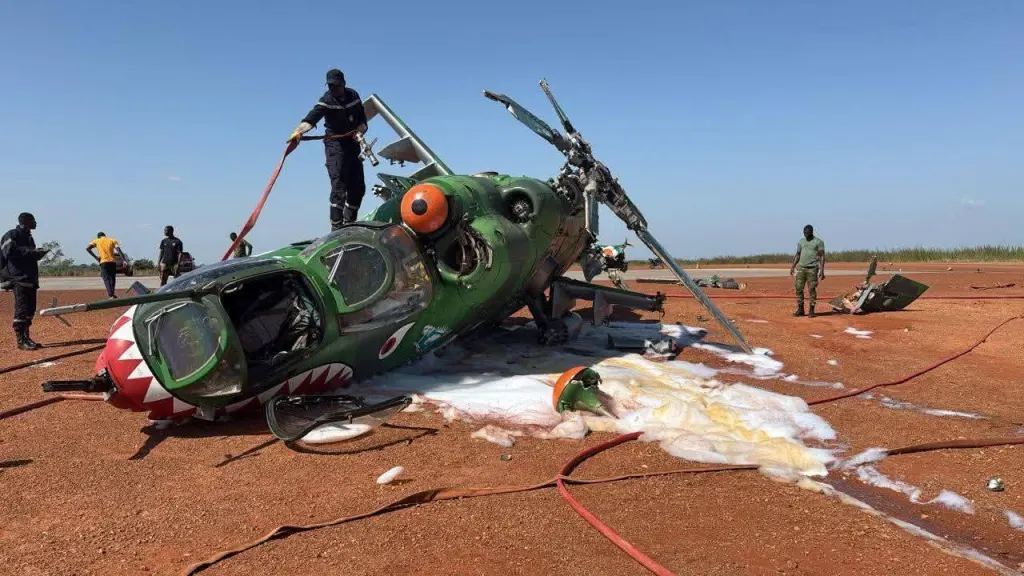

Côte d’Ivoire’s already fragile air power has suffered another blow following the crash of an Mi-24D attack helicopter at Korhogo Airport on Monday. The aircraft, operated by the Force Aérienne de la Côte d’Ivoire (FACI), reportedly encountered a technical malfunction during takeoff around 1:00 p.m. local time. According to military officials, the pilots managed to execute an emergency landing that saved the crew from harm, but the helicopter sustained serious structural damage, including the complete detachment of its tail boom. The incident effectively grounded the air force’s last operational Mi-24 Hind, a setback with wide-ranging implications for national security and counter-insurgency efforts in the country’s volatile north.
Korhogo, located near Côte d’Ivoire’s borders with Mali and Burkina Faso, has long served as a critical forward base for operations against Islamist militant groups active in the Sahel region. The airbase is a logistical hub supporting ground troops tasked with preventing militant infiltration and protecting communities along the frontier. With the loss of this helicopter, the FACI’s ability to provide aerial fire support, troop mobility, and rapid response to security threats in the north has been severely weakened.
The Mi-24 Hind, a rugged Soviet-designed attack helicopter, has been central to Côte d’Ivoire’s counter-insurgency and reconnaissance missions since the early 2000s. Following years of political instability and conflict, the government refurbished several units with the help of Eastern European contractors to bolster air power. However, the fleet has faced persistent mechanical failures, maintenance difficulties, and parts shortages. Monday’s accident continues a worrying pattern: at least three Mi-24s have been lost in crashes or forced landings since 2019, underscoring both the age of the aircraft and the challenges of sustaining them in tropical operating environments.
The incident also highlights the broader strain on Côte d’Ivoire’s defence apparatus. The country has invested heavily in military modernisation over the past decade, expanding its troop numbers and upgrading surveillance capabilities. Yet, its air force remains underdeveloped compared to neighbouring powers such as Ghana and Nigeria. While Côte d’Ivoire has acquired newer light aircraft and unmanned aerial vehicles for reconnaissance, it lacks a reliable fleet of heavy-lift or attack helicopters capable of sustained operations in remote areas.
Economically, the crash carries ripple effects beyond the immediate military loss. Maintaining operational security along the northern border is vital to Côte d’Ivoire’s agricultural and trade zones, which depend on stable transport corridors linking Abidjan to the Sahel. Any reduction in aerial patrols could embolden cross-border banditry, disrupt trade flows, and deter investment in northern regions already lagging behind in infrastructure and development. Korhogo and surrounding areas are central to the country’s cotton and cashew industries, sectors that contribute significantly to export earnings and rural employment. A deterioration in security would therefore threaten both livelihoods and state revenue.
Furthermore, the cost of replacing or repairing an Mi-24 helicopter is significant. Given the depreciation of the West African CFA franc and rising defence expenditures across the region, Côte d’Ivoire faces difficult fiscal trade-offs. The government may be forced to divert funds from social or infrastructure programmes to maintain military readiness, especially as security concerns intensify along its borders with Mali and Burkina Faso. Both neighbours continue to battle expanding insurgencies linked to al-Qaeda and Islamic State affiliates, which have occasionally spilt into Ivorian territory.
The incident may also prompt discussions on Côte d’Ivoire’s reliance on ageing Soviet-era platforms and the need for a more sustainable defence procurement strategy. While Russian-made helicopters like the Mi-24 are known for their durability and cost efficiency, limited access to spare parts and maintenance expertise has made long-term operation increasingly untenable. Abidjan has explored partnerships with Western and Turkish defence firms for light combat aircraft and drones, but financial constraints and competing domestic priorities have slowed progress.
An investigation into the Korhogo crash has been launched by the General Staff of the Armed Forces to determine whether pilot error, mechanical fatigue, or inadequate maintenance was responsible. However, regardless of the outcome, the incident underscores the urgency of modernising the FACI’s fleet and investing in training and technical capacity.
For now, the immediate consequence is operational vulnerability. Without air cover, troops stationed in the north will have to rely more heavily on ground logistics and allied intelligence to monitor militant movement. This reduces mobility and slows response times, increasing the risk of surprise attacks or incursions. In a region already shaped by instability, such capability gaps could undermine not just Côte d’Ivoire’s internal security but also the wider regional effort to contain Sahelian extremism.
In the short term, the government may seek support from international partners, including France and the United States, both of which maintain security cooperation programmes in West Africa. Yet, the longer-term question remains whether Côte d’Ivoire can sustain its security commitments while balancing economic growth and social development. The Korhogo crash, though not fatal, is a stark reminder that even as the country enjoys relative peace compared to its neighbours, the fragility of its defence infrastructure remains a critical weakness.