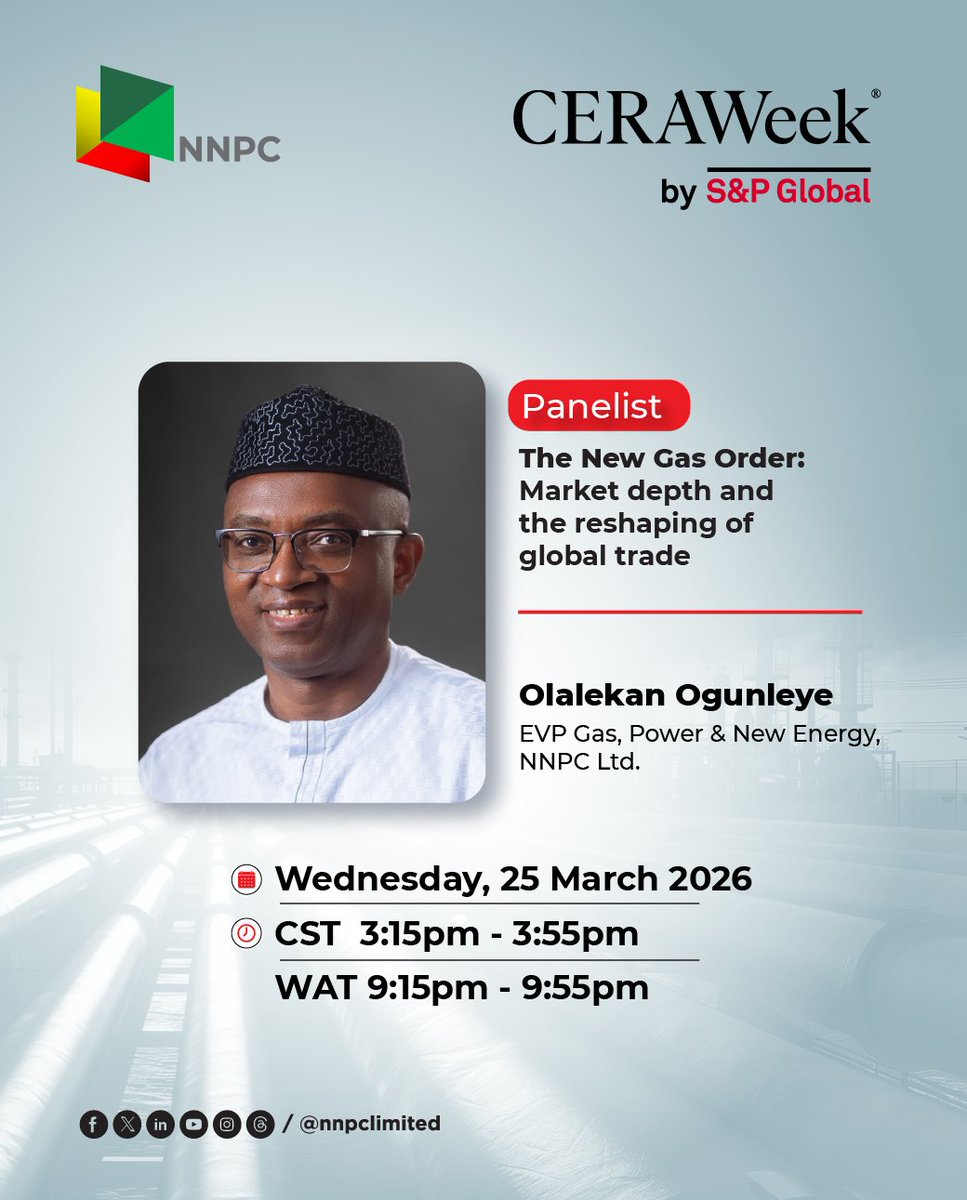

The Nigerian National Petroleum Company Limited (NNPC Ltd) says Nigeria is experiencing increased demand for its liquefied natural gas (LNG) cargoes, driven by shifting global energy dynamics and geopolitical tensions.
Speaking at the CERAWeek by S&P Global conference in Houston, NNPC’s Executive Vice President, Olalekan Ogunleye, said buyers are increasingly turning to Nigeria due to its strategic location and vast gas reserves.
“We are right in the middle of the market. We are 10 sailing days from Europe, close to the Atlantic Basin and close to Asia,” Ogunleye said. “We see commercial opportunities on top of the fact that we have the most gas reserves in Africa.”
He noted that demand for natural gas remains strong despite ongoing geopolitical tensions, including disruptions linked to conflicts in the Middle East, which have pushed buyers to diversify supply sources.
To capitalise on the growing interest, Ogunleye said the NNPC is in discussions to expand LNG capacity, including plans to add two new production trains. The company is also pursuing a 12 million metric tonnes per annum LNG project, alongside gas-based industrial hubs, to harness Nigeria’s estimated 200 trillion cubic feet of gas reserves.
Nigeria’s LNG exports are largely handled by Nigeria LNG Limited (NLNG), in which NNPC is the majority shareholder. The facility currently has the capacity to export up to 22 million metric tonnes annually and is constructing a seventh production train expected to be completed in 2027.
Industry experts say evolving global risks are reshaping energy trade flows. LNG consultant Martin Houston noted that recent geopolitical developments have increased the urgency for buyers to secure alternative supply sources.
He added that countries in Africa and South America with proven gas reserves but underdeveloped export capacity could benefit from rising demand, particularly through flexible solutions such as floating LNG.
Nigeria’s LNG sector, however, has faced challenges in recent years. Data from Bloomberg showed that exports dropped by about 20 per cent in early 2025 due to pipeline vandalism and supply disruptions in the Niger Delta.
The NLNG operator had attributed the decline to sabotage, which constrained gas supply to its processing facilities and disrupted shipment schedules. Despite these setbacks, exports showed signs of recovery in 2024.
Meanwhile, NNPC’s Group Chief Executive Officer, Bayo Ojulari, said Nigeria is working to increase crude oil output by approximately 100,000 barrels per day in the coming months.
He noted that the country averaged between 1.6 million and 1.7 million barrels per day last year and is targeting an average of 1.8 million barrels per day in 2026.