
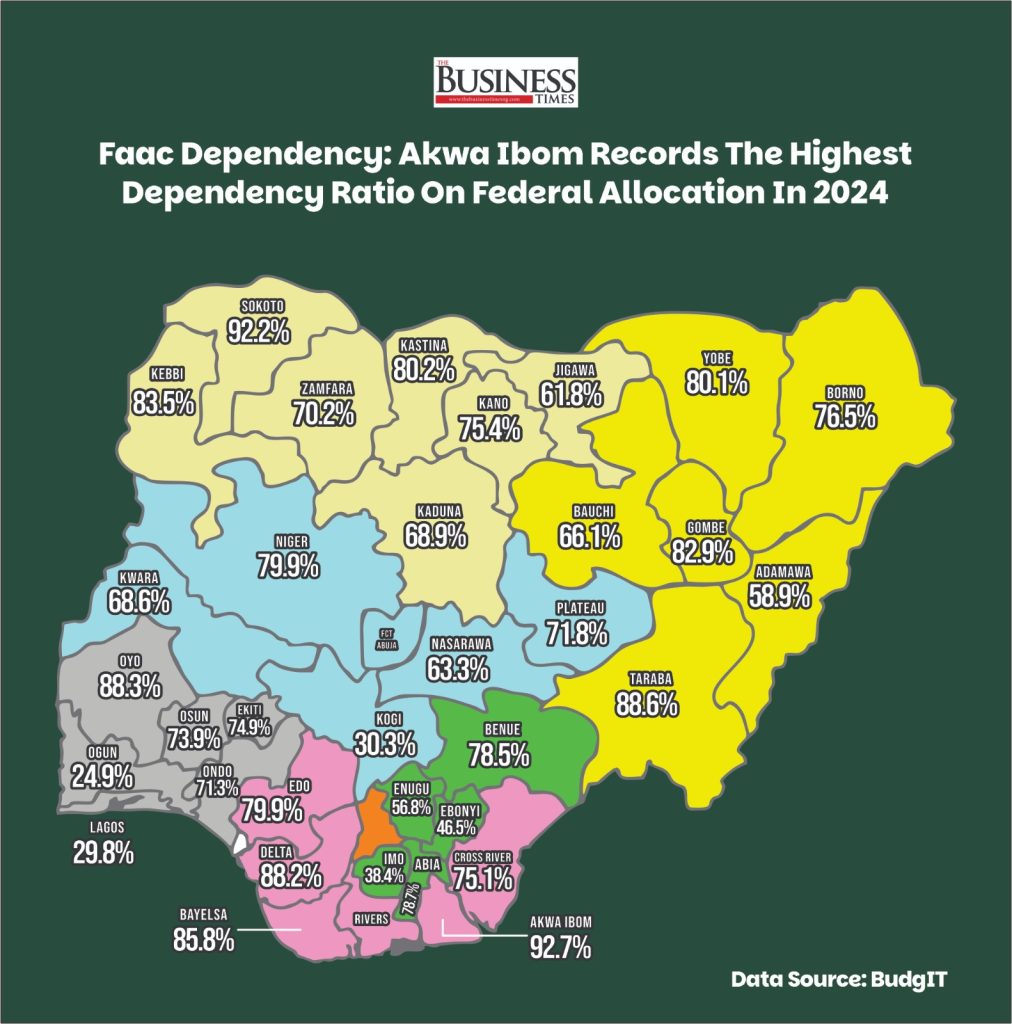
Despite recurring calls for fiscal federalism and economic diversification, most Nigerian states remain tethered to monthly allocations from the Federation Account Allocation Committee (FAAC). The imbalance is so deep that in 2024, 32 of the 36 states relied on the federation account for more than 60 percent of their total revenue.
According to the National Bureau of Statistics (NBS) data on Internally Generated Revenue (IGR), Lagos and Rivers stood out as the only states capable of surviving independently of federal allocations. Others — even oil-rich Bayelsa and Delta — would struggle to pay salaries or fund basic services without federal intervention.
In 2024, Nigerian states collectively generated ₦2.53 trillion in IGR, an increase of 10 percent from ₦2.31 trillion in 2023. However, the federal allocation to states for the same period totalled about ₦5.7 trillion — more than double their own internally sourced funds.
Lagos accounted for about ₦400 billion, roughly 16 percent of the national IGR pool, followed by Rivers (₦230 billion), FCT (₦200 billion), and Ogun (₦150 billion). At the bottom were Yobe, Nasarawa, and Taraba, each collecting less than ₦20 billion. The contrast reveals how deeply skewed Nigeria’s fiscal structure is toward a few urban and resource-rich centres.
The debt trap beneath the numbers
Even with steady federal inflows, states have continued to pile up debts. Data from the Debt Management Office (DMO) show that by June 2025, the total domestic and external debt owed by states and the FCT had risen to ₦9.73 trillion, up from ₦5.85 trillion in June 2023 — a 66 percent increase in two years.
Many states with the lowest IGR ratios also carry the heaviest debt burdens relative to their revenue base. Bauchi’s ₦443 billion debt is nearly 14 times its ₦32 billion IGR; Adamawa’s ₦238 billion debt is 12 times its ₦20 billion IGR. By contrast, Lagos — Nigeria’s most indebted state at ₦1.2 trillion — maintains a debt-to-IGR ratio of about 3:1, a much healthier position.
Experts say Nigeria’s fiscal arrangement remains heavily centralised. The federal government retains 52.68 percent of national revenue while states and local governments share 26.72 percent and 20.6 percent respectively. This structure encourages dependence and discourages competition among states to grow their economies.
Dr Tunde Ogunleye, an economist at the University of Ibadan, explains that “most states treat FAAC like a monthly salary rather than a stopgap. There’s no real incentive to expand their productive base when Abuja guarantees cash flow every month.”
The problem is not merely political but structural. The Constitution places crucial revenue sources such as mining, VAT, and maritime taxes under federal control.
Attempts to devolve more fiscal powers — for instance, through the 2022 VAT legal battle between the Rivers State government and the Federal Inland Revenue Service (FIRS) — have been met with judicial and political resistance.
A political economy of complacency
The assurance of federal allocations has bred what analysts describe as a “culture of fiscal complacency.” Many governors focus on short-term projects rather than building sustainable revenue streams through agriculture, industrial parks, or land-use taxation. In some states, tax collection is outsourced to private agents with weak oversight, reducing transparency and potential returns.
A Business Times review of NBS data shows that more than 20 states still generate over 60 percent of their IGR from Pay As You Earn (PAYE) — a tax on salaried workers — while informal and business sectors remain largely untapped. This means that state revenues move in lockstep with federal wage payments and public-sector employment, further entrenching dependence on Abuja.
Nigeria has attempted several reforms to improve subnational fiscal autonomy. In 2018, the World Bank’s States Fiscal Transparency, Accountability and Sustainability (SFTAS) programme incentivised states to publish budgets and expand IGR sources through grants. While SFTAS helped institutionalise transparency, its impact on real revenue growth was limited. Once the programme ended in 2023, most states reverted to old patterns.
Fiscal analyst Taiwo Akinola argues that “the next phase must focus on true fiscal devolution. Without constitutional change, states can’t own or exploit solid minerals or collect VAT locally. That makes the idea of self-reliant states almost impossible.”
A tale of two states
Lagos and Rivers offer contrasting models of what is possible. Lagos has built a robust tax administration that draws from a diversified economy — trade, real estate, manufacturing, and tech. It has also invested in digitising revenue collection through the Lagos Internal Revenue Service (LIRS). Rivers, while oil-dependent, has made strides in land tax and service charges.
Yet, for many other states, reform remains rhetorical. For instance, in Kano — Nigeria’s most populous northern state — IGR of ₦35 billion barely covers the monthly wage bill of ₦4 billion. Zamfara and Katsina each generate less than ₦20 billion a year despite vast solid mineral reserves and agricultural potential.
Analysts say three steps are essential: first, empowering states to develop resource-based industries such as mining and agro-processing; second, digitising tax administration to capture the informal sector; and third, reforming public finance management to curb leakages and expand the tax net.
The federal government’s new Revenue Mobilisation and Fiscal Commission review may also reshape allocation formulas to reward IGR performance — an idea long floated but rarely implemented.
As Nigeria grapples with debt servicing and declining oil revenues, subnational dependence on Abuja has become both a fiscal and political risk. Without structural reform and economic creativity at the state level, FAAC allocations will remain lifelines — not bonuses — for governors. And until states turn their comparative advantages into productive value chains, Nigeria’s federal system will continue to function as a one-wallet economy.
‘Governors prioritise loyalty over productivity’
Dr Grace Adeniyi, a fiscal policy specialist at the Centre for Development Studies, says Nigeria’s fiscal framework “traps states in dependency.”
“When 70 percent of subnational revenue comes from FAAC, what you get is political loyalty, not economic innovation,” she explains. “Governors will always prioritise staying in Abuja’s good books rather than building local productivity. Fiscal autonomy must go beyond agitation — it requires states to modernise land registries, digitise informal tax collection, and improve spending efficiency. Lagos’s success came not just from scale, but from discipline and reform continuity.”
Adeniyi adds that unless states “move from rent collection to genuine value creation,” Nigeria will continue to recycle the same revenue crises under different administrations.
Speaking with Hassan Abdullahi, an economist, he believes the problem is more structural than behavioural.
“The post-SFTAS regression was predictable,” he says. “Most states saw transparency as a box-ticking exercise for grants, not a shift in fiscal culture. The bigger issue is that Nigeria runs a unitary economy disguised as federalism. Even if states doubled their IGR tomorrow, the Constitution still denies them control over major resources.”
According to him, “unless there’s a constitutional amendment to decentralise VAT, mineral rights, and power generation, the current system will keep breeding fiscal laziness and debt overhang.”