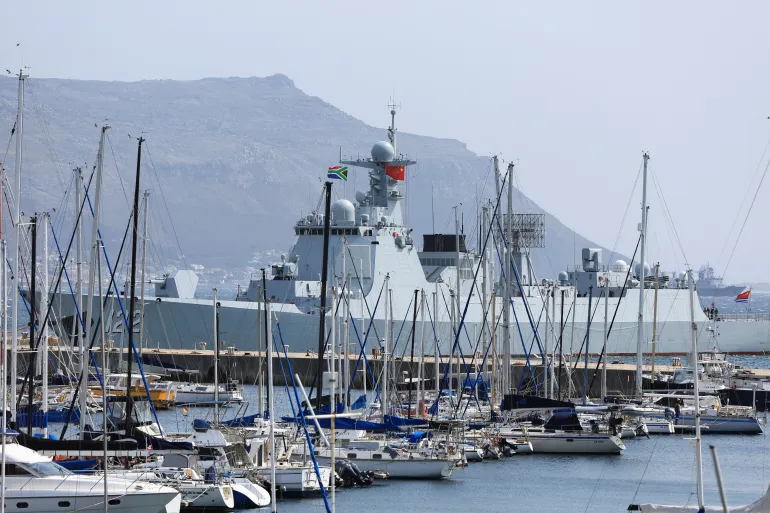

China, Russia and Iran launched a week-long joint naval exercise last Saturday in South African waters, in what Pretoria described as a BRICS Plus operation aimed at strengthening maritime security and safeguarding key shipping lanes. Dubbed Exercise WILL FOR PEACE 2026, the drills bring together naval forces from the expanded BRICS bloc, which now includes Egypt, Indonesia, Saudi Arabia, Ethiopia and the United Arab Emirates alongside the original members: Brazil, Russia, India, China and South Africa. Brazil, Egypt and Ethiopia are participating as observers, according to Chinese military officials at the opening ceremony.
While South Africa has a history of conducting naval exercises with China and Russia, this operation comes amid heightened geopolitical tensions with the United States. President Donald Trump has repeatedly criticised BRICS nations, accusing the bloc of pursuing “anti-American” policies and threatening additional trade tariffs on member countries.
Domestic criticism has also emerged. The pro-Western Democratic Alliance, South Africa’s second-largest political party, argued that the drills undermine the country’s stance of neutrality and risk positioning it as a pawn in the power dynamics of larger states. However, South Africa’s military dismissed these concerns, emphasising that the exercise is non-political and primarily focused on enhancing naval capabilities, interoperability and maritime safety.
Economically, the drills carry broader significance. South Africa’s maritime routes are critical for regional trade, particularly the transport of goods along the Indian Ocean and Atlantic corridors. Ensuring the security of these shipping lanes protects vital imports and exports, including raw materials, oil, and manufactured goods, which underpin the country’s GDP and the wider Southern African trade network. Joint exercises with multiple BRICS Plus navies also signal a commitment to regional stability, potentially reducing the risk of piracy and disruption that could inflate shipping costs and insurance premiums.
Strategically, Exercise WILL FOR PEACE 2026 demonstrates the increasing operational cooperation among BRICS Plus members, reflecting the bloc’s broader ambition to assert influence on global trade and security. By including additional observers from Africa and Asia, the drills also highlight the bloc’s intent to expand its maritime presence and foster collaborative security mechanisms beyond traditional bilateral partnerships.
While the exercise is framed as a security initiative, it has indirect economic and geopolitical implications. Enhanced naval coordination among BRICS Plus countries may shift trade and security dynamics in the Indian Ocean and Southern Atlantic, potentially affecting global shipping patterns, foreign investment considerations, and regional alliances. For South Africa, actively participating in such exercises reinforces its role as a regional security player while maintaining ties with both Western and non-Western powers.
Ultimately, the exercise represents a balancing act for South Africa, which seeks to strengthen regional security and economic interests without overtly aligning against Western partners. With maritime trade increasingly intertwined with national and continental economic growth, Exercise WILL FOR PEACE 2026 underscores the strategic intersection of military cooperation and economic safeguarding in a rapidly evolving global landscape.