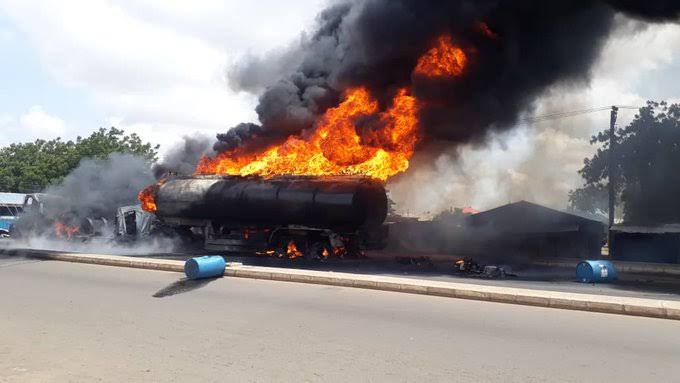

Nigeria’s recurring tanker fires continue to claim lives and destroy property, with a fresh fire beneath Otedola Bridge in Lagos on Monday, October 19, 2026, bringing renewed attention to a location that has witnessed deadly tanker disasters in previous years.
The incident came four days after a petrol tanker explosion near Oluku Market along the Benin-Lagos Expressway in Edo State, where people reportedly rushed to scoop spilled fuel before the tanker caught fire.
The Lagos State Emergency Management Agency (LASEMA) reportedly deployed its Tiger Response Team after receiving a distress call at about 4:24 pm on Monday. However, the cause of the fire, the tanker’s contents and possible casualties had not been officially established in the information available at the time of writing.
The latest incident has revived memories of the deadly Otedola Bridge tanker explosion of June 28, 2018, when a petrol tanker fell, spilled fuel and burst into flames, engulfing nearby vehicles.
Channels Television reported on June 28, 2018, that nine people had died. The Lagos State Government subsequently confirmed that the death toll had risen to 12 by July 2, while the Federal Road Safety Corps (FRSC) recorded 54 vehicles burnt in the disaster.
The same location witnessed another deadly tanker explosion on March 11, 2025, when a gas tanker fell and caught fire while attempting to access the expressway from Otedola Estate Road.
Channels Television reported on March 11, 2025, that two people died and three others were injured, with 12 vehicles, eight tricycles and a building damaged. In a statement published on March 14, 2025, the National Emergency Management Agency (NEMA) reported one confirmed death, four injuries and 14 vehicles completely burnt. The differing official figures underline the importance of identifying the reporting source when citing casualties.
The recurrence of major tanker fires at Otedola Bridge raises questions about the effectiveness of preventive measures, vehicle safety enforcement and emergency preparedness on busy highways.
The danger extends beyond Lagos. At Oluku Market in Edo State on Thursday, October 15, 2026, a petrol tanker reportedly fell and spilled fuel into nearby drainage channels. The PUNCH reported that the subsequent explosion injured 11 people, who were taken to the University of Benin Teaching Hospital.
The incident also destroyed shops and affected vehicles. The newspaper reported that residents had gathered to collect the spilled petrol before the explosion.
Fuel scooping remains one of the most dangerous features of tanker accidents. Petrol releases highly flammable vapour, which can ignite when exposed to an ignition source. People gathering around a fallen tanker also risk being trapped if the vehicle catches fire.
The scale of Nigeria’s wider tanker safety problem is reflected in research published in December 2024 by Abdulmajid M. Na’inna in the Nigerian Research Journal of Engineering and Environmental Sciences. The study documented 169 petroleum tanker fire and explosion incidents resulting in 1,613 deaths between January 2009 and October 2024.
The researcher identified spilled-fuel scooping, collisions and human error among factors contributing to fatalities. The study relied on publicly available reports rather than a comprehensive official national database, making the figures a documented research estimate rather than a complete government tally.
Safety experts have also highlighted tanker design and inadequate inspections. Premium Times reported on October 17, 2026, that safety professional Timothy Iwuagwu called for improved tanker construction and more rigorous inspection of vehicles before they are allowed on Nigerian roads.
Preventing further disasters requires more than public warnings after each explosion. Authorities must enforce vehicle safety standards, ensure proper tanker maintenance, improve hazardous-road management and strengthen emergency responses. Drivers must observe safety rules, while emergency agencies need to secure accident scenes quickly and keep crowds away from spilled fuel.
The repeated tragedies also demonstrate the need for a consolidated national database recording tanker crashes, fires, injuries, deaths and their causes. Reliable data would help authorities identify high-risk locations and assess whether existing interventions are working.
From the 2018 Otedola Bridge inferno to the 2025 gas tanker explosion, the Oluku Market disaster and Monday’s reported fire, the pattern is difficult to ignore. Unless prevention and enforcement improve, another tanker accident could once again turn a busy road into a mass-casualty scene.