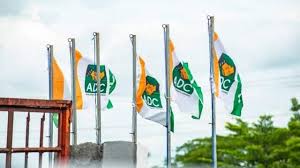

The African Democratic Congress has insisted it will proceed with its scheduled congresses and national convention, defying warnings from the Independent National Electoral Commission amid an escalating leadership crisis within the party. In a statement issued on Friday, the party said its internal processes would go ahead as planned despite what it described as “illegal actions” by the electoral umpire.
The National Organising Secretary, Chinedu Idigo, and the National Publicity Secretary, Bolaji Abdullahi, jointly signed the statement. The party maintained that it had complied with all statutory requirements, including formally notifying INEC of its activities. According to the party’s timetable, screening of aspirants will hold on 7 April, followed by appeals on 8 April, while polling unit, ward and local government congresses are slated for 9 April. Appeals from those exercises will take place on 10 April, with state congresses fixed for 11 April and subsequent appeals on 12 April. The party said its national convention will be held on 14 April.
“This is to notify all party members that, despite INEC’s illegal actions, the African Democratic Congress will continue with its congresses as scheduled, having duly notified INEC by our letters dated 27th February 2026 and 28th March 2026,” the statement read.
The latest development follows a sharp escalation in tensions between the party and the electoral commission. The ADC, at a world press conference on Thursday, called for the immediate resignation of the INEC chairman, Joash Amupitan, and national commissioners, accusing the commission of undermining democracy and interfering in the internal affairs of political parties. The party’s National Chairman, Senator David Mark, expressed concern over what he described as a shrinking democratic space under President Bola Tinubu. Mark alleged that INEC’s decision to freeze recognition of the ADC leadership raised serious questions about the commission’s neutrality and independence.
“We demand the immediate resignation or sack of the INEC Chairman and all national commissioners. We no longer have confidence in them,” Mark said, adding that the commission was incapable of conducting credible elections. He also insisted that the party would continue its activities regardless of INEC’s stance, arguing that the law does not require the commission’s presence at party congresses and conventions.
The crisis stems from INEC’s decision to suspend recognition of the ADC leadership factions in compliance with a Court of Appeal ruling directing all parties to maintain the status quo pending the determination of a suit at the Federal High Court. The suit was filed by a former National Vice Chairman of the party, Nafiu Bala, who is challenging Mark’s emergence as national chairman following the resignation of Ralph Nwosu last year. Bala is seeking to be declared national chairman in line with the party’s constitution. The case remains pending.
Meanwhile, Mark’s faction had filed an interlocutory appeal ahead of proceedings at the Federal High Court, but the Court of Appeal dismissed the appeal and ordered all parties to maintain the status quo. Following the ruling, INEC announced on Wednesday that it would not recognise any faction of the party until the substantive case is determined. However, Mark argued that there is no legal basis for INEC to de-recognise the party, insisting that the commission misinterpreted the appellate court’s directive. He said INEC ought to have sought judicial clarification if it was uncertain about the ruling.
Mark also accused the All Progressives Congress of fuelling the crisis, alleging that Bala was being used as a tool to destabilise the ADC. He claimed the ruling party was determined to retain power “by all means,” even if it meant plunging the country into avoidable political instability. The accusation reflects the broader context of Nigeria’s competitive political environment, where opposition parties frequently allege that the ruling party uses state institutions to weaken potential challengers ahead of elections.
Reacting earlier, INEC Chairman Amupitan had warned the party against proceeding with its planned congresses without the commission’s supervision, citing the ongoing court process. Speaking on Arise Television, he said a motion relating to the dispute is yet to be determined, cautioning that proceeding regardless could attract “grave legal consequences.” He cited precedents in Zamfara and Plateau States where failure to comply with court orders led to the nullification of electoral victories, with candidates who came second eventually declared winners. “They are at liberty to do whatever they want to do, but INEC does not want to go into this situation again,” he said.
From a political governance perspective, the ADC crisis highlights the fragility of opposition party structures in Nigeria. Political parties are essential institutions for democratic consolidation, providing platforms for policy debate, candidate recruitment, and voter choice. When internal disputes escalate to the courts and result in prolonged leadership uncertainty, the party’s ability to perform these functions is severely constrained. For the ADC, which has sought to position itself as a viable alternative to the dominant parties, the ongoing impasse risks alienating members, confusing supporters, and undermining its competitiveness in future elections.
The legal principle at stake is the binding nature of court orders, even when parties disagree with them. The Court of Appeal’s directive to maintain the status quo ante bellum places the party in a holding pattern. Until the Federal High Court delivers judgment on the substantive matter, neither faction can legitimately claim to be the authentic leadership of the party, and INEC cannot recognise any executive without breaching the court’s directive. The commission’s posture of non-recognition flows from this legal reality rather than any independent desire to interfere in party affairs.
The ADC’s decision to proceed with congresses and a national convention despite the subsisting court order carries significant legal risk. As Amupitan warned, electoral commissions have historically refused to monitor party activities conducted in defiance of court orders, and candidates who emerge from such processes risk disqualification. The precedents from Zamfara and Plateau States, where the Supreme Court invalidated elections because parties failed to conduct valid primaries, loom large. Candidates who participate in the ADC’s planned congresses may find themselves without a valid nomination when the time comes for election filing.
The broader lesson concerns the importance of internal dispute resolution mechanisms within political parties. When parties rely on courts to resolve every leadership disagreement, they cede control over their own governance to the judiciary and expose themselves to lengthy delays and unpredictable outcomes. Strengthening internal arbitration mechanisms, electoral guidelines, and party constitutions could help future disputes stay out of the courts or be resolved more quickly when they do enter the legal system. For the ADC, the path to resolution lies not in defying the court but in awaiting its judgment or pursuing a negotiated settlement between the warring factions.