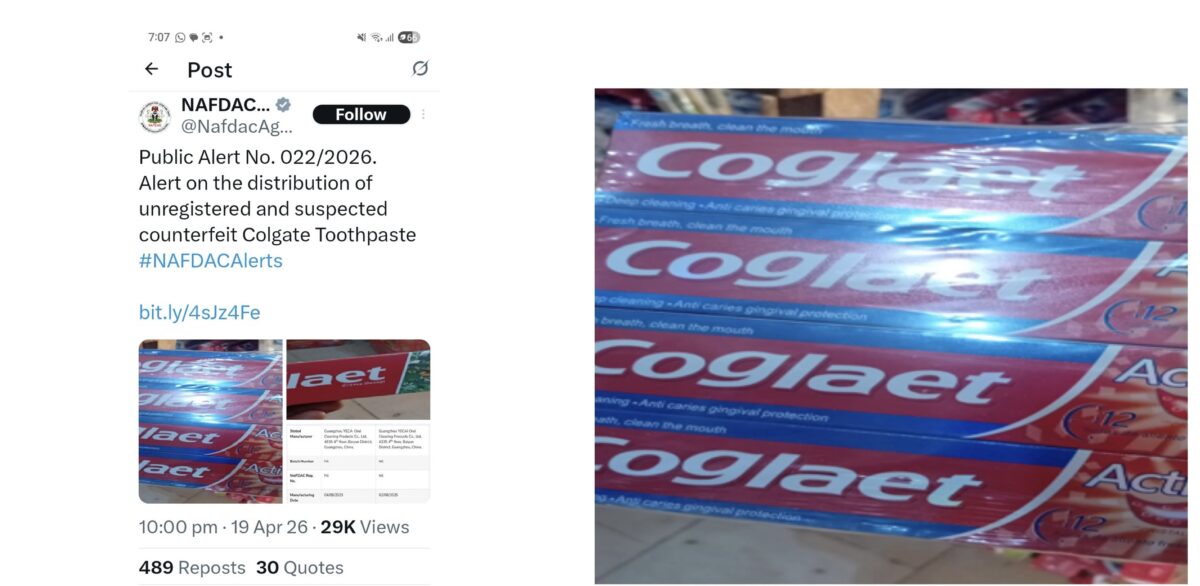

The National Agency for Food and Drug Administration and Control (NAFDAC) has issued an urgent public health warning following the discovery of unregistered and suspected counterfeit Colgate toothpaste circulating in the Nigerian market. Specifically identified in Kaduna State, the illicit products branded as Colgate ActivGel and Colgate Herbal (100g variants) represent a significant breach in the nation’s pharmaceutical and consumer goods supply chain. Beyond the immediate health risks to consumers, the proliferation of these sub-standard goods poses a direct threat to the integrity of the retail sector and the fiscal stability of legitimate manufacturers operating within the Nigerian economy.
The discovery was made by NAFDAC’s Post-Marketing Surveillance (PMS) Directorate following a consumer complaint. Investigations revealed that the counterfeit items were being funneled into the market through informal, “door-to-door” sales representatives, a distribution method that bypasses traditional regulatory checks and lacks formal documentation such as invoices or proofs of purchase. This shadow supply chain not only endangers public safety but also erodes the revenue base of authorized distributors and the original brand owners, who contribute significantly to Nigeria’s corporate tax revenue and manufacturing GDP.
From an economic perspective, the presence of counterfeit consumer staples creates a “market of lemons,” where consumer confidence in premium brands is undermined by the fear of purchasing hazardous imitations. For the Nigerian manufacturing sector, which is already grappling with high production costs and logistical bottlenecks, the added burden of competing with zero-cost, unregulated counterfeits can lead to diminished profit margins and potential job losses. Furthermore, the healthcare costs associated with treating ailments caused by toxic or substandard ingredients in counterfeit toiletries place an avoidable strain on both household disposable income and the national healthcare infrastructure.
NAFDAC has commenced a comprehensive investigation to track the distributors of these unregistered items, emphasizing that the absence of a NAFDAC registration number is a primary indicator of a product’s illegitimacy. The agency’s move to sanitize the market is critical for maintaining an environment conducive to Foreign Direct Investment (FDI). Multinational corporations like Colgate-Palmolive rely on robust intellectual property enforcement and market regulation to justify continued investment in local production and distribution networks. Failure to curb such counterfeiting activities could signal regulatory weakness, potentially deterring future investment in Nigeria’s fast-moving consumer goods (FMCG) sector.
To mitigate these risks, there is an urgent need for enhanced collaboration between regulatory bodies, law enforcement, and market unions to identify and dismantle the networks responsible for these illicit trades. Strengthening the “traceability” of consumer products through digital verification systems could serve as a long-term economic safeguard, ensuring that only certified goods reach the end-user. As the investigation in Kaduna continues, the vigilance of the public remains a vital component in protecting the economic and physical well-being of the federation.
The success of NAFDAC’s enforcement actions will be a key determinant in restoring market order and protecting legitimate commerce. Ensuring that the Nigerian market remains hostile to counterfeiters is essential for fostering a transparent business environment where innovation and quality are rewarded. As the government continues its drive for industrialization, the protection of brand equity and consumer safety must remain at the forefront of its regulatory agenda to ensure sustainable economic growth and the protection of the nation’s human capital.