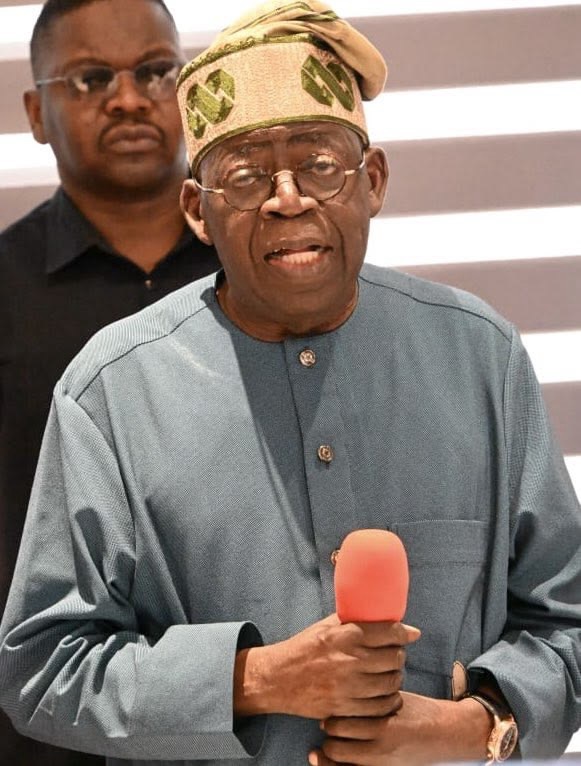

President Bola Ahmed Tinubu has defended the economic reforms introduced by his administration, saying the difficult decisions taken over the last three years helped Nigeria avoid a deeper financial crisis and created a foundation for economic recovery.
In a statement released on Thursday to mark the third anniversary of his administration, Tinubu admitted that Nigerians are facing economic hardship but insisted that the country is gradually moving towards stability and long-term growth.
The statement, shared on X by presidential spokesman Bayo Onanuga, reflected on Tinubu’s journey since taking office in May 2023 after winning the presidential election under the All Progressives Congress (APC). He defeated former Vice President Atiku Abubakar of the Peoples Democratic Party (PDP) and Peter Obi of the Labour Party in a tightly contested election.
According to the President, his administration inherited major economic problems, including fuel subsidy payments, multiple exchange rates, rising debt, insecurity, poor energy supply, and low public confidence in government institutions.
Tinubu revealed that Nigeria was spending as much as N18.4 billion daily on petrol subsidies before the subsidy removal, with total spending exceeding N4 trillion in 2022 alone. He also said the country lost over N8 trillion within three years because of exchange-rate distortions and speculative activities linked to the foreign exchange market.
He explained that these challenges forced his administration to introduce “difficult but necessary” reforms aimed at stabilising the economy and preventing fiscal collapse.
The President admitted that the reforms have increased the cost of living and placed pressure on families, businesses, and workers. However, he maintained that the policies were important to secure Nigeria’s future.
“We have not solved every problem, and we are not yet where we want to be. But the foundation for recovery has been laid,” Tinubu stated.
Tinubu also highlighted areas where he believes progress has been made since 2023. According to him, investor confidence is improving, while the Nigerian stock market has grown significantly. He said the All Share Index increased from 53,000 points in 2023 to 250,000 points in 2026, while market capitalisation rose from N30 trillion to N160 trillion.
The President further pointed to ongoing infrastructure projects across the country, including the Lagos-Calabar Coastal Highway, Sokoto-Badagry Super Highway, Abuja-Kaduna-Zaria-Kano Road, and the East-West Road. He said more than 2,700 kilometres of roads are currently under construction or rehabilitation nationwide.
In the oil and gas sector, Tinubu noted that reforms have attracted fresh investments from international oil companies. He added that the $5 billion NLNG Train 7 project is nearing completion, while modular refineries and increased local refining capacity are helping to reduce dependence on imported fuel.
The President also highlighted progress in agriculture, education, housing, healthcare, and telecommunications. He said millions of farmers have received support through fertilisers, improved seedlings, irrigation, and financing programmes.
Tinubu disclosed that over 1.5 million students have benefited from the Nigerian Education Loan Fund, with more than N282 billion disbursed as student loans. He added that over 10,000 housing units are being delivered under the Renewed Hope Housing Programme across 14 states and the Federal Capital Territory.
On security, the President said military and security agencies have intensified operations against terrorists, kidnappers, bandits, and oil thieves, making some highways and communities safer.
Despite the government’s optimism, many Nigerians continue to struggle with rising inflation, food prices, and fuel costs. Nigeria’s inflation rate increased to 15.69 percent in April 2026, while global oil prices also climbed sharply due to tensions in the Middle East.
Meanwhile, the Central Bank of Nigeria recently reduced the Monetary Policy Rate from 27 percent to 26.5 percent in an effort to support economic growth and reduce borrowing costs.
Tinubu, who has already secured the APC presidential ticket for the 2027 election, is expected to seek a second and final term in office next year.