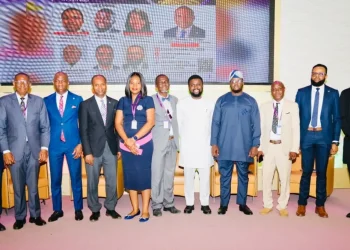

For years, the defining characteristic of Nollywood was volume. Producers churned out films at a relentless pace, but consistent commercial success at the box office remained elusive. That narrative has been decisively rewritten. As the industry celebrates a string of billion-naira blockbusters from Funke Akindele’s record-shattering Behind the Scenes to Toyin Abraham’s Oversabi Aunty—industry executives are crediting a shift from instinct to a structured, data-driven playbook. At a recent forum organized by the School of Media and Communications at Pan Atlantic University, two key operators laid out the new blueprint: treating films as commercial products requiring a 360-degree marketing strategy from conception through post-release .
The New Math of the Box Office
The numbers driving this strategic shift are staggering. In early 2026, Behind the Scenes made history as the first Nollywood production to surpass the ₦2 billion mark at the Nigerian box office, a feat that drew commendation from the National Orientation Agency as a milestone for the nation’s creative economy . Shortly after, Toyin Abraham’s Oversabi Aunty, co-produced with FilmOne Studios, crossed ₦1.08 billion, proving the commercial viability of long-term creative partnerships . Even newer releases are following the curve; Timini Egbuson’s Love and New Notes defied a historic post-premiere slump to rally past ₦362 million, becoming the highest-grossing West African release of the year to date .
Victoria Ogar, Head of Distribution at FilmOne Entertainment, emphasized that these results are not accidental. “Marketing is very key to everything when it comes to product selling, product strategy, and positioning,” she stated, arguing that a film remains merely an invisible idea without deliberate promotion . She outlined the classic Four Ps of Marketing—Product, Price, Place, and Promotion as the framework explaining the success of consistent hitmakers like Funke Akindele, who balances star power with franchise loyalty.
The 360-Degree Strategy in Action
The “360-degree approach” detailed by Tofunmi Akinshiye of Savvy Media Africa moves far beyond the traditional trailer drop. It is a three-phase operation. First is the pre-content phase, involving teasers, cast reveals, and curated “influencer boxes” sent to key voices to build anticipation. This leads to the premiere phase, which is treated not as a celebration but as a calculated marketing tool to generate early social proof .
However, the most critical and often neglected phase is post-release sustenance. Akinshiye revealed that many films lose momentum immediately after opening weekend. To combat this, successful campaigns deploy ongoing content pillars, blog amplification, and partnerships with both macro and micro-influencers to keep the title in the public consciousness . This tactic was crucial for Love and New Notes, which suffered a massive 60% drop in its second weekend due to religious fasting periods. Ogar noted that this was the lowest drop a Nollywood film had experienced, but Timini Egbuson’s aggressive push for social media skits with fellow cast members revived audience interest .
Franchises, Economics, and the “Comp Title”
The industry is also learning the language of corporate finance. Ogar stressed that every cinema-bound film needs a “comp title” —a previous release with similar elements used to benchmark box office potential . Producer track records, cast social media strength, and regional audience data now factor heavily into distribution plans.
Furthermore, the rise of “franchise economics” is evident. Kene Okwuosa, Group CEO of Filmhouse Group, noted that Oversabi Aunty’s progression from ₦500 million in 2025 to ₦1 billion in 2026 reflects sustained audience growth and disciplined execution . This vertical integration where studios like FilmOne control production, marketing, and distribution allows for consistency that independent producers struggle to match.
As cinema infrastructure grows (with projections estimating 135 theatres nationwide by 2026), the stakes are rising . However, the executives warned that budgets must align with strategy. A Yoruba-language film, for instance, should concentrate promotional spend in the Southwest rather than spreading resources evenly across markets where returns are unlikely . As Nollywood moves further into its blockbuster era, the lesson is clear: while a great story fills the heart, strategic, data-backed marketing fills the seats.