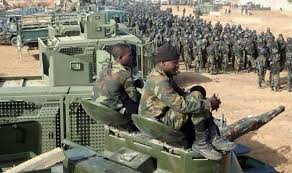

The Nigerian Army, through the Joint Task Force Operation Hadin Kai, has recorded decisive victories in the North-East by intensifying offensives against the leadership and strategic strongholds of ISWAP and Boko Haram. The Theatre Commander, Maj.-Gen. Abdulsalam Abubakar, disclosed the progress during an interview with the News Agency of Nigeria (NAN) in Maiduguri on Friday, March 27, 2026, noting that troops are steadily “tightening the noose” on insurgent enclaves.
The structural and tactical consequence of these recent operations has been the dismantling of insurgent command hierarchies. High-value targets eliminated include Modu Kundiri, a top ISWAP commander and Qa’id of the Pulka axis, and Malam Bako Gorgore (Abou Mustapha), a senior member of ISWAP’s Shura Council responsible for recruitment and ideological direction. These neutralizations, occurring along the strategic Madagali–Gwoza route and in the Kukawa Local Government Area, have reportedly triggered leadership uncertainty and disrupted the command-and-control structures linking the Sambisa Forest to the Mandara Mountains.
Analytically, the impact on “Operational Degradation and Internal Fractures” is becoming increasingly evident. Beyond direct combat, internal crises within ISWAP have led to the deaths of figures like Abu Kasim and Abu Nazir, the former reportedly killed by an IED planted by rival elements. Gen. Abubakar highlighted that these are not random strikes but targeted operations aimed at the “operational backbone” of the insurgency, significantly reducing the terrorists’ freedom of movement across critical corridors in Borno State.
The impact on “Air-Ground Synergy and Technological Warfare” was underscored by a major engagement in Malam Fatori, Abadam Local Government Area. Troops repelled a sophisticated assault by ISWAP elements who utilized armed drones and advanced tactics. The military responded with a combination of coordinated ground fire and precision airstrikes, resulting in the deaths of 84 terrorists, including senior commanders. Additionally, rapid-response airstrikes in the Ngoshe–Pulka corridor recently neutralized over 50 insurgents following a failed attack, demonstrating a marked improvement in surveillance and strike coordination.
Furthermore, the Air Component of Operation Hadin Kai continues to play a decisive role in destroying logistics hubs and intercepting fleeing fighters. Successful strikes in the Yuwe axis of Sambisa Forest took out several other high-value commanders, including Saddam, Saleh Garin Kago, Hussaini Ubaida, and Ba Alayi Benbem. Gen. Abubakar maintained that while the security situation remains fluid, the military currently holds the advantage in the Sambisa Forest, the Timbuktu Triangle, and the shores of Lake Chad.
The long-term outlook for the North-East depends on the military’s ability to sustain this high-tempo offensive while managing the evolving technological threats, such as insurgent drone usage. As the 2026 campaign progresses, the Theatre Command remains focused on extending operations deeper into remaining enclaves to permanently break the operational capacity of the insurgent groups.