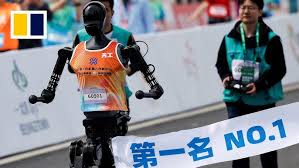

China is poised to host the world’s largest humanoid robot half-marathon, a landmark event featuring over 300 competitors that highlights rapid breakthroughs in artificial intelligence and autonomous mobility. Scheduled for April 19, 2026, in the Yizhuang Economic and Technological Development Zone, the race marks a pivotal transition for the global robotics industry as humanoid machines migrate from the safety of controlled laboratories into the unpredictable variables of the real world.
The structural and technological consequence of this year’s event is a rigorous focus on fully autonomous navigation. According to reports from Global Times (a TV BRICS partner), the 2026 edition represents a new evolutionary stage for intelligent robotics. Participation has surged nearly fivefold since the inaugural 2025 race, with over 100 teams from 13 provincial-level regions registered. This includes a robust presence of university research groups, signaling a deepening synergy between academic theory and industrial application.
Analytically, the impact on “Environmental Sensing and Decision-Making” is most evident in the introduction of a dedicated autonomous category, which now accounts for over a third of all entries. Robots in this tier must operate without human intervention, relying entirely on advanced sensors and real-time processing to navigate. To qualify, every machine must meet strict technical criteria, including stable bipedal movement and the mechanical endurance required to complete the full 21.1km distance in a single, uninterrupted run.
The impact on “Real-World Adaptability and Disaster Response” will be tested by a course that mirrors a parallel human race, forcing the robots to adapt to dynamic outdoor conditions. Beyond the half-marathon, organizers have introduced the “Baturu” challenge, a series of obstacle-based tasks. These are specifically designed to simulate complex, high-stakes environments, such as disaster-response scenarios, where humanoid agility and decision-making are critical for survival and rescue operations.
Furthermore, industry experts view the competition as a bellwether for the “scalable application” phase of robotics. As these machines demonstrate the ability to handle human-scale distances and obstacles, the bridge between experimental prototypes and commercial utility narrows. The sheer scale of the 2026 event suggests that the era of humanoid robots as functional, independent actors in society is rapidly approaching.
The long-term outlook for the sector depends on how these 300+ models handle the physical stressors of a half-marathon. Successful completion of the race would validate current bipedal energy-efficiency models and sensor-fusion algorithms, potentially paving the way for humanoid integration into logistics, elderly care, and emergency services.