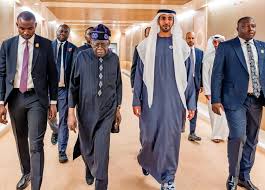

Nigeria is set to deepen economic ties with the United Arab Emirates as the Federal Government prepares to sign several bilateral agreements during the ongoing Abu Dhabi Sustainability Summit, officials have said.
The Minister of Foreign Affairs, Yusuf Tuggar, disclosed this on Monday ahead of President Bola Tinubu’s address at the summit and a series of high-level meetings with global leaders, including the President of the UAE, Mohammed bin Zayed Al Nahyan.
According to Tuggar, the Abu Dhabi meeting builds on commitments reached at the last Conference of Parties (COP) held in Brazil and is aimed at translating earlier discussions into concrete investments and financing arrangements.
He said Nigeria intends to use the platform to attract funding for clearly defined projects, particularly in the gas-to-power sector, where the country is seeking private capital to boost electricity generation and reduce outages.
Nigeria and the UAE maintain strong commercial relations, with bilateral trade, including non-oil exports, exceeding $4.3 billion in 2024. Nigeria exports crude oil, gold and agricultural products to the UAE, while imports from the Gulf state include refined petroleum products, vehicles and technology. The UAE is also among Nigeria’s leading foreign investors, with interests spanning infrastructure and energy.
A key outcome expected from the summit is the signing of a Comprehensive Economic Partnership Agreement (CEPA), which Tuggar said would provide investment protection for businesses from both countries and unlock pending investment decisions.
He noted that many Nigerian entrepreneurs operating in the UAE are awaiting the agreement, which would strengthen investor confidence and safeguard cross-border commercial activities.
Beyond gas and energy, the proposed agreements are expected to cover agriculture, manufacturing and broader trade facilitation. Tuggar also pointed to recent improvements in financial flows and airline operations between both countries as signs of growing economic stability.
He added that Nigeria’s ongoing pipeline projects and gas licensing rounds are designed to attract further exploration and production investments, positioning gas as a cornerstone of the country’s power and industrial strategy.