
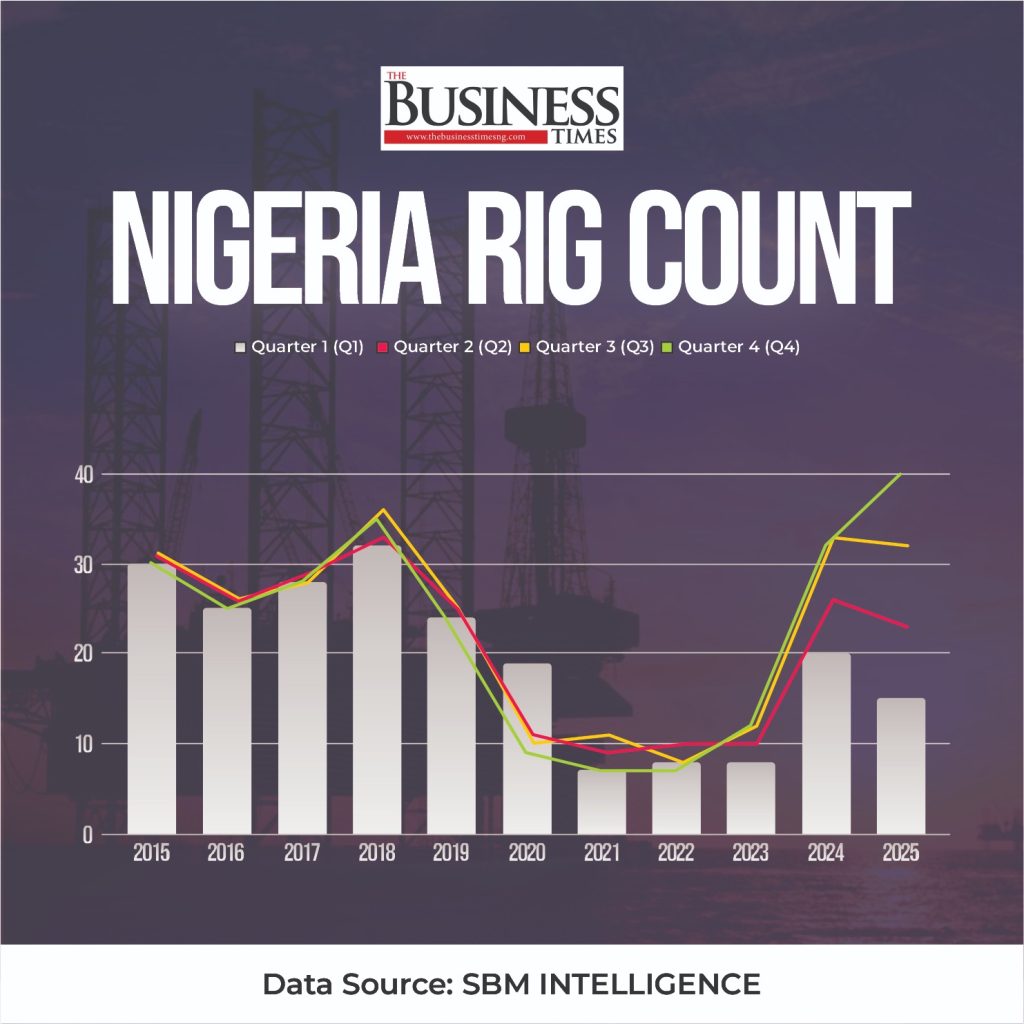
In the language of oil and gas, few metrics speak as plainly as the rig count. It is a direct barometer of investment, activity, and confidence. For Nigeria, the story told by its quarterly rig count from 2015 to 2025 is a rollercoaster of stability, collapse, and a fiercely ambitious recovery, painting a picture of an industry at a critical juncture.
For years, the count held steady, hovering around a respectable 30 active rigs. But in 2020, the floor fell out. The one-two punch of the COVID-19 pandemic and an oil price war sent the industry reeling. The data captures this freefall in stark terms: from 19 rigs in Q1 2020 to a catastrophic low of just 9 by year’s end. The slump deepened through 2021 and 2022, with counts stuck in the single digits—a level indicative of an industry on life support. Production followed suit, at one point falling below a million barrels per day, a nadir for Africa’s largest oil producer.
Today, however, the mood is shifting. The rig count has begun its slow climb back, projected to surge to 32 by the end of 2024 and a remarkable 40 by Q4 2025. This resurgence is not accidental. It is the result of a concerted effort to tackle the sector’s most pernicious problems.
“The collaborative efforts between the Nigerian National Petroleum Company Limited, security agencies, and private operators have significantly curtailed crude oil theft and vandalism,” stated Mele Kyari, Group Chief Executive Officer of NNPC Ltd., at the 2024 Nigeria International Energy Summit in Abuja. “This has been a fundamental prerequisite for restoring investor confidence and allowing production to flow.”
This recovery is remarkable, given the lows of just a few years ago. A combination of gains from dealing with oil theft, better management of host communities, and new investments driven by the Petroleum Industry Act (PIA) implementation has been the engine of this rebound. The success of initiatives like “Project One Million Barrels” is evident as Nigeria now consistently hits its OPEC production ceiling.
But hitting this ceiling immediately presents a new strategic dilemma. With production capacity rebounding, Nigeria finds itself in an OPEC straitjacket. The nation now faces a pivotal decision: can it negotiate a higher quota within the cartel, or is it time to strike out alone?
“We are in active and constructive dialogue with our OPEC counterparts regarding our production baseline,” revealed Senator Heineken Lokpobiri, Minister of State for Petroleum Resources, during a panel at the Africa Oil Week in Cape Town. “Nigeria’s capacity is growing, and our quota must reflect this new reality. All options, as a sovereign nation, remain on the table to ensure we maximize the benefit of our resources for our people.”
This diplomatic challenge is matched by a pressing financial one. The sustainability of this recovery is shadowed by the question of encumbered production. Reports indicate that a significant portion—potentially up to 55% of government oil revenue—is already pledged to service massive loans. This threatens to starve the very investments needed for future growth.
Beyond recovering lost ground, the sector must now look forward. The rig count’s rise must be matched by a clear medium-term investment plan to expand production capacity, incentivise marginal field development, and fast-track frontier basin exploration.
“The rig count is a leading indicator, but it is not the end goal,” cautioned Roger Brown, CEO of Seplat Energy, at a recent industry webinar. “The real test is what we do with this activity. We must channel it into projects that address the structural bottlenecks—the aging infrastructure, the need for gas monetization, and the imperative to bring new fields online. The Frontier Exploration Fund is crucial here.”
Indeed, the rising rig count presents a golden opportunity to pivot towards gas. As the global energy transition accelerates, Nigeria’s vast gas reserves are its strategic advantage.
“Our focus is to deepen domestic gas utilization and position Nigeria as a leading global LNG hub,” said Philip Mshelbila, Managing Director of Nigeria LNG, at the Gastech conference in Singapore. “The rig activity supports our feedstock ambitions, but we need parallel investments in pipelines, processing facilities, and a clear, stable fiscal framework to make this a reality.”
The consensus is clear: the current rebound cannot be the finish line. It is a hard-won turning point. The government must view it as a chance to rebuild the petroleum sector into a transparent, diversified, and future-facing industry.
The climb from 9 rigs to a projected 40 is a story of resilience. But the next chapter will be defined by difficult choices on OPEC, strategic de-risking of investments, and a relentless focus on converting drilling activity into sustainable, unencumbered revenue. The rigs are turning again in the Niger Delta; now, the real work of securing Nigeria’s energy future begins.