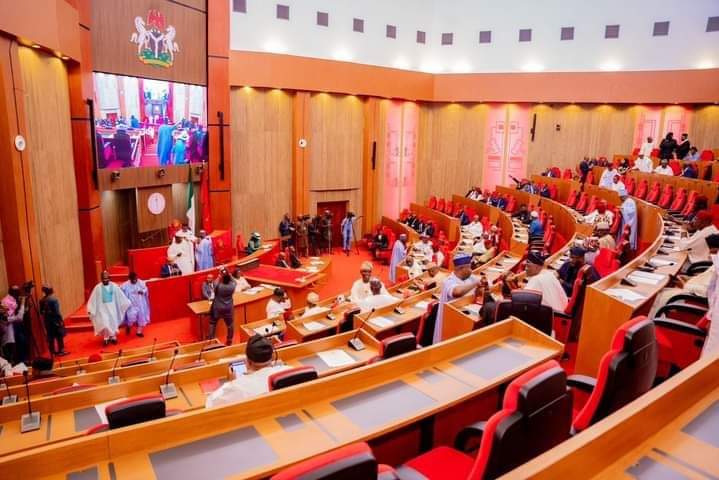

The Nigerian Senate on Tuesday opened a public hearing on proposed amendments to the Banks and Other Finacial Institutions Act (BOFIA) and launched an investigative session into the rising wave of Ponzi schemes across the country.
Senate President Godswill Akpabio, represented by Senate Leader Opeyemi Bamidele, declared the hearing open at the National Assembly. The session examined a bill seeking to amend BOFIA 2020 (SB959) and a motion probing fraudulent investment platforms, with specific reference to the recent Crypto Bridge Exchange (CBEX) collapse.
Akpabio said the initiative underscores the Senate’s commitment to safeguarding financial stability while encouraging responsible innovation within Nigeria’s fast-evolving digital economy. He noted that the country’s financial system has been reshaped by fintech growth, digital platforms and cryptocurrency-related activities, creating new regulatory challenges.
According to him, the proposed amendment will expand the supervisory authority of the Central Bank of Nigeria (CBN), including clearer provisions for identifying and regulating systemically important institutions, particularly technology-driven financial service providers. “Enhanced supervision is not a constraint on growth; it is a safeguard for sustainable growth,” Akpabio said. He dismissed calls for a separate fintech regulatory commission, arguing that fintech oversight is closely linked to the CBN’s existing mandate. Creating an additional regulator, he said, could result in fragmented supervision and overlapping responsibilities.
Akpabio clarified that cryptocurrency investment and exchange licensing fall under the Securities and Exchange Commission (SEC), while transaction monitoring and financial stability remain within the CBN’s purview. Warning about the proliferation of fraudulent schemes, he described the CBEX collapse as evidence of Nigerians’ vulnerability to unrealistic investment promises.
“Ponzi schemes exploit economic hardship and limited financial literacy,” he said. “They undermine trust in legitimate institutions and inflict severe financial and emotional harm.”
“The financial system operates fundamentally on trust,” Akpabio added. “Strengthening oversight of systemically important institutions and addressing fraudulent schemes are essential to preserving stability and restoring confidence in Nigeria’s financial system.”
Mukhail Abiru, chairman of the Senate Committee on Banking, said the amendment would empower the CBN to designate major fintech and digital financial institutions as systemically important and create a national registry to enhance transparency and risk-based supervision.
Philip Ikeazor, CBN deputy governor for financial system stability, backed the proposal, noting that some fintech firms now process transaction volumes comparable to mid-sized banks. Orekia Opemi-Yusuf, director of payment systems supervision at the CBN, cautioned against duplicating regulatory structures, saying it would conflict with global best practices. Representatives of the Economic and Financial Crimes Commission (EFCC) disclosed that N1.3 trillion involving 1,200 victims was linked to the CBEX fraud, adding that substantial assets have been seized and forfeiture proceedings are underway.