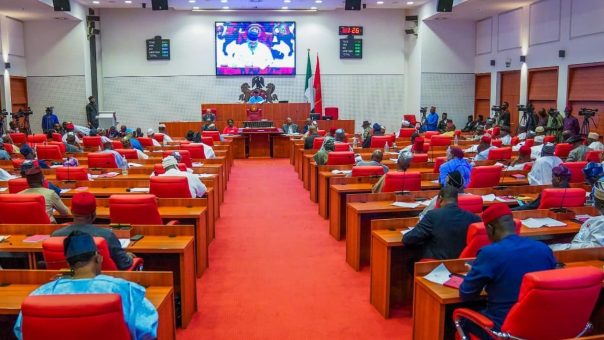

Nigeria’s Senate yesterday initiated a crucial move to restructure and strengthen the nation’s financial infrastructure, focusing on boosting non-oil exports and restoring trust in the insurance industry. The reforms, debated at a public hearing organised by the Senate Committee on Banking, Insurance and Other Financial Institutions, centre on two critical proposed laws, the Nigerian Export-Import Bank (Amendment) Bill, 2025, and the National Insurance Commission (Repeal) and Insurance Regulatory Commission Bill, 2025.
Committee Chairman, Senator Mukhail Abiru, framed the proposed legislation as a means to modernise outdated laws and align Nigeria’s financial system with international standards. “These bills represent a crucial step in shaping the future of Nigeria’s financial system,” he said, emphasising that lawmaking must align with the national goals of economic transformation and stability.
In a message delivered on behalf of the Senate President, Godswill Akpabio, the upper chamber described the measures as a “covenant with Nigeria’s economic future.” Akpabio stressed the necessity of the reforms, declaring, “The NEXIM Bank is not just a bank; it is a bridge between our factories and the world. It must be empowered to lead, not just to lend,” while adding that the insurance sector “must evolve into a bulwark of trust and fairness in our economy.”
The most significant proposal under the NEXIM Amendment Bill is the plan to raise the bank’s capital base from the current ₦50 billion to an ambitious ₦1 trillion. Abba Bello, the Managing Director of NEXIM Bank, strongly supported the amendment, stating that the bank’s current capital, which he noted is only about $33 million, is “grossly inadequate” to effectively support Nigeria’s massive export ambitions, particularly under the African Continental Free Trade Area (AfCFTA). He endorsed raising the capital to at least ₦500 billion, and “ideally ₦1 trillion,” to enable the bank to deliver on its full mandate.
Stakeholders, including the Capital Market Academics of Nigeria, concurred, arguing that a ₦1 trillion minimum threshold is necessary for NEXIM to become competitive with its better-capitalised peers in countries like India, China, and South Africa. They noted that the bank’s undercapitalisation has historically limited its impact and excluded it from global credit ratings.
The bill also proposes the establishment of an Export Development Trust Fund. Olusegun Ayo Omosehin, the Commissioner for Insurance, described the fund as “a masterstroke,” noting that it would unlock long-awaited financing for exporters to acquire raw materials, logistics, and essential capital goods. Representatives from the construction and manufacturing sectors also threw their weight behind the fund, urging lawmakers to ensure materials like building components are included as eligible export items. Additional proposed reforms include separating the Central Bank of Nigeria’s (CBN) oversight from NEXIM’s board leadership and promoting governance continuity.
On the insurance front, the proposed bill seeks to repeal the outdated 1997 law and create a modern Insurance Regulatory Commission. Commissioner Omosehin explained that the new law would reflect modern realities by empowering the regulator to supervise digital platforms, merge failing institutions, and enforce compliance directives more effectively.
A landmark reform embedded in the bill is the creation of an Insurance Dispute Resolution Tribunal. Stakeholders unanimously described this as a key provision that would significantly boost investor and consumer confidence. “The tribunal will provide quick, affordable, and professional redress to policyholders,” Omosehin stated. “It will restore trust in the system and encourage more Nigerians to embrace insurance.” The proposed bill also features stricter compliance timelines and new regulatory powers for actuarial practice, reforms described by industry players as long overdue.
These two legislative exercises are strategically aligned with Nigeria’s most pressing economic goals: diversification and restoring financial confidence.The proposed ₦1 trillion NEXIM capital base and the creation of the Export Development Trust Fund are direct instruments for tackling the nation’s reliance on oil. By significantly increasing NEXIM’s capacity, the government aims to channel vast sums of low-cost, long-term credit toward non-oil exports, generating much-needed foreign exchange (FX) earnings and stabilising the Naira. This move transforms the bank from a minor lender into a powerful financial catalyst capable of driving industrial expansion and integrating Nigerian manufacturers into global supply chains, fulfilling a core promise of the government’s economic agenda.
Simultaneously, the creation of a specialised Insurance Dispute Resolution Tribunal addresses a fundamental weakness in the financial system: lack of trust. Nigeria’s insurance sector currently has very low penetration, partly because citizens and businesses often lack confidence in the speed and fairness of claims resolution. By providing a quick, professional, and reliable legal avenue for redress, the tribunal is expected to boost consumer confidence, leading to a higher uptake of insurance policies. A stronger, more trustworthy insurance sector acts as a bulwark of stability for the wider economy, facilitating deeper risk transfer and encouraging greater investment in high-risk, high-reward sectors like agriculture and manufacturing. If passed, these two bills could mark one of the most comprehensive overhauls of Nigeria’s financial regulatory framework in decades, fundamentally strengthening the twin pillars of export finance and risk management.