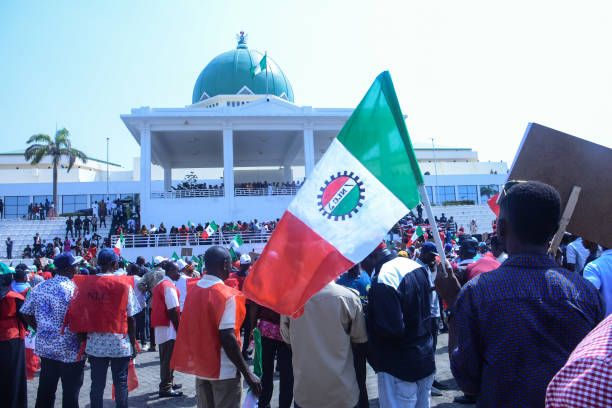

The Nigeria Labour Congress (NLC) has denied negotiating the ₦40,000 consequential adjustment granted to federal government workers following the implementation of the ₦70,000 national minimum wage in 2024. The labour organisation described claims linking its leadership to the negotiation of the additional payment as false, insisting that the responsibility rested with public sector trade unions and their negotiating councils.
In a statement dated November 8, 2026, and signed by its Acting General Secretary, Comrade Benson Upah, the NLC said its involvement in the minimum wage process was limited to negotiating the national minimum wage through a tripartite arrangement involving organised labour, the government and employers’ representatives.
It explained that the national minimum wage establishes the lowest amount employers are legally required to pay workers, while consequential adjustments involve reviewing existing salary structures to reflect the new wage benchmark. According to the Congress, these adjustments are negotiated separately by unions within their respective sectors and are not handled directly by the NLC.
“Therefore, the claim that the NLC was responsible for negotiating the N40,000 across-the-board addition as consequential adjustment for federal workers is not only false but is a deliberate distortion of the collective bargaining framework in Nigeria,” the statement said.
The Congress identified the Joint Public Service Negotiating Council (JPSNC) as the body responsible for negotiating consequential adjustments for federal government employees. The council comprises government representatives and approximately eight trade unions, whose leadership engages the Federal Government on the implementation of minimum wage agreements and adjustments to existing salary structures.
The NLC added that similar arrangements exist at the state level, where corresponding negotiating councils engage state governments on salary adjustments. For private sector employees, industrial unions negotiate with employers’ associations based on the conditions and wage structures of their respective industries.
The Congress cited the Association of Food, Beverage and Tobacco Employers (AFBTE) and the National Union of Food, Beverages and Tobacco Employees (NUFBTE) as an example of organisations that handle negotiations within their sector. It further maintained that although it represents workers across public and private sectors, it does not directly negotiate consequential adjustments on their behalf.
“The N40,000 outcome was the sole responsibility of the leadership of the unions in the public sector,” the statement added.
The labour body also said it had never negotiated consequential adjustments directly with the Federal Government or private sector employers since the introduction of the national minimum wage system. The clarification comes as preparations begin for another round of national minimum wage negotiations. The NLC warned that attempts to misrepresent its role in previous negotiations could create confusion and division within the labour movement.
It accused unnamed individuals of spreading misinformation to shift responsibility for the salary adjustment and undermine workers’ unity ahead of the forthcoming negotiations. The Congress urged Nigerian workers to disregard what it described as propaganda and remain focused on protecting their interests.
It also reaffirmed its commitment to working towards a new national minimum wage that reflects workers’ economic realities and brings earnings closer to a living wage.