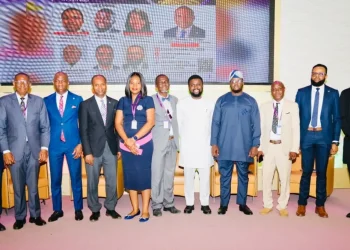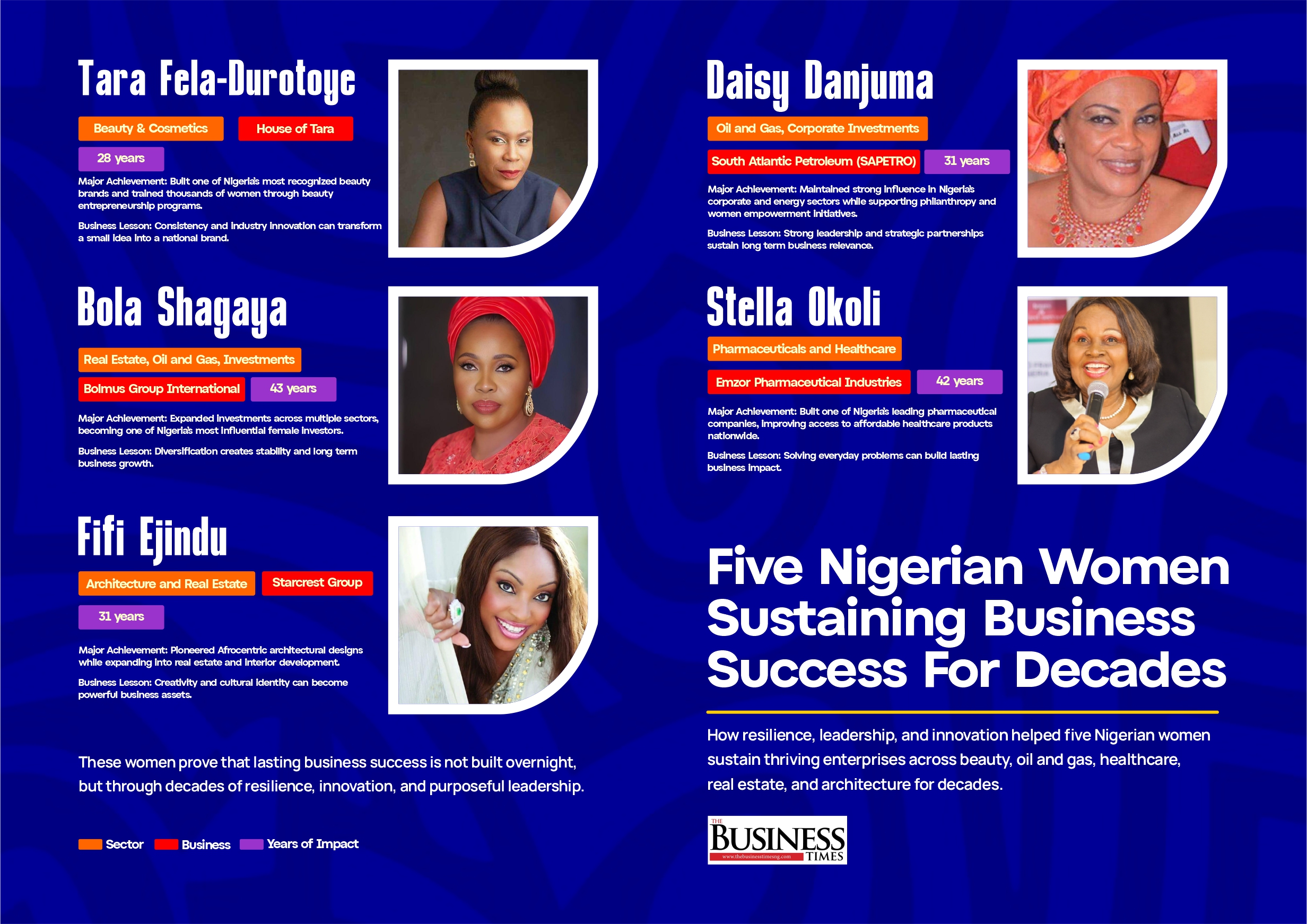

Hajia Bola Shagaya, Fifi Ejindu, Tara Fela Durotoye, Daisy Danjuma, Stella Okoli
For decades, Nigeria’s economic story has been shaped not only by oil, banking, and politics, but also by entrepreneurs who understood how to survive uncertainty, adapt to shifting markets, and build institutions capable of enduring economic turbulence. Among the most remarkable figures in that journey are women who entered industries historically dominated by men and quietly built lasting influence across sectors.
From oil and gas to architecture, cosmetics, pharmaceuticals, and corporate governance, these women transformed personal ambition into multi sector enterprises that continue to shape Nigeria’s private sector today.
Hajia Bola Shagaya
In the early 1980s, Bola Shagaya resigned from a secure position at the Central Bank of Nigeria to pursue private enterprise at a time when female participation in large scale business remained limited.
She founded Bolmus International and secured distribution rights for Japanese imaging giant Konica across West Africa, becoming a dominant figure in the region’s photography supply chain. Her expansion into photo processing through Fotofair Nigeria Limited created a nationwide network of laboratories that became central to Nigeria’s photography ecosystem before the digital era. Shagaya later diversified into oil and gas, banking, manufacturing, and real estate through companies such as Practoil Limited and Voyage Oil and Gas.
Her strategy reflected a clear understanding of Nigeria’s economic instability. Rather than relying on a single sector, she built a diversified empire capable of surviving currency crises, policy shifts, and fluctuations in oil prices. More than four decades later, her relevance in business circles reflects not just wealth, but endurance and strategic positioning.
Fifi Ejindu
Fifi Ejindu transformed architectural expertise into a diversified business structure spanning construction, investment, diplomacy, and oil and gas. In 1983, she became the first Black African woman to earn a Bachelor of Architecture degree from Pratt Institute in New York. Instead of limiting herself to consultancy, she saw architecture as an entry point into broader economic opportunities. She founded the Starcrest Group in 1995, initially focusing on real estate and construction before expanding into project management and energy related ventures.
Ejindu became widely recognized for her “neo traditional” architectural style, blending African cultural aesthetics with contemporary construction. That distinction helped position Starcrest within Nigeria’s luxury real estate market, where credibility and trust remain critical.
Beyond business, she expanded into international investment relations and economic diplomacy, particularly through initiatives linked to trade and investment partnerships between Nigeria and Angola. Her career reflects a long term approach to business built on diversification, specialization, and strategic networking.
Tara Fela-Durotoye
In 1998, Tara Fela Durotoye started a small makeup studio from her living room while studying law. At the time, professional makeup artistry was barely recognized in Nigeria, and the beauty industry lacked formal structure. Rather than remain a service provider, she built an ecosystem around beauty education, product distribution, and entrepreneurship. That vision transformed House of Tara International into one of Africa’s most influential beauty brands.
A major turning point came through the Stanford SEED Transformation Program, which helped her shift from founder led operations to institution building. Under her leadership, House of Tara expanded into stores, makeup academies, and a vast network of trained beauty representatives across Africa. She also played a pioneering role in formalizing bridal makeup artistry and professional beauty training in Nigeria.
Unlike businesses built solely around personality, Tara focused on systems, leadership pipelines, and sustainability. Her philosophy became central to her book, “Building Beyond You”, where she advocates for creating businesses capable of surviving beyond their founders. Today, her impact extends beyond cosmetics into entrepreneurship development and women empowerment across Africa.
Daisy Danjuma
Daisy Danjuma’s career reflects a quieter but equally strategic form of influence built through governance, institutional leadership, and corporate participation. From law to politics and eventually to oil and pharmaceuticals, Danjuma established herself within sectors where leadership depends heavily on credibility, networks, and long term strategic positioning.
Unlike entrepreneurs driven by visibility, much of her influence has emerged through boardrooms, investment structures, and policy circles. Her involvement in Nigeria’s oil sector, alongside corporate governance and philanthropic initiatives, highlights the close relationship between business leadership and institutional influence in Nigeria’s economy.
Over the years, she has remained active in conversations around investment, governance, and economic development, demonstrating that corporate power is often sustained through consistency and strategic alliances rather than publicity alone.
Stella Okoli
From a modest pharmacy in Somolu to one of Africa’s most influential pharmaceutical companies, Stella Okoli built a business empire defined by resilience, industrialization, and long term vision. Her journey began in 1977 with the establishment of Emzor Chemists Ltd in Lagos. At a time when Nigeria depended heavily on imported drugs, Okoli recognized the need for local manufacturing and stronger pharmaceutical infrastructure.
After expanding into wholesale distribution through Emzor Drugstore Ltd in 1981, she gained critical insight into the pharmaceutical supply chain and the growing challenge of counterfeit medicines. In 1984, she founded Emzor Pharmaceuticals and reportedly used her father’s house as collateral to secure funding for local production.
That decision transformed Emzor from a retail business into a manufacturing powerhouse. Over the next four decades, Okoli focused heavily on local production, quality control, and vertical integration. One of her most ambitious investments was the establishment of a $23 million Active Pharmaceutical Ingredient plant in Sagamu, designed to reduce dependence on imported raw materials from Asia.
The strategy strengthened Nigeria’s pharmaceutical manufacturing capacity while reducing exposure to foreign exchange instability. Despite inflation, infrastructure deficits, and regulatory challenges, Emzor built its reputation on consistency and trust. Today, the company employs roughly 1,000 people directly, manufactures more than 200 registered products, and exports to markets across West Africa and beyond.
Beyond business, Okoli became a strong advocate for industrial policy reform and indigenous manufacturing through leadership roles within the Manufacturers Association of Nigeria and the Pharmaceutical Manufacturers Group. Her success demonstrated that large scale pharmaceutical manufacturing could thrive in Nigeria despite economic uncertainty and foreign competition.
Collectively, these women represent more than individual success stories. Their careers reflect broader truths about Nigeria’s economy: the importance of adaptability, the value of diversification, and the reality that enduring businesses are often built through long term positioning rather than short term visibility.
In a country where many companies struggle to survive inflation, policy instability, and economic uncertainty, their longevity stands out. They built enterprises capable of evolving with Nigeria itself, ambitious, resilient, resourceful, and constantly changing