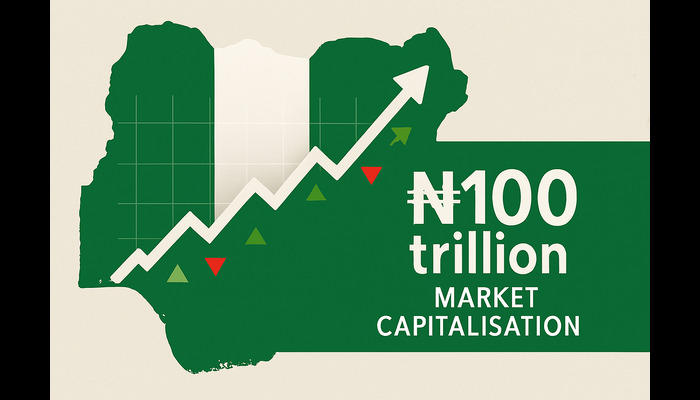

Nigeria’s equities market has achieved a major milestone by exceeding a ₦100 trillion valuation, closing at ₦101.8 trillion on Monday, 5 January 2026, the first time the market has reached this level. The breakthrough came as investors reacted positively to early-year trading and positioned themselves ahead of the full-year corporate earnings season.
The Nigerian Exchange All-Share Index (ASI), a key gauge of market performance, rose by 1.74 per cent on the same day to 159,215.48 points, marking one of the strongest daily gains so far this year. Traders said this reflects renewed optimism among both institutional and retail investors after a period of consolidation in late 2025.
According to market analysts, part of the rally is driven by the so-called “January Effect”, a seasonal pattern where stock prices often rise at the start of the year as investors rebalance portfolios and take fresh positions after the holiday period. Vetiva Research, a Lagos-based firm, noted that rebalancing in banking and dividend-yielding stocks has been particularly influential in driving activity.
Trading volumes on the day were strong, with investors exchanging around 695.6 million shares worth about ₦18.57 billion across 56,632 deals. The market’s year-to-date performance also improved, rising by more than 2 per cent based on continued repositioning by market participants.
Temi Popoola, the Group Managing Director and Chief Executive Officer of the Nigerian Exchange Group (NGX Group), welcomed the milestone. He described the breach of the ₦100 trillion threshold as a defining moment for Nigeria’s capital market that signals renewed investor confidence. Popoola said the market’s performance reflects its growing depth and resilience and its ability to respond positively to improving economic conditions and structural reforms.
Market experts say the advance builds on the strong rally seen in 2025, when the NGX recorded impressive returns as investor confidence strengthened, driven by favourable macroeconomic developments, improved liquidity and attractive dividend prospects.
Much of the recent interest has centred on large- and mid-cap stocks, especially in the banking, consumer goods and insurance sectors, which have historically attracted significant trade volumes and foreign participation. Analysts suggest that activity may remain lively as companies begin to release full-year earnings and investors adjust their strategies based on performance outlooks and dividend expectations.
Despite the upbeat start, some experts caution that markets can be volatile and that price gains may moderate as investors take profits or respond to fresh economic data. Still, the overall sentiment is positive, with many portfolio managers anticipating that strong fundamentals and increased foreign interest could continue to support the equities market in the coming months.
For Nigeria’s financial community, crossing the ₦100 trillion valuation mark is not just symbolic. It highlights the progress of the stock market as a key channel for investment and capital mobilisation, reinforcing its role in supporting broader economic growth.