
Nigeria and the United States have signed a framework agreement to deepen American investment in Nigeria’s mining sector and accelerate the development of the country’s estimated $700 billion mineral wealth.
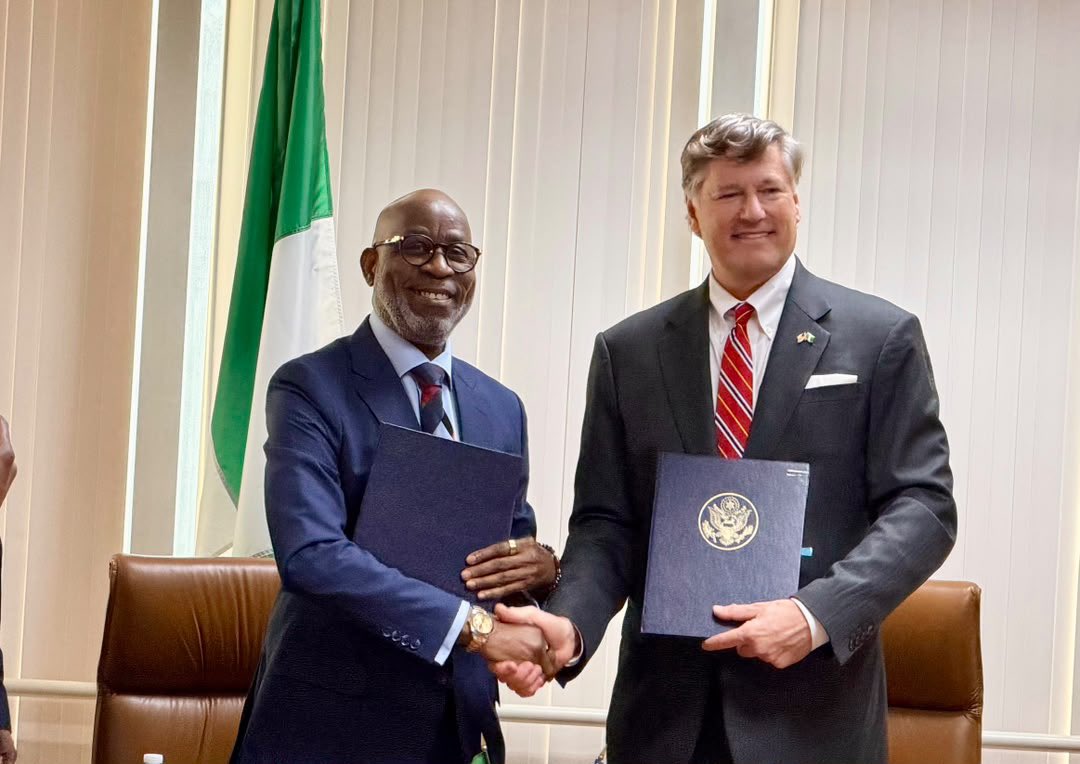
The agreement was signed and exchanged on Wednesday, September 23, 2026, by Nigeria’s Minister of Solid Minerals Development, Dele Alake, and US Deputy Secretary of State Christopher Landau at Nigeria’s Mission House in New York, on the sidelines of the 81st United Nations General Assembly. Channels Television reported the signing on September 24, 2026.
The framework is designed to move cooperation beyond government-to-government engagement by facilitating business-to-business transactions and investment across Nigeria’s mineral value chain.
According to Alake, the agreement covers geological data and exploration, mineral development and processing, infrastructure, and technical capacity. He said Nigeria’s objective is to move away from exporting raw minerals and instead build greater local value through processing, skills development and job creation.
“Some agreements manage the present, and some agreements shape the future. The framework we sign today belongs to the second kind,” Alake said, according to a September 24, 2026 report by Western Post.
He added that Nigeria did not want to remain a source of raw materials for value created elsewhere, saying the country’s ambition was to convert its mineral potential into local processing, quality jobs and opportunities for Nigerian businesses.
The estimated $700 billion value attached to Nigeria’s mineral deposits is not a new valuation arising from the US agreement. Alake first publicly cited the figure in September 2023, when he said Nigeria’s solid mineral resources were worth more than $700 billion based on available geological data. The Ministry of Information reported the statement on September 20, 2023.
More recently, the Solid Minerals Development Fund has continued to describe the country’s mineral wealth as an estimated $700 billion opportunity, while stressing the need for better geological data, credible projects and financing to turn the resources into productive investments.
The latest agreement therefore places greater emphasis on the investment infrastructure needed to convert that resource potential into economic activity, particularly through exploration, processing and supporting infrastructure.
Landau described Nigeria as a strategic partner for the United States and said Washington was interested in building on recent cooperation between both countries.
“The signal we are sending is that the United States and Nigeria are partners,” Landau said, according to Channels Television’s September 24, 2026 report.
The framework also fits into Nigeria’s broader push to develop domestic mineral value chains. On September 22, 2026, Vice President Kashim Shettima told the African Minerals Strategy Group in New York that African countries needed to move away from exporting raw minerals and develop processing and manufacturing industries around their natural resources.
For Nigeria, the key test will now be whether the framework translates into actual exploration projects, processing facilities, infrastructure investment and jobs rather than remaining a diplomatic agreement.