
Nigeria’s export story is changing beneath the attention given to cocoa and other familiar agricultural commodities, with raw materials and less-publicised products increasingly driving foreign-exchange earnings.
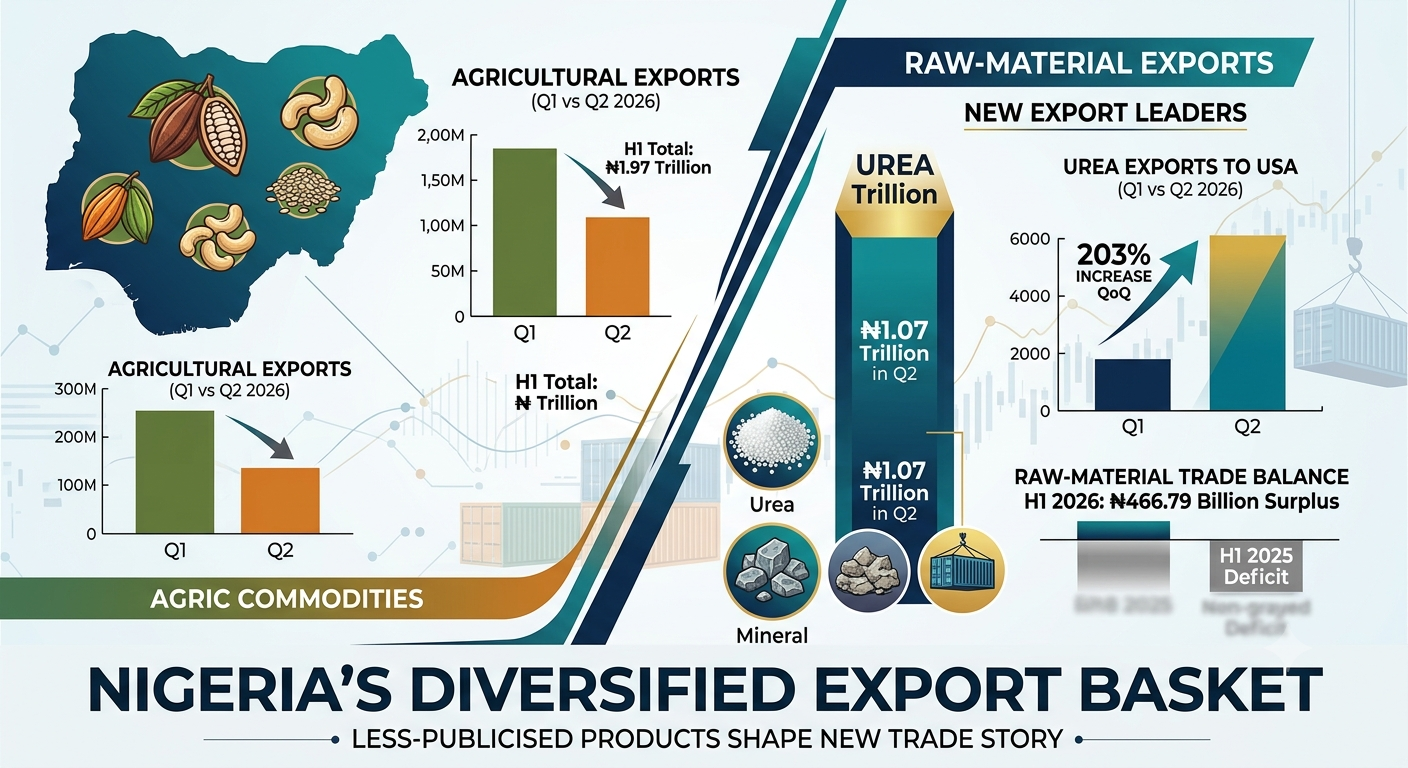
Raw-material exports rose 105.9% year-on-year to ₦3.84 trillion in the first half of 2026, according to an analysis of National Bureau of Statistics (NBS) foreign trade data published by Nairametrics on September 24, 2026. The increase pushed Nigeria’s raw-material trade balance from a ₦1.67 trillion deficit in the first half of 2025 to a ₦466.79 billion surplus in the first half of 2026.
The turnaround was concentrated in the second quarter. Raw-material exports reached ₦2.31 trillion in Q2, up from ₦1.53 trillion in Q1 and 181.2% above the ₦819.72 billion recorded in Q2 2025, according to the NBS data analysed by Nairametrics.
Urea was a major contributor. Nairametrics reported on September 15, 2026, that Nigeria’s urea exports to the United States jumped 203% quarter-on-quarter to ₦1.07 trillion in Q2, from ₦353.04 billion in Q1. The increase made urea the largest Nigerian export to the US during the quarter.
The development contrasts with the performance of agricultural exports. NBS data showed agricultural exports fell to ₦802.99 billion in Q2 from ₦1.17 trillion in Q1. In the first half of 2026, agricultural exports totalled ₦1.97 trillion, according to TheCable’s September 14 analysis of the NBS figures.
The composition of agricultural exports also shifted sharply between the two quarters. Cashew nuts in shell led the agricultural export table in Q2 at ₦268.61 billion, followed by standard-quality cocoa beans at ₦154.31 billion and sesame seeds at ₦96.03 billion.
That compares with Q1, when cocoa beans were valued at ₦596.89 billion, sesame at ₦153.77 billion, soybeans excluding seeds at ₦129.27 billion and cashew nuts at ₦119.76 billion, according to the same NBS-based analysis.
The quarterly swings show why Nigeria’s export story cannot be reduced to cocoa alone. Cocoa remains an important source of export earnings, but its reported value can vary significantly between quarters depending on the product category and shipment patterns. Sesame also remained a substantial earner in Q2 despite falling from its Q1 value.
Meanwhile, the broader trade numbers point to a growing role for raw materials. Nigeria’s total exports reached ₦27.02 trillion in Q2 2026, according to the NBS data cited by TheCable on September 14.
The first-half figures therefore point to a more varied export economy. Agricultural commodities such as cocoa, cashew and sesame remain important, but the surge in raw-material exports, particularly urea, shows that some of Nigeria’s biggest movements in foreign trade are happening outside the commodities that traditionally dominate public attention.
For Nigeria’s diversification drive, the significant development is not that cocoa has become irrelevant. It is that the export basket is becoming harder to describe through one or two headline commodities, with industrial-scale raw-material exports now playing a much larger role.