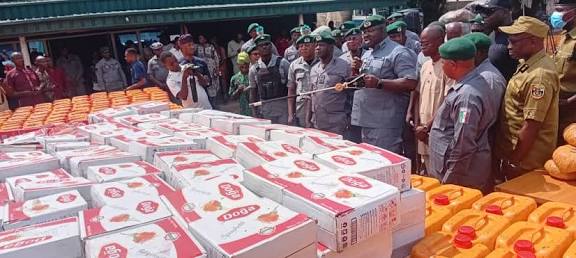

The Nigeria Customs Service has seized contraband goods valued at N6.77 billion in a sweeping anti-smuggling operation across border communities in Ogun State, underscoring the federal government’s renewed efforts to curb illicit trade and protect domestic industries.
Customs officials said the seizures were made during coordinated enforcement raids targeting key smuggling corridors along Nigeria’s western border with Benin Republic, an area long regarded as a hotspot for illegal imports and revenue leakages.
The intercepted items reportedly included foreign parboiled rice, used vehicles, petroleum products, narcotics, textile materials, and other prohibited imports smuggled into the country through unauthorized routes. Authorities also impounded several vehicles allegedly used to transport the goods across the border.
Officials described the operation as one of the largest recent crackdowns in the region, reflecting heightened surveillance and intelligence-driven enforcement strategies adopted by the service in recent months.
The Comptroller-General of Customs said the seizures demonstrate the agency’s commitment to tightening border controls amid mounting concerns over economic sabotage, insecurity, and the impact of smuggling on local manufacturing and government revenues.
Nigeria has intensified customs enforcement as authorities seek to reduce dependence on imports, improve non-oil revenue generation, and stabilize domestic production. Smuggling has remained a major challenge for policymakers, particularly in border states where porous routes enable illegal trade flows.
Analysts say the continued influx of prohibited goods undermines local producers by flooding the market with cheaper alternatives, while also depriving the government of billions of naira in customs duties and taxes annually.
The latest operation comes as the federal government pushes broader reforms aimed at strengthening trade compliance and improving border management systems. Security agencies have increasingly relied on intelligence gathering, technology deployment, and inter-agency collaboration to tackle sophisticated smuggling networks operating across the region.
Industry stakeholders note that sustained enforcement could help support local agriculture and manufacturing sectors, especially rice millers and textile producers that have long complained about unfair competition from illicit imports.
However, trade experts caution that enforcement alone may not fully address the problem unless accompanied by broader economic reforms, improved infrastructure, and streamlined trade policies that reduce incentives for illegal cross-border commerce.
The Customs Service said investigations into the seized goods and suspected smugglers are ongoing, adding that offenders would face prosecution in accordance with Nigeria’s customs and anti-smuggling laws.
The agency also reiterated its warning to importers, clearing agents, and border communities against engaging in illegal trade activities, emphasizing that surveillance operations would continue across major smuggling routes nationwide.