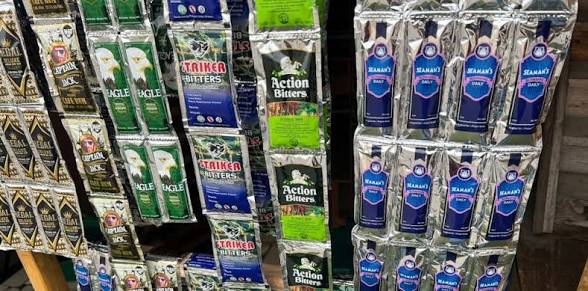

NAFDAC’s Sachet Alcohol Ban Meets Stubborn Resistance on the GroundNigeria’s drug and food regulator is finding that banning a product on paper is easier than removing it from the market. Months after the Federal Government’s prohibition on alcoholic drinks packaged in sachets, PET bottles and glass containers under 200 millilitres took full effect, the National Agency for Food and Drug Administration and Control (NAFDAC) says illicit production is continuing, sometimes in plain defiance of the law.
Director-General Prof. Mojisola Adeyeye disclosed that enforcement teams raiding facilities in Lagos and Ogun states recovered banned 100ml PET bottles and rolls of sachet packaging film bearing production dates as recent as July 23, 2026, evidence, she said, that some manufacturers kept operating well after the ban was meant to be fully enforced. She described the pattern as “deliberate, calculated defiance” rather than confusion over the rules.
The agency’s account points to fairly sophisticated evasion tactics. Some operators reportedly relocated production lines to unregistered, off-site facilities and stripped signboards from factories to make them harder to identify, according to NAFDAC. In Ogun State, the agency has sealed at least two facilities, Nigerian Distillers Limited and Intercontinental Distillers Limited, both along Idiroko Road, over alleged violations, and enforcement officers say they have faced physical attacks while carrying out raids, incidents NAFDAC has vowed to refer for prosecution.
The ban itself traces back to Senate resolutions directing NAFDAC not to extend a moratorium that had let manufacturers keep selling small-format alcohol while the industry adjusted. The policy underpinning it, Nigeria’s National Alcohol Policy, was signed by Coordinating Minister of Health and Social Welfare Prof. Ali Pate on July 2, 2026, following earlier sensitisation campaigns run jointly by NAFDAC, the National Orientation Agency and the Federal Competition and Consumer Protection Commission. Regulators have justified the crackdown on public health grounds, arguing that the low price and easy concealment of sachet and small-bottle alcohol have made it disproportionately accessible to minors, contributing to underage drinking and substance abuse.
A parallel legal question has also surfaced: the Federal Ministry of Health and Social Welfare told the Federal High Court in a February 2026 filing that enforcement authority rests solely with NAFDAC under the NAFDAC Act, distancing itself from any suggestion that the ministry could pause or direct the agency’s raids.
For now, NAFDAC describes the nationwide mop-up as ongoing rather than complete, with markets, motor parks, bars and retail outlets across the six geopolitical zones still being targeted. Whether the sealed factories and seizures translate into a lasting supply squeeze, or whether production simply migrates further underground, remains an open question the agency itself appears unable to answer definitively.