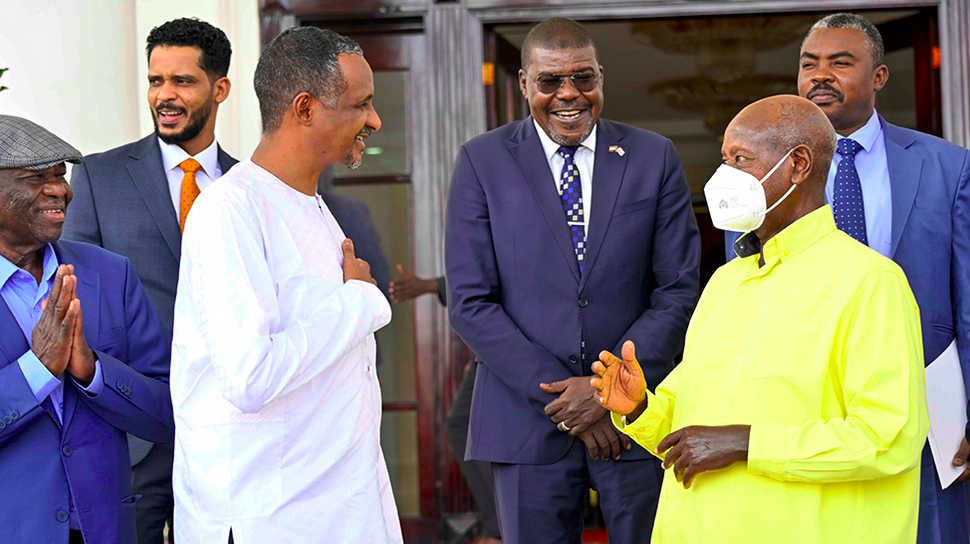

Ugandan President Yoweri Museveni’s high-level talks with Sudanese paramilitary commander Mohamed Hamdan Dagalo underscore the profound economic contagion risks emanating from nearly three years of civil war in Sudan. The meeting at State House in Entebbe on Friday, the RSF leader’s first public international engagement since June 2025, focuses on ending a conflict that has spiralled into one of the world’s worst humanitarian crises. For the broader East African region and beyond, including Nigeria’s commercial interests in trans-Saharan trade and continental stability, the stakes are not merely political but deeply economic.
Museveni, appointed by the African Union to head a committee facilitating direct negotiations between Dagalo and Sudanese army chief Abdel Fattah al-Burhan, reiterated his conviction that sustainable peace requires inclusive dialogue rather than military victory. Dagalo acknowledged Sudan’s deepening humanitarian and institutional crises, emphasising the urgent need for a peaceful solution. Yet the path to resolution remains obstructed, with al-Burhan on Thursday rejecting a proposed humanitarian truce unless the RSF withdraws from captured cities and military sites.
The economic dimensions of this protracted conflict are staggering. Sudan’s productive economy has collapsed, with agricultural output, the traditional backbone of livelihoods, devastated by fighting in key farming regions. Trade routes linking landlocked South Sudan, Chad, and the Central African Republic to Port Sudan on the Red Sea have been severed or rendered perilous, disrupting regional supply chains and inflating costs for goods moving across the Sahel. The humanitarian crisis, with millions displaced and facing acute food insecurity, imposes significant burdens on neighbouring states hosting refugees.
For Nigeria, the conflict’s transmission mechanisms are indirect but consequential. Sudan sits astride critical trans-Saharan trade corridors historically linking West Africa to the Red Sea and the Middle East. While Nigeria’s immediate commercial engagement with Sudan is modest, the broader destabilisation of the Sahel region compounds existing security challenges along Nigeria’s northern borders. Furthermore, as Africa’s largest economy and a key voice in the African Union, Nigeria has a vested interest in the continent’s conflict resolution mechanisms functioning effectively. Prolonged instability in a major member state undermines the collective economic integration agenda embodied in the African Continental Free Trade Area.
The humanitarian toll also carries fiscal implications. International donors responding to the Sudan crisis redirect resources that might otherwise support development programmes across Africa. Regional security architectures are strained, diverting attention and funding from economic transformation agendas. For Nigeria, which aspires to lead continental peace and security initiatives, the inability to resolve a major conflict in its broader neighbourhood reflects on the collective capacity to manage African challenges through African-led solutions.
Museveni’s engagement with Dagalo represents a recognition that military stalemate is economically unsustainable. The conflict has already persisted for nearly three years, with numerous ceasefire attempts failing. Each additional month of fighting destroys productive assets, displaces skilled workers, and erodes the institutional capacity necessary for post-conflict reconstruction. The longer the war continues, the costlier and more complex the eventual recovery becomes.
The African Union’s designation of Museveni as lead negotiator signals continental ownership of the peace process, a principle Nigeria has long championed. Success would validate the AU’s conflict resolution mechanisms and strengthen the case for African-led approaches to economic and political integration. Failure would reinforce scepticism about continental institutions and potentially invite extra-African intervention, with unpredictable consequences for regional stability.
For Nigeria’s economic policymakers, the Sudan crisis serves as a stark reminder of the fragility of regional stability and its intimate connection to national prosperity. The “Renewed Hope” agenda’s emphasis on strengthening Nigeria’s productive base and diversifying trade relationships cannot succeed in isolation from the continent’s broader security environment. A stable, recovering Sudan is in Nigeria’s interest—not primarily as a trading partner today, but as a component of the peaceful, integrated Africa necessary for tomorrow’s economic ambitions.