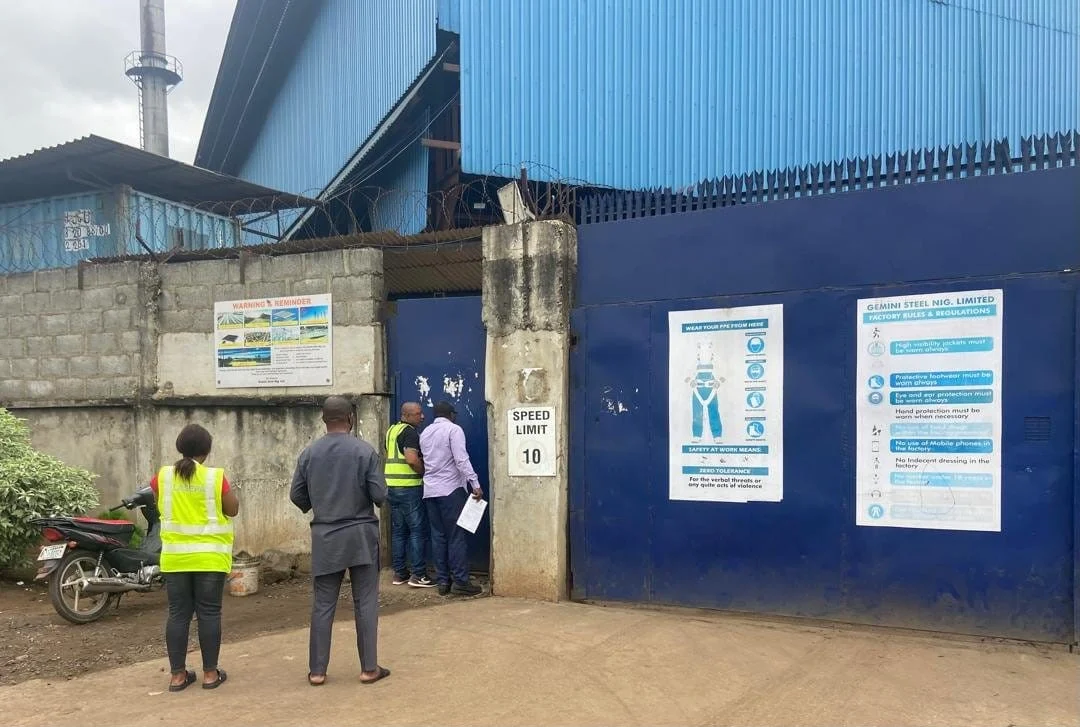

The Lagos State Environmental Protection Agency (LASEPA) has sealed six iron and steel manufacturing companies in the Odogunyan Industrial Layout, Ikorodu, escalating a compliance dispute that has simmered since late last year.
The enforcement action, carried out on Monday, July 27, 2026, followed a directive from the Commissioner for the Environment and Water Resources, Tokunbo Wahab. The affected firms are Germini Steel Nigeria Limited, Top Steel Nigeria Limited, Pulkit Alloy Nigeria Limited, Landcraft Steel Nigeria Limited, Sunflag Steel Nigeria Limited and African Steel Nigeria Limited.
LASEPA said inspections uncovered the release of hazardous particulate matter, including brown dust, black dust, mill scale, shredded dust and other non-metallic airborne particles, which it said pose risks to air quality and public health in surrounding communities.
Monday’s closures are not an isolated action. LASEPA had issued a three-day ultimatum to iron and steel operators in the same Odogunyan corridor in December, following a stakeholders’ meeting convened by the agency’s General Manager, Dr. Babatunde Ajayi, on December 2, 2025. That earlier warning cited the absence of effective pollution-control measures, failure to install effluent treatment plants and neglect in constructing buffer walls around scrap metal yards. The latest shutdown suggests operators may not have fully addressed those concerns within the intervening period, though LASEPA has not detailed which specific violations triggered Monday’s action.
Speaking during the exercise, Ajayi said industrial operators must adopt cleaner production processes and install pollution-control systems capable of reducing harmful emissions, adding that compliance is not optional but essential to public health and sustainable industrial growth.
The agency reiterated that the Lagos State Government intends to continue taking firm action against facilities that violate environmental standards, as part of a broader push to tighten industrial oversight across the state.
For manufacturers operating in Lagos’s industrial corridors, the pattern, an ultimatum followed months later by sealed premises, signals that regulatory tolerance for delayed compliance may be narrowing. Companies that received warnings in December but did not complete remediation face not just reputational exposure but potential production stoppages, underscoring the operational risk of treating environmental directives as negotiable timelines rather than firm deadlines.