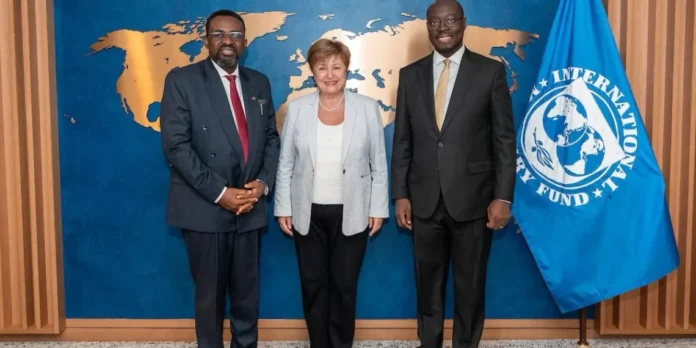

The International Monetary Fund (IMF) announced last Friday that it had reached a staff-level agreement with Ghanaian authorities on the fifth review of the country’s $3 billion Extended Credit Facility (ECF) programme. Once approved by the IMF Executive Board, the agreement will unlock a further $385 million, bringing total disbursements under the programme to more than $2.8 billion since its approval in May 2023.
The IMF said the latest review reflects Ghana’s continued progress in stabilising its macroeconomic environment after a period of severe fiscal and external imbalances that culminated in the 2022 debt crisis. “Macroeconomic stabilisation is taking root. Growth in the first half of 2025 was stronger than anticipated, underpinned by robust services activity and agricultural output,” the Fund said. “The external sector has improved noticeably on the back of strong export performance, particularly in gold and cocoa.”
According to the Fund, the positive momentum is expected to continue into 2026, with growth projected at 4.8 percent, while inflation is forecast to remain within the Bank of Ghana’s target band. This marks a significant turnaround from the double-digit inflation and currency depreciation that plagued Ghana’s economy in 2022, when the cedi lost nearly half its value against the US dollar and inflation soared above 50 percent.
Under the IMF-supported programme, Ghana has undertaken a series of fiscal and structural reforms aimed at restoring debt sustainability, rebuilding foreign reserves, and strengthening public financial management. These include tighter expenditure controls, improved domestic revenue mobilisation, and a shift toward more targeted social spending to protect vulnerable households. The country has also advanced its external debt restructuring negotiations with bilateral and commercial creditors under the G20 Common Framework — a process crucial to securing long-term debt relief and restoring investor confidence.
Ghana’s efforts have been supported by an improved external environment, particularly rising gold prices and steady cocoa exports, which have helped bolster foreign exchange reserves. The government has also benefited from recent improvements in electricity supply and stability in the services sector, which remains a major contributor to GDP.
However, analysts note that significant challenges remain. Despite recent progress, Ghana continues to face tight fiscal space, high domestic interest costs, and limited access to international capital markets. The IMF has repeatedly emphasised the need for sustained fiscal discipline and stronger domestic revenue mobilisation to consolidate the gains achieved so far.
The Fund’s statement comes amid a gradual improvement in investor sentiment towards several African economies that have undergone IMF-supported reforms, including Zambia and Kenya. For Ghana, the continued engagement with the IMF is viewed as a critical anchor for policy credibility and market confidence ahead of the 2026 general elections.
If the IMF Board approves the review in the coming weeks, the new disbursement will provide additional budget support to help the government meet external financing needs, stabilise the cedi, and sustain social and infrastructure spending.
The IMF concluded by reaffirming its commitment to supporting Ghana’s economic recovery efforts, noting that the authorities’ steadfast implementation of reforms is yielding results, and that continued focus on fiscal consolidation, prudent monetary policy, and progress on debt restructuring will be key to maintaining the current momentum.