


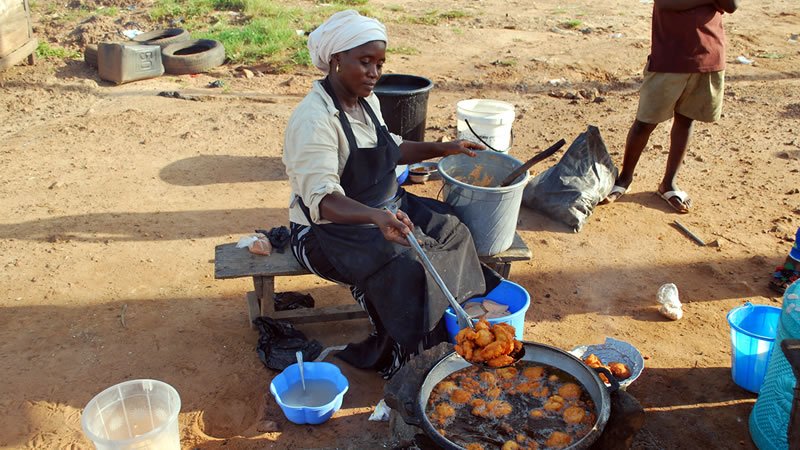

In many Nigerian neighbourhoods, the early morning rhythm once began with the sound of hot oil bubbling in roadside pans. Elderly women sat outside their homes, shaping and frying balls of akara as neighbours stopped by for breakfast. The smell of freshly fried akara drifting through the street was a familiar part of daily life.
Today, that scene is becoming less common.
Across many urban neighbourhoods, the small home-front akara stalls that once dotted residential streets are quietly disappearing. In their place, the business is slowly migrating to busy junctions, markets and commercial areas.
Behind this subtle shift is a powerful economic force. Rising food prices and higher cooking costs are reshaping the akara trade, changing not only where the snack is sold, but also who sells it and how the business is run.
The cost of the core ingredients has surged sharply. Vegetable oil now sells for about ₦65,000 for a 25-litre keg, while a 50kg bag of beans costs roughly ₦50,000. About a decade ago, an akara seller could stock both ingredients for around ₦23,000. Today, the same basic inputs can cost close to ₦120,000.
Cooking fuel has also become a major pressure point. In the past, many akara sellers relied on firewood, which was cheap and easily available, before gradually shifting to cooking gas for convenience and speed. However, gas prices have also climbed significantly. A kilogram of cooking gas that sold for around ₦370 in 2016 now sells for roughly ₦1,400.
For a small-scale home vendor, these increases significantly raise the amount of capital required to start and sustain the business.
As costs rise, the structure of the trade itself is beginning to change.
What was once a small, home-based side hustle run by elderly women is increasingly being replaced by younger, more mobile operators working in high-traffic areas. Walk through a busy junction today, and you are more likely to find groups of young men, usually two to four working together, frying akara in larger batches and selling at scale.
For many of them, the business is less about preserving tradition and more about survival in a difficult job market.
Emmanuel, one of the vendors we spoke to, says rising costs are the biggest challenge.
“Everything is a challenge,” he said. “But mainly the price of gas and beans. When I started this business, one paint bucket of beans was ₦3,000. Now it’s ₦4,500.”
Emmanuel started selling akara about six months ago after deciding his salary job was no longer enough to meet his expenses.
Even with the higher costs, the trade still offers some income. On a good day, he reports earning between ₦4,000 and ₦5,000. However, the changes in the akara market are not only affecting sellers. Consumers are also noticing shifts in the snack’s accessibility.
Kehinde believes it is now harder to find.
“To me, akara is less accessible now,” he said.
Asked why, he pointed to the broader rise in food prices.
“Because of the increase in food prices in this part of Nigeria.”
Others see the situation differently.
Oluchi argues that akara may actually be more available in some places today.
“Not really,” she said when asked whether the snack had become less accessible. “Akara is actually more accessible now because some vendors produce it in larger quantities.”
But she believes demand itself may be evolving.
“People’s lifestyles have changed,” she explained. “Akara is not something people consume as much anymore. And even when they do, they are more conscious about hygiene. It also depends on where you live.”
Taken together, these perspectives reveal a deeper transformation.
Rising input costs are squeezing small neighbourhood vendors, pushing the business away from household stalls and toward more commercialised operations in busy locations. At the same time, changing lifestyles and shifting consumer preferences are subtly reshaping demand.
The result is a quiet but visible change in the akara economy. The snack itself has not disappeared. But the social structure around it, the familiar neighbourhood stall run by a known face, is gradually fading.
In its place is a more capital-intensive, more commercial version of the same tradition.
At a broader level, the changes in the akara trade reflect the pressure food inflation is placing on Nigeria’s vast urban informal economy. Street food vendors, small traders and neighbourhood food stalls operate on extremely thin margins and rely heavily on a handful of basic inputs such as grains, cooking oil and fuel. When the prices of these essentials rise sharply, the impact is immediate. Vendors either reduce portion sizes, raise prices, relocate to busier areas where sales volumes are higher, or exit the business entirely. In cities where millions rely on informal food vendors for affordable daily meals, these adjustments ripple quickly through neighbourhoods.
In that shift lies a broader lesson about inflation in Nigeria: when the cost of basic inputs such as beans, vegetable oil and cooking gas rises sharply, the first casualties are often the small, informal businesses that shape everyday life.




Yes, I agree with you. there was actually a night I walked through my neighborhood to find places had seen before that they fried akara in the evening to eat with a bread had bought 1 day ago, but those people are no longer there and I think location too is a factor, because I noticed it’s very easy to see 2 or more people still frying akara in the evening/night like surulere for example, but it’s really difficult to see someone frying akara in the neighborhood in Alimosho in the day time or evening.