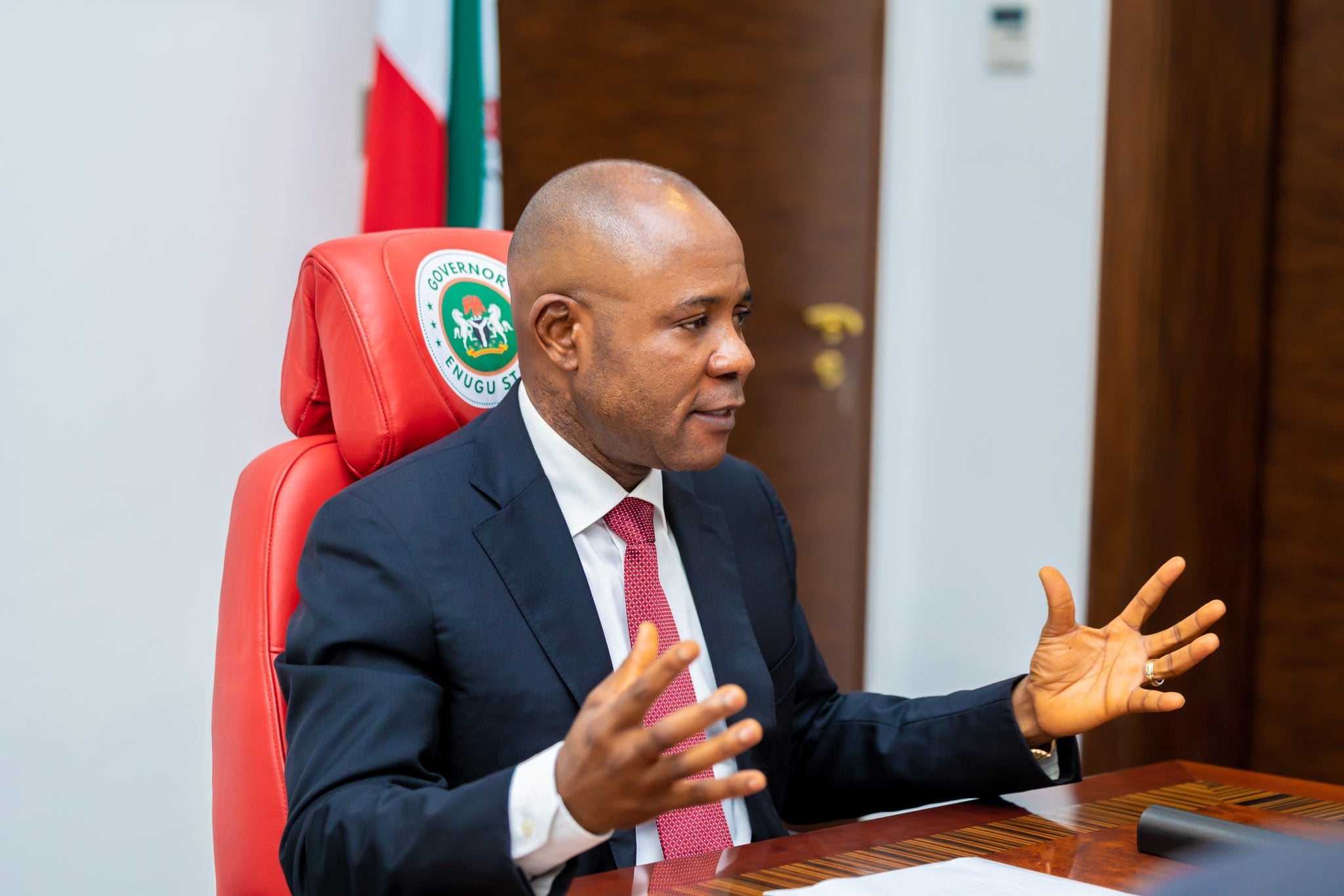

Enugu State Governor, Peter Mbah, on Wednesday urged leaders and stakeholders in the South-East to embrace economic integration by repositioning the region as a unified market, warning that operating as separate states has become unsustainable in today’s global economy.
Mbah made the call at the opening of the South-East Vision 2025 Regional Stakeholder Forum, inaugurated by Vice President Kashim Shettima at the International Conference Centre in Enugu. He stressed that meaningful regional development required coordination rather than isolated state-level efforts, while commending President Bola Tinubu for setting up the South East Development Commission to drive collective growth.
“I invite you to a bold re-imagining of the South-East as a single economic bloc. For too long, we have looked at our five states as individual islands, but the era of the solitary path is over,” the governor said.
As part of this vision, Mbah proposed the establishment of a South-East Common Market, which he described as a seamless platform for integrating trade, skills, and industrial activity across the region.
“Today, I propose the birth of the South-East Common Market, a bold, borderless unification of our commerce, our talent, and our industrial grit,” he stated.
According to him, economic integration would elevate the South-East into a powerful regional economy. “By fusing our five distinct economies into one powerhouse, we are no longer just negotiating for a seat at the table; we are building the table ourselves,” Mbah said.
He emphasised that the proposal went beyond policy formulation and was aimed at unlocking shared prosperity. “This is more than a policy shift; it is the awakening of an economic giant, transforming the South-East into a single, seamless theatre of enterprise where our shared heritage fuels our collective prosperity,” he added.
Speaking at the forum themed Charting a Shared Path to Sustainable Prosperity for South-East Nigeria, Mbah said modern economic success favours regions capable of integrating markets, organising at scale, and building resilient systems.
He described the South-East Vision 2050 as a framework designed to tackle challenges beyond the reach of individual states, but warned that the plan must be matched with immediate implementation.
He called for a jointly funded and managed regional feasibility and project preparation phase, starting with transport and logistics infrastructure. “Second, we must begin with logistics and connectivity, because economies do not integrate on paper; they integrate through movement,” he said.
Mbah stressed the need for planned interstate road, rail, and multi-modal corridors, noting that such infrastructure should be treated as regional assets. “These are not prestige projects. They are productivity infrastructure, and they must be planned and contracted as regional assets, not state trophies,” he said.
The governor also urged stronger regional cooperation on security, investment regulations, and dispute resolution, warning that fragmentation now limits the region’s competitiveness.
“That fragmentation is no longer a historical footnote. It has become a present-day constraint. The world we are operating in now is unforgiving of disconnection and lack of unity,” he said.