


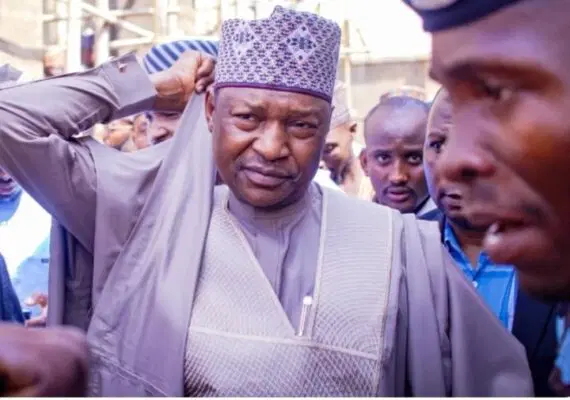

The dramatic legal saga involving Nigeria’s former Attorney-General of the Federation (AGF), Abubakar Malami, took a darker turn on Monday as operatives of the Department of State Services (DSS) arrested him moments after his release from the Kuje Correctional Centre in Abuja. Malami had just secured his freedom after meeting the bail conditions set by the Federal High Court in a high-profile money laundering case. However, his reprieve was short-lived, as security agents whisked him away in connection with grave new allegations of terrorism financing.
Witnesses at the scene reported that the former Minister of Justice was intercepted immediately after stepping out of the prison gates. Malami, who had been detained alongside his wife, Bashir Asabe, and son, Abubakar Abdulaziz Malami, reportedly demanded to see the identification of the officers before being led into a waiting vehicle. This re-arrest complicates an already labyrinthine legal battle initiated by the Economic and Financial Crimes Commission (EFCC), which accuses the trio of laundering approximately N8.7 billion.
The economic implications of these developments are profound for Nigeria, a nation currently grappling with fiscal reforms and a push for greater transparency. The sheer scale of the assets involved in Malami’s case underscores the depth of alleged financial malfeasance at the highest levels of government. The court has already ordered the interim forfeiture of 57 properties linked to the former AGF, valued at a staggering N213 billion. To put this into perspective, this sum rivals the annual budgetary allocations for key sectors like health or education in many Nigerian states.
When public officials are accused of diverting such colossal sums, the ripple effects are felt throughout the economy. It depletes the treasury of funds essential for infrastructure and social safety nets, exacerbating poverty and inequality. Furthermore, the addition of terrorism financing charges introduces a severe risk factor for investor confidence. Foreign and domestic investors monitor the rule of law and political stability closely; allegations that a former chief law officer was involved in funding instability could dampen economic sentiment and deter capital inflows.
Conversely, the aggressive pursuit of these cases by the EFCC and DSS signals a potential strengthening of institutional accountability. Successfully recovering the N213 billion in assets would not only be a victory for the anti-corruption drive but could also provide a non-oil revenue boost to the federal government. As the legal proceedings unfold, the outcome will serve as a litmus test for Nigeria’s commitment to rooting out systemic corruption and restoring economic sanity.


