
When MTN Nigeria and Airtel Nigeria suddenly suspended airtime and data borrowing services, it sparked immediate suspicion among millions of Nigerian users. The timing of the move, combined with viral claims that MTN had recovered trillions of naira within days, pushed a popular narrative: that the telecom giants were shutting down borrowing services to force debt repayment. But is this really the case, or is the situation being misread?
At the centre of the confusion is the role of the Federal Competition and Consumer Protection Commission (FCCPC). The Commission recently introduced new regulations governing digital lending in Nigeria. These rules classify services like airtime and data borrowing as forms of consumer credit, meaning they are now subject to stricter financial oversight.
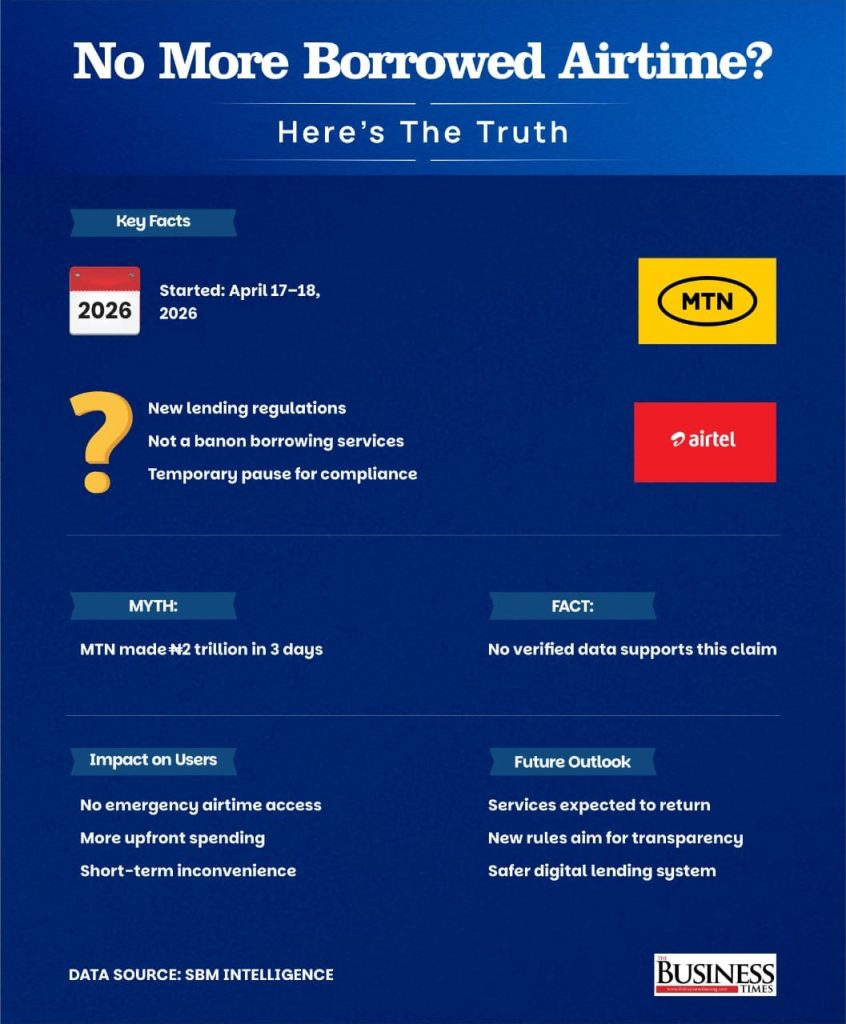
Under these regulations, telecom operators offering such services are required to meet specific conditions. These include obtaining appropriate licensing, ensuring full transparency of fees and repayment terms, and complying with stronger consumer protection standards. The FCCPC has repeatedly clarified that it did **not ban airtime or data borrowing services**. Instead, it is restructuring how these services must operate to ensure fairness and accountability in the digital lending space.
Because of these new requirements, telecom operators were given a compliance window to adjust their systems. However, both MTN and Airtel opted to temporarily suspend their airtime and data borrowing services while they work through the regulatory requirements. This decision was made to avoid operating outside the law during the transition period.
This is where the misunderstanding about “debt recovery” begins. Many consumers assumed the suspension was a deliberate attempt to recover outstanding balances from users. While airtime borrowing does involve repayment, the evidence does not support the idea that the suspension was designed to aggressively collect debts or trigger mass repayments.
In fact, the narrative that MTN recovered over ₦2 trillion within three days has circulated widely online, but it is not backed by any credible financial report or official statement. No verified data from MTN or any regulatory body confirms such a figure. Given the structure of telecom revenue and repayment cycles, such a sudden recovery would be highly unlikely and would have been formally reported if it occurred.
Instead, what is more consistent with available information is that the suspension is regulatory in nature. Airtime and data borrowing services fall into a grey area between telecom services and micro-lending. The FCCPC’s new framework is aimed at bringing clarity to this space, ensuring that consumers are not exposed to hidden charges or unclear repayment structures.
For Airtel Nigeria, the company has stated that the pause is part of its efforts to align with evolving regulatory expectations. The emphasis is on compliance, not on financial enforcement or debt recovery. This suggests that the suspension is temporary and procedural rather than punitive.
Despite this explanation, the impact on consumers has been immediate and noticeable. Airtime and data borrowing have become deeply integrated into daily communication habits in Nigeria. For many prepaid users, these services act as a safety net, allowing them to stay connected even when funds are low.
Without access to borrowed airtime, users are now required to pay upfront for all services. This has created challenges, particularly for low-income earners and individuals with irregular income. What was once a flexible system has become more rigid, forcing users to adjust how they manage communication expenses.
The absence of borrowing services is especially felt during emergencies. Many Nigerians relied on borrowed airtime for urgent calls, internet access, or essential communication. Its sudden unavailability has led to frustration and a sense of disruption across user groups.
Beyond inconvenience, the change also highlights how dependent consumers have become on telecom-based credit systems. What began as a simple value-added service has evolved into an essential financial tool for many households. The suspension has therefore exposed how deeply embedded these services are in everyday life.
At the same time, regulators argue that these reforms are necessary. The FCCPC’s involvement is aimed at ensuring that digital lending services operate transparently and fairly. By bringing airtime borrowing under formal oversight, the goal is to protect consumers from unclear charges, excessive fees, and potential exploitation.
While the short-term effect is discomfort for users, the long-term intention is to create a more structured and accountable system. When airtime borrowing eventually resumes, it is expected to operate under clearer rules, with improved disclosure of costs and repayment conditions.
In summary, the suspension of airtime and data borrowing services by MTN and Airtel is not a response to debt recovery pressure, nor is it an attempt to extract more money from users. Instead, it is a regulatory adjustment driven by the FCCPC’s new digital lending framework.
The viral claim that MTN recovered trillions of naira in a matter of days remains unverified and misleading. What is clear, however, is that Nigeria’s telecom sector is undergoing a transition where services once considered simple conveniences are now being treated as regulated financial products.
For consumers, this means short-term inconvenience but potentially greater protection in the future. And for the industry, it marks the beginning of a new era where compliance, transparency, and accountability take priority over speed and flexibility.