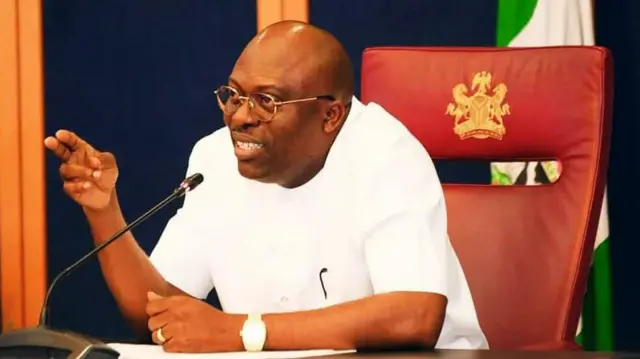

A High Court order has temporarily halted the impeachment proceedings against Rivers State Governor Siminalayi Fubara, providing a brief judicial respite in a political crisis that has threatened to destabilize Nigeria’s most vital economic zone. While the injunction prevents an immediate constitutional breakdown, it merely presses pause on a deep-seated conflict that continues to paralyze governance, deter investment, and cast a shadow over the nation’s oil revenue and fiscal planning. The underlying war for control of the state’s resources between Governor Fubara and his predecessor, Nyesom Wike, remains unresolved, leaving the economy of the Niger Delta in a state of suspended animation.
The direct economic impact of this continued uncertainty is severe. Rivers State is the operational headquarters of Nigeria’s hydrocarbon industry, hosting critical national assets and export terminals. A protracted leadership crisis fosters an environment where crucial decisions on security, community engagement, and infrastructure are delayed. This directly threatens the fragile operational stability required for consistent oil and gas production, which the country relies upon for over 80% of its foreign exchange earnings and roughly half of its government revenue. Any disruption in Rivers has an immediate and disproportionate effect on national economic indicators.
Furthermore, the political impasse freezes state-level governance. Legislative functions are inevitably consumed by the survival battle, stalling the passage of budgets, approvals for key projects, and long-term development planning. This governance vacuum stifles local business activity, halts public infrastructure projects, and exacerbates unemployment in a densely populated, youthful state. The inability of the state government to function with clear authority discourages new private investment, as businesses cannot plan for the future amidst such volatility. The court’s intervention, while legally significant, does not unlock this gridlock.
The crisis also highlights a damaging pattern of political risk that affects Nigeria’s investment profile. The high-stakes struggle for control of state resources and patronage networks, evident in the Fubara-Wike feud, signals to international and domestic investors that economic decisions can be subordinated to protracted political wars. This perception increases the risk premium for investing not just in Rivers State, but in Nigeria as a whole, as it underscores institutional fragility at the sub-national level. Capital is mobile and will flow to more predictable environments.
Ultimately, the High Court’s order is a temporary procedural shield, not a solution to the economic threat. It prevents an abrupt political explosion but does not address the smoldering crisis beneath. For the Nigerian economy, a permanent resolution is urgently needed. The lasting damage is measured in lost investment, missed economic opportunities, and a steady erosion of confidence in one of the country’s few productive centers. True economic relief for Rivers State, and by extension Nigeria, will come only from durable political settlement that allows governance to resume, not from a temporary judicial pause in the fighting.