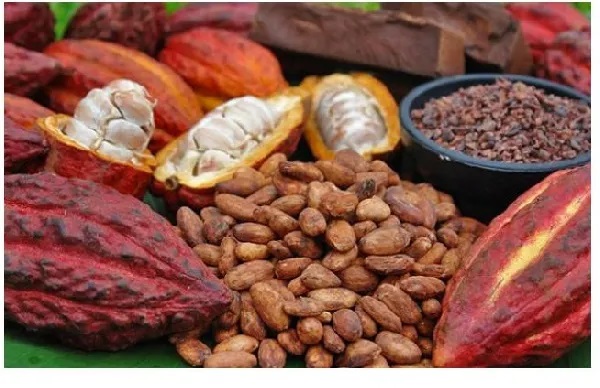

Nigeria’s cocoa industry emerged as the standout performer in the country’s agricultural export basket in the first quarter of 2026, even as total agricultural exports declined sharply from a year earlier.
Data from the National Bureau of Statistics (NBS) showed that superior-quality cocoa beans generated ₦596.9 billion in Q1 2026, accounting for about 50.9 per cent of Nigeria’s agricultural export earnings. Including cocoa butter and other cocoa products, cocoa-related exports generated more than ₦643 billion during the quarter.
The performance came as total agricultural exports fell by about 31 per cent year-on-year to roughly ₦1.17 trillion, from about ₦1.7 trillion in Q1 2025. The figures underline the growing importance of cocoa to Nigeria’s non-oil export earnings.
The government is seeking to strengthen production alongside exports. In July, the Federal Ministry of Agriculture and Food Security, working with the Cocoa Research Institute of Nigeria (CRIN), flagged off the distribution of one million improved hybrid cocoa seedlings to farmers.
The programme is designed to rehabilitate ageing plantations, establish new farms and improve productivity. Government officials say the improved planting materials offer higher yield potential and better resistance to diseases and climate-related pressures. CRIN has also indicated that some improved varieties can begin fruiting in about two years under suitable conditions, compared with longer periods for conventional trees.
However, strong export earnings do not necessarily mean cocoa production has increased. Global cocoa prices have experienced significant volatility, meaning export values can rise because of higher prices as well as increased volumes. The sustainability of Nigeria’s recent export performance will therefore depend on whether higher earnings are eventually matched by stronger output.
Nigeria remains one of the world’s leading cocoa producers and is commonly ranked fourth globally, although rankings vary by production year and data source. It remains far behind the world’s largest producers, highlighting the scale of the production gap.
Value addition is another major policy priority. Agriculture Minister Abubakar Kyari has rejected reports of plans to ban raw cocoa exports, saying the government’s policy is to encourage domestic processing while allowing raw-bean exports to continue. The objective is to increase Nigeria’s share of higher-value products such as cocoa butter, powder and chocolate.
Exporters must also prepare for stricter international traceability requirements. The European Union’s Deforestation Regulation covers cocoa and requires products entering the EU market to meet deforestation-free and traceability standards. Following changes adopted in 2025, the rules will apply from December 30, 2026, to large and medium-sized operators, with most micro and small operators receiving until June 30, 2027.
For Nigeria, the real test is whether improved seedlings, better farm management, stronger traceability and expanded processing capacity can convert cocoa’s export strength into sustainable production growth.
Q1 2026 demonstrates cocoa’s importance to Nigeria’s agricultural exports. It does not yet prove a production revival.