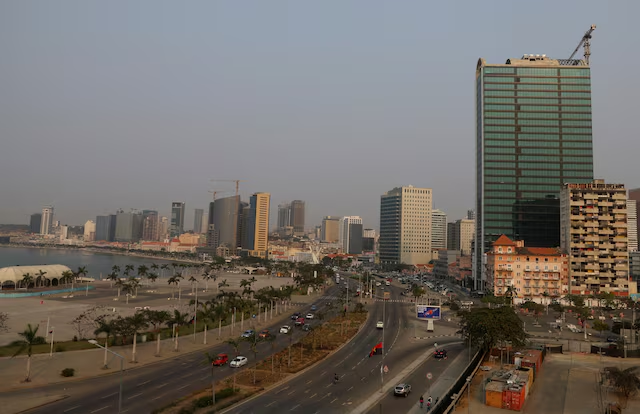

Facing severe fiscal constraints, the Angolan government has formally launched its 2026 annual debt plan, confirming its intention to secure approximately $1.7 billion through an international bond issuance. This substantial capital raising effort, supplemented by an additional $1.4 billion in secured commercial financing, represents a critical test of international investor confidence in the country’s commitment to moving beyond an oil dependent economic model. The strategy addresses an immediate crisis where debt service costs threaten to consume over 40 percent of state expenditure, while simultaneously funding a broader, government led pivot toward private sector growth and diversified revenue streams.
The decision to return to international capital markets underscores the acute pressure on Luanda’s public finances. With oil revenues historically funding the state budget, prolonged price volatility and production challenges have created a persistent fiscal shortfall. The projection that debt servicing alone could absorb nearly half of all government spending this year is unsustainable, crowding out essential expenditure on infrastructure, health, and education. The bond issuance and complementary commercial financing, which includes innovative debt for health swap operations, provide immediate liquidity to meet obligations and prevent a destabilising fiscal crunch. However, they also increase the nation’s external debt stock, making the terms of this borrowing and the market’s reception pivotal for future economic stability.
This financial manoeuvring occurs against a backdrop of subdued economic prospects. The International Monetary Fund recently forecast growth of just 2 percent for Angola in 2026, a rate that lags behind population expansion and underscores the stagnation risks of a state dominated, hydrocarbon reliant structure. The government’s economic pivot, which this capital injection is designed to support, aims to catalyse a fundamental shift. Key pillars include the ongoing reduction of costly state subsidies, which distort markets and drain the treasury, and the deliberate opening of strategic sectors to private investment. These reforms are intended to improve the business climate, stimulate non oil productivity, and create a more dynamic and job creating economy.
For international investors, the bond represents a calculated risk based on Angola’s reform trajectory. The government is not merely seeking a financial lifeline; it is using the necessity of borrowing to signal its dedication to a new policy path. By confirming the continuation of subsidy cuts and sectoral openings, Luanda aims to reassure the market that borrowed funds will support a transition toward greater fiscal health and economic resilience, not perpetuate old imbalances. The success of the issuance will serve as a direct barometer of global finance’s belief in this promised transformation.
The broader implications for the region are significant. As one of Africa’s largest oil producers and economies, Angola’s struggle to escape the resource curse and build a diversified, private sector led model is being closely watched. A successful bond placement coupled with tangible progress on reforms could bolster confidence in other commodity dependent nations pursuing similar paths. Conversely, difficulties could signal market scepticism about the pace of change. Ultimately, Angola’s 2026 debt plan is more than a fundraising exercise; it is a high stakes demonstration of whether the country can leverage external capital to finance its escape from the very economic dependencies that now necessitate such borrowing.