


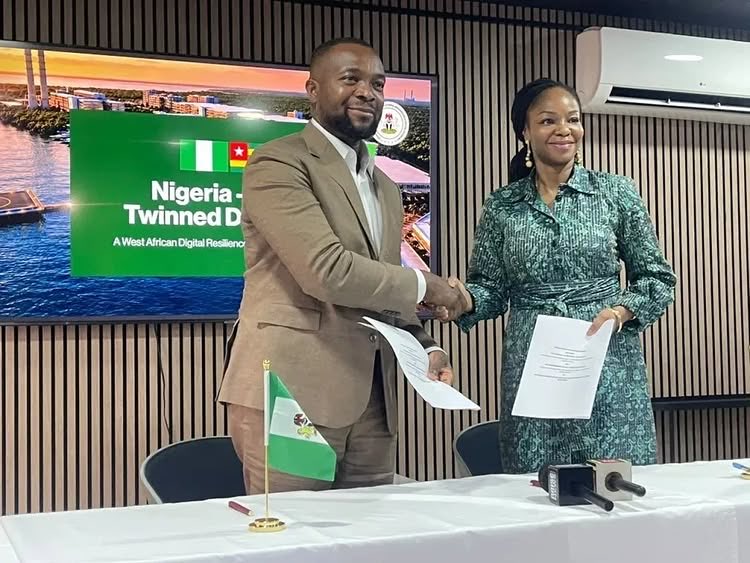

Nigeria and Togo have signed a Memorandum of Understanding (MoU) to develop two interconnected data parks across both countries, targeting an initial Phase 1 investment of $30 million to $50 million to attract global technology operators and strengthen West Africa’s digital infrastructure.
Signed in Lagos on Thursday, November 26, 2026, by Nigeria’s Minister of Communications, Innovation and Digital Economy, Bosun Tijani, and Togo’s Minister of Digital Economy and Transformation, Cina Lawson, the bilateral initiative is structured as a public-private partnership designed to serve both Anglophone and Francophone markets across the region.
Rather than building and operating data centres directly, both governments will establish serviced data parks, providing secured land, reliable electricity, water, cooling systems, and high-capacity fibre-optic connectivity where independent operators can construct and run their facilities.
Tijani said the project will be executed through a joint Special Purpose Vehicle (SPV) modelled after Nigeria LNG (NLNG). Under this structure, government equity participation will range between 25% and 49%, leaving the majority stake and bulk of capital mobilisation to private investors while the states provide regulatory backing and enabling legislation.
Nigeria has identified Egbin, adjacent to the Egbin Power Station in Ikorodu, Lagos State, as its preferred candidate site, subject to a feasibility assessment. Tijani noted that Egbin offers proximity to power generation, water resources for cooling, subsea and terrestrial fibre connectivity, and critical security infrastructure. Togo has also identified a candidate location with access to water and fibre infrastructure, though its final site selection has yet to be formally disclosed.
For Togo, Lawson described the partnership as a strategic opportunity to combine markets with Africa’s largest digital economy to draw international cloud and hyperscale investors, while positioning Togo as a regional hub for data backup and disaster recovery. She added that the initiative remains open to other West African nations.
Beyond physical infrastructure, the two ministries are exploring a regional “data embassy” framework in collaboration with the Economic Community of West African States (ECOWAS). Modeled on diplomatic conventions, the framework would allow participating governments and institutions to host sensitive sovereign data in cross-border facilities while retaining full legal jurisdiction and protection over their information.
Both countries are targeting initial project milestones by the second quarter of 2027, though Tijani acknowledged that timelines will depend on transaction closures and private capital mobilisation.
The bilateral push aligns with Nigeria’s broader digital infrastructure expansion, including its planned 90,000-kilometre national open-access fibre-optic network, aimed at meeting surging demand for cloud computing, artificial intelligence, and local data hosting across West Africa.