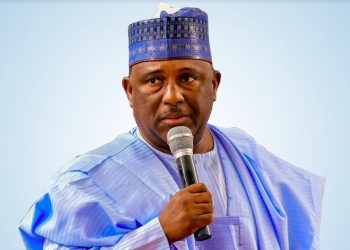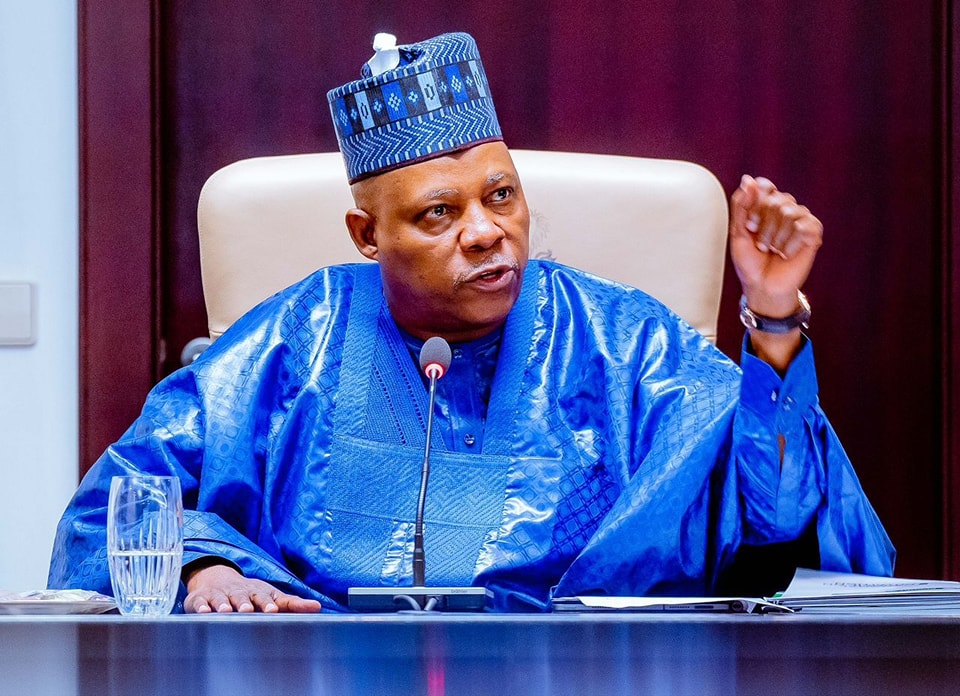

Vice-President Kashim Shettima has attacked former Vice-President Atiku Abubakar over his proposal to restore petrol subsidy, warning that reversing President Bola Tinubu’s economic reforms would take Nigeria backwards.
Speaking on Monday, October 26, 2026, at the 32nd Nigerian Economic Summit in Abuja, Shettima accused Atiku, the African Democratic Congress (ADC) presidential candidate for the 2027 election, of advocating subsidy restoration for political convenience rather than economic reasons.
According to TheCable in a report published on October 26, Shettima questioned Atiku’s ability to manage a modern economy, citing his training at the Kano School of Hygiene.
“He wants us to backslide into primitivity for political convenience,” Shettima said, referring to Atiku’s position on subsidy restoration.
The vice-president also questioned Atiku’s economic credentials, arguing that he lacked the skills required to manage a modern economy. The remarks formed part of his defence of the Tinubu administration’s decision to end the petrol subsidy in May 2023.
Shettima said the country had been “teetering on the verge of collapse” when Tinubu took office, with foreign reserves standing at $33.9bn. He argued that the previous subsidy arrangement had become vulnerable to abuse and diverted public resources from other priorities.
“We have created a subsidy scam, a subsidy industry that we are taking part in at the agony of our people,” he said, according to The PUNCH on October 26.
Shettima maintained that removing the subsidy was a difficult but necessary decision, arguing that delaying reforms would have increased their eventual cost. He also said the former pricing arrangement encouraged cross-border fuel smuggling, allowing neighbouring countries to benefit from cheaper Nigerian petrol.
Atiku has advocated a production-based subsidy approach, which differs from simply reinstating the former general subsidy arrangement. The distinction is important to the debate over how the government could support domestic production and consumers without recreating the fiscal pressures associated with the previous system.
The disagreement comes as Nigerians continue to face high transport, food and business costs following the removal of the subsidy. While the Federal Government argues that the policy has reduced pressure on public finances, critics have called for stronger measures to protect households from its effects.
To support the administration’s reform agenda, Shettima cited improvements in economic indicators, including gross domestic product growth, foreign investment inflows and petroleum production.
The National Bureau of Statistics reported that Nigeria’s real GDP grew by 3.89% year-on-year in the first quarter of 2026, compared with 3.13% in the corresponding quarter of 2025. The figures indicate continued economic expansion, although growth alone does not establish how evenly the benefits are reaching households.
The NBS also reported that capital importation reached $10.37bn in the first quarter of 2026, up 83.83% from $5.64bn in the same period of 2025. Its report, released on June 3, showed that portfolio investment accounted for $9.86bn, or 95.09%, of the total, while foreign direct investment stood at $135.08m.
The composition of the inflows is significant because portfolio investments in financial instruments can respond more quickly to market conditions than long-term investments in productive businesses.
Shettima further said crude oil and condensate production reached 1.735 million barrels per day in June 2026, highlighting the importance of petroleum output to government revenue and foreign-exchange earnings.
However, the administration faces the challenge of translating economic growth and increased capital inflows into more jobs, stronger household purchasing power and lower living costs.
The subsidy dispute is expected to remain part of the economic debate ahead of the 2027 general election, as political parties present competing proposals for managing public finances, fuel prices and economic hardship.
Shettima urged Nigerians to examine the long-term implications of candidates’ economic proposals, arguing that national policy should be based on stable frameworks rather than short-term political considerations.
The debate highlights the challenge facing Nigeria’s next election: how to maintain fiscal stability and encourage investment while addressing the cost-of-living pressures experienced by households and businesses.