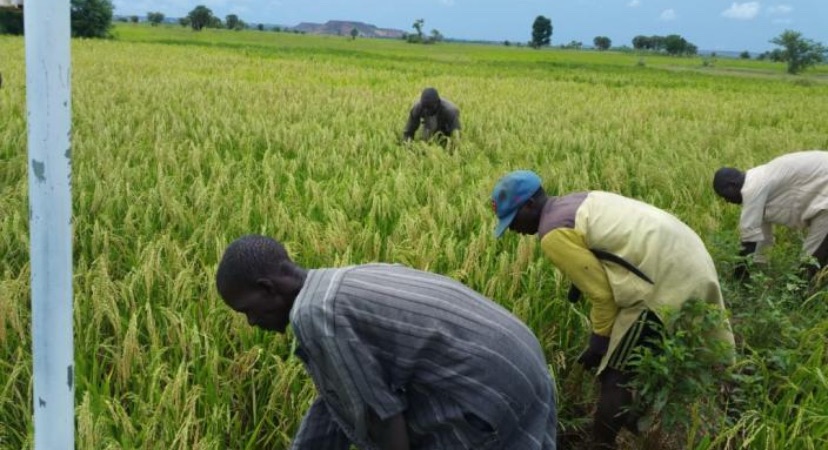

Kano, Kebbi, Jigawa — Nigeria’s northern rice belt is recording measurable growth in output this season, with new figures showing the country’s milled rice production climbing toward 5.5 million metric tons in the 2025/2026 marketing year, much of it driven by expanded farming activity across the north.
According to production data, Nigeria’s milled rice output is projected at approximately 5.5 million metric tons for the 2025/2026 season, continuing an upward trend that has persisted, with fluctuations, since 2010. When measured in unprocessed paddy form, national output has been even higher in recent years, with paddy rice production reaching close to 8.9 million metric tons in 2023 alone. The Central Bank of Nigeria puts current national rice production at around 7.0 million metric tons, against a domestic consumption demand of 10.5 million metric tons, leaving a supply gap of roughly 2.5 million metric tons that northern producers are increasingly working to close.
Kebbi, Kano, Borno, Niger, and Benue remain the country’s leading rice-producing states, with the bulk of that output concentrated in the north. Kano State alone recorded 1.2 million metric tons of rice at the height of national production in 2017, when Nigeria’s total output peaked at roughly 15 million metric tons. Farmers and agricultural officials in the region say this season’s harvest is tracking toward similarly strong numbers, aided by wider adoption of improved seed varieties and expanded irrigation.
Much of the recent gain has been linked to targeted interventions. The Central Bank of Nigeria’s Anchor Borrowers’ Programme, credited with sparking the country’s so-called “rice revolution,” has continued to channel financing and inputs to smallholder farmers across the north. Separately, the System of Rice Intensification (SRI), introduced in Kano and Jigawa States under the UKAID-funded LINKS programme, has been used since 2021 to raise farmer incomes through higher yields while cutting seed use, water consumption, and greenhouse gas emissions. A related SRI-WAAPP initiative, backed by the World Bank across 13 ECOWAS countries, has also supported productivity gains in the region since 2014.
“Farmers are getting more support than they used to, from access to quality seeds to training on modern planting methods,” a Kano-based agricultural extension worker said. “That has translated directly into more paddy coming out of the fields this season.”
Even with these gains, Nigeria remains one of the world’s largest rice importers. The U.S. Department of Agriculture has previously projected Nigeria among the top global rice buyers, with import volumes running into the millions of metric tons annually to bridge the gap between local supply and demand. Analysts say sustained increases in northern output, if matched with better storage, processing capacity, and rural infrastructure, could gradually reduce the country’s reliance on imported rice and ease pressure on foreign exchange.
Security challenges remain a constraint on the sector’s full potential. Farmer-herder conflicts, banditry, and insurgent activity in parts of the North-West and North-Central — including Zamfara, Kaduna, Katsina, Benue, and Plateau States — have disrupted farming in some communities and continue to weigh on logistics costs, which have contributed to elevated retail rice prices nationwide. Despite this, output data from the current season points to overall growth across the north’s major producing states.
State agricultural ministries say they are working with development partners to sustain the momentum by expanding irrigation infrastructure, strengthening farmer cooperatives, and improving access to affordable inputs ahead of the next planting cycle.