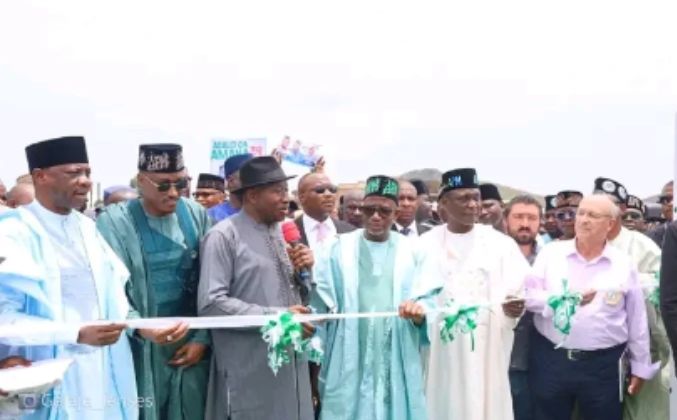

Former President Goodluck Jonathan on Monday, August 10, 2026 commissioned 18 township roads spanning 49.7 kilometres across Bauchi metropolis, projects Governor Bala Abdulkadir Mohammed said were executed at a cost of ₦58.7 billion.
Speaking at the ceremony, Jonathan described the network as evidence of purposeful governance, framing durable road infrastructure as a precondition for sustainable economic growth. He noted this was his third official visit to the state, and commended Mohammed, a former Federal Capital Territory minister under his administration, for what he called visionary leadership and disciplined use of public resources.
Governor Mohammed said the roads were built to standard, with durable pavement, drainage, culverts, road markings and solar-powered street lighting on selected routes. He linked the intervention to improved mobility, economic activity and job creation within the state capital, while urging residents to protect the assets.
The commissioning is part of a broader target: Mohammed’s administration has pledged to construct at least 5,000 kilometres of roads across Bauchi State and says it has completed roughly 3,000 kilometres since taking office in 2019.
Alongside the roads, Jonathan performed groundbreaking for four recreational parks in Bauchi metropolis, Golden Jubilee Park, General Hassan Usman Katsina Park, Shehu Azare Park and Suleiman Adamu Park, valued at ₦4.68 billion, with 70 percent of contractor payments already disbursed. The government expects the parks to be completed within 12 months.
The road commissioning also comes days after Bauchi State secured a $91.6 million financing package from the ECOWAS Bank for Investment and Development to fund 24 additional roads and bridges, signalling continued reliance on both domestic capital votes and external development finance to sustain the state’s infrastructure drive.
For subnational governments, large-ticket road commissioning events of this kind serve a dual purpose: they deliver tangible, visible infrastructure while reinforcing political capital ahead of election cycles. Whether the scale of spending translates into proportionate economic returns, job creation, reduced logistics costs, higher property values along the corridors, will depend on maintenance culture and complementary investment, areas where several Nigerian states have historically underperformed relative to construction spend.