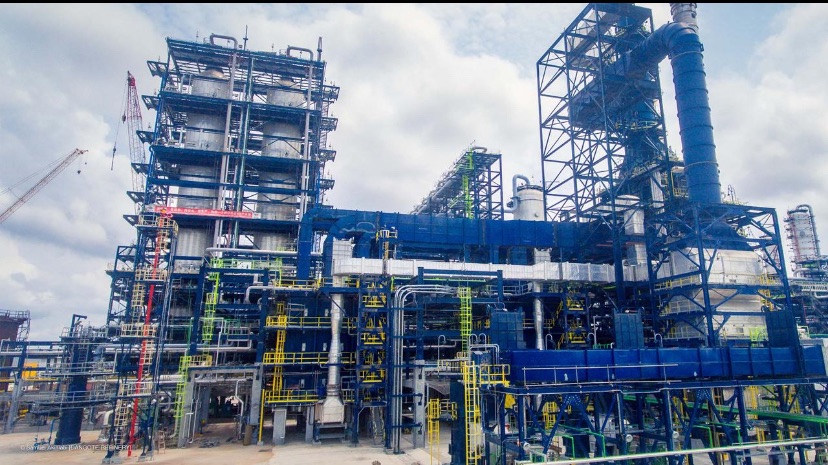

Africa’s richest businessman, Aliko Dangote, has revealed that the Dangote Petroleum Refinery will consume about 2.5 percent of all crude oil traded globally once it begins operating at full capacity.
Dangote made the announcement while welcoming the Minister of State for Industry, Senator John Owan Enoh, and senior officials from the Federal Ministry of Industry during a tour of the 700,000-barrels-per-day Dangote Petroleum Refinery, the Dangote Petrochemicals complex and Dangote Fertiliser Limited in Lagos.
Speaking during the visit, Dangote described the refinery as the biggest business challenge he has ever undertaken. He explained that many financial institutions and investors initially doubted the project could be completed because of its enormous size and cost.
According to him, the refinery faced several major obstacles, including disruptions caused by the COVID-19 pandemic, foreign exchange shortages and rising project costs. Despite these setbacks, he said the successful completion of the refinery proves that Nigerian businesses can execute projects that meet global standards.
Dangote noted that the refinery is expected to become one of the world’s largest single-train refineries. At full production, it will process 700,000 barrels of crude oil daily, representing roughly 10 percent of the refining capacity of the United States and consuming about 2.5 percent of globally traded crude oil.
He said the success of the refinery should inspire more Nigerian entrepreneurs to invest in large-scale projects that can transform the country’s economy.
According to Dangote, industrialisation remains the fastest path to creating jobs, reducing imports and building long-term economic prosperity. He stressed that countries that have achieved sustained economic growth did so by developing strong manufacturing industries rather than relying mainly on the export of raw materials.
He also urged the Federal Government to continue creating a stable business environment where investors can confidently commit long-term capital. Dangote explained that policy consistency is more valuable to investors than temporary incentives because frequent policy changes create uncertainty and discourage investment.
The business leader further disclosed that Dangote Industries recently raised an unsecured corporate bond at interest rates lower than Nigeria’s sovereign benchmark. He described the achievement as a sign that investors have increasing confidence in well-managed Nigerian private companies.
Dangote added that when local businesses succeed, they encourage both domestic and foreign investors to invest in the country. According to him, thriving indigenous companies send a strong message that Nigeria is capable of supporting large-scale industrial investments.
He maintained that if Nigeria hopes to build a one-trillion-dollar economy, industrial development must remain a national priority, with the private sector playing a leading role.
During the visit, the Minister of State for Industry, Senator John Owan Enoh, praised the Dangote Refinery as one of Africa’s most important industrial investments.
He described the integrated facility as a major contributor to Nigeria’s economic transformation and said it represents the type of investment needed to expand manufacturing, create employment and increase local value addition.
The minister added that processing raw materials within Nigeria instead of exporting them in their raw form will strengthen the country’s economy, improve global competitiveness and support the Federal Government’s long-term development goals.
He reaffirmed the government’s commitment to working closely with the private sector to promote industrial growth, attract investment and accelerate Nigeria’s journey toward becoming a stronger manufacturing economy.